 Skagit County
 Why Burlington Roofs Take a Different Kind of Beating
Burlington sits low in the Skagit Valley, close enough to Puget Sound and the Skagit River delta that homes here deal with a steady flow of marine air. That air carries salt, and salt-laden moisture works on fasteners, flashing, and metal roof components differently than dry inland air does. Add in the region's long stretch of driving, wind-pushed rain — often coming in sideways rather than straight down — and you have conditions that punish roofs with weak flashing, thin underlayment, or poor drainage far faster than a roof of the same age would wear out somewhere drier.
Then there's moss. Skagit County's mild, wet winters and shaded, tree-lined lots common around Burlington create a moss and algae season that can stretch across most of the year, not just a few weeks. A roof that isn't detailed with that in mind will show black streaking, lifted shingle edges, and trapped moisture within a few seasons — well before it should.
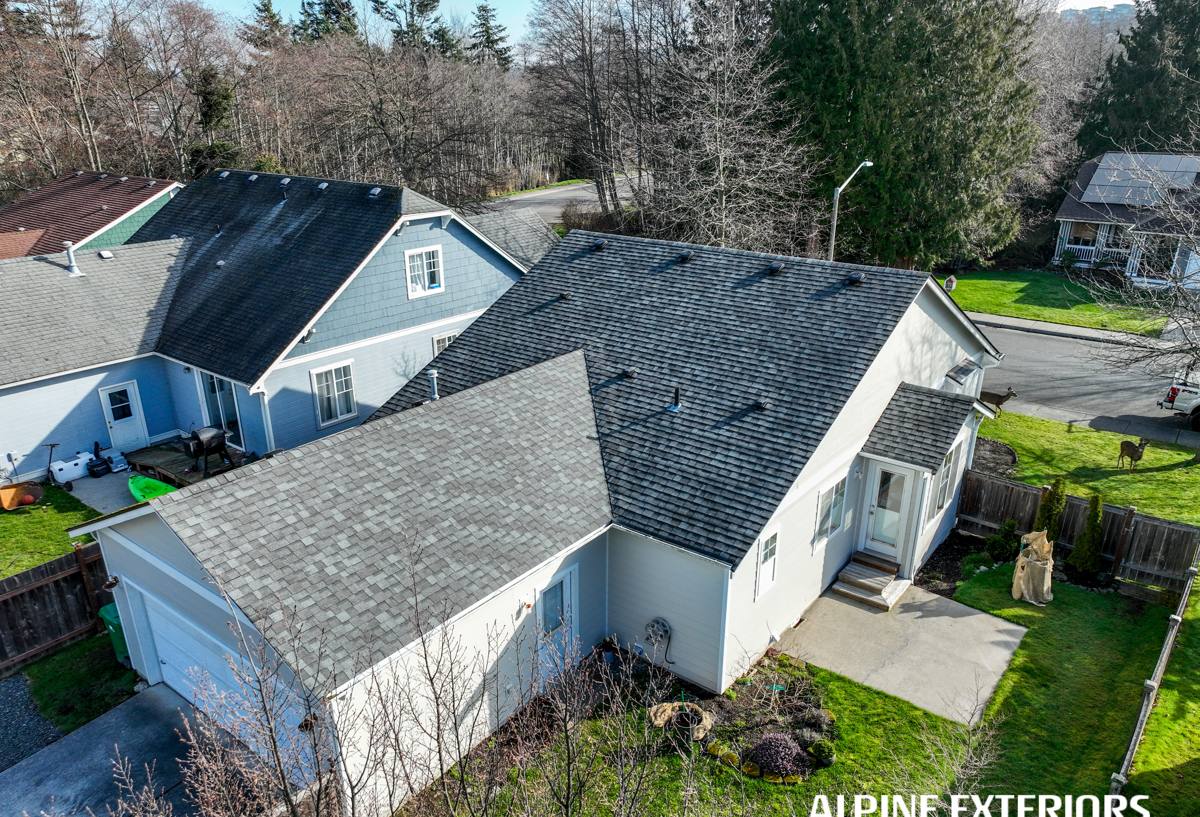
What a Correct New Roof Installation Actually Involves
Tear-Off and Deck Inspection
In a climate this wet, we don't recommend installing a new layer over old roofing. A full tear-off lets us actually see the deck — soft spots, rot around old vent boots, and hidden moisture damage don't show up until the old layers are gone. Any damaged sheathing gets replaced before anything new goes down; skipping this step is one of the most common reasons a "new roof" fails early.
Underlayment and Water-Shedding Details
We use synthetic underlayment as a base layer and extend ice-and-water shield membrane at eaves, valleys, and around every penetration — beyond the bare code minimum — because this area's rain volume and wind-driven angle push water into places a lighter installation wouldn't anticipate. Drip edge at eaves and rakes, and kick-out flashing wherever a roofline meets a sidewall, are non-negotiable details; both are cheap to do right and expensive to fix later once the wall behind them has rotted.
Ventilation That Matches the Attic
A roof lives or dies on balanced intake and exhaust ventilation. Soffit vents pull cooler air in, ridge or box vents let warm, moist air out, and baffles keep insulation from blocking that airflow. Get this wrong and you trap moisture in the attic — which shows up as premature moss growth, mold on the underside of the deck, and shortened shingle life, regardless of how good the shingles themselves are.
Flashing at Every Penetration
Chimneys, plumbing stacks, skylights, and any roof-to-wall transition are where the overwhelming majority of leaks start — not in the open field of shingles. We install step flashing and counterflashing as our standard rather than relying on sealant or mastic alone, because sealant degrades and shrinks; metal properly woven into the roofing doesn't depend on a caulk bead holding up for twenty years.
Choosing a Roofing Material for Skagit County's Climate
There's no single "best" roofing material for every home, but some perform noticeably better under constant damp, salt air, and heavy moss pressure. The table below reflects how the common options compare specifically for coastal Skagit County conditions, not generic national ratings.
| Material | Moss/Algae Resistance | Salt Air Durability | Typical Lifespan | Relative Install Cost |
|---|---|---|---|---|
| Standard asphalt shingle | Fair — improves with algae-resistant (AR) granules | Good with corrosion-resistant fasteners | 20–25 years | Lowest |
| Algae-resistant (AR) asphalt shingle | Good | Good with corrosion-resistant fasteners | 25–30 years | Low-to-moderate |
| Standing seam metal | Very good — sheds moss with little surface texture | Requires marine-grade coating or aluminum near the coast | 40–50+ years | Higher |
| Synthetic/composite shake | Good | Good | 30–40 years | Moderate-to-higher |
Metal roofing tends to shed moss more easily because there's less texture for spores to catch on, but it needs the right coating or alloy to hold up to salt air long-term, and it's a more sensitive, detail-heavy installation. AR asphalt shingles remain the most common choice in the valley because they balance moss resistance, cost, and proven long-term performance without the added installation sensitivity of metal.
Moss and Algae: What Actually Slows Them Down
Nothing makes a roof permanently moss-proof — that's an honest starting point, not a sales pitch. What actually helps is a combination of factors working together. Zinc or copper strips installed just below the ridge release trace metal ions with every rain that inhibit moss and algae growth as water washes down the slope. AR shingle granules do something similar at the surface level. Good attic ventilation keeps the deck from staying warm and damp, which removes one of moss's favorite conditions. Keeping nearby tree branches trimmed back reduces both shade and the steady drop of organic debris that gives moss something to root in.
Beyond the roof itself, clean gutters and downspouts matter more here than in drier climates — a clogged gutter backs water up under the shingle edge, which accelerates rot at exactly the spot moss already tends to gather. When cleaning is needed, a soft wash rather than a pressure washer protects the shingle granules; blasting a roof with high-pressure water strips away the very protection you're trying to preserve.
Our Installation Process
- On-site evaluation of the existing roof, attic ventilation, and any problem areas, with measurements and a written scope.
- Material walkthrough so you understand the real trade-offs for your home, not just a product catalog.
- Permit pulled through the appropriate local building department before any work begins.
- Full tear-off, with old material hauled away and the deck inspected as it is exposed.
- Any damaged sheathing replaced and documented before new underlayment goes down.
- Synthetic underlayment, ice-and-water membrane, drip edge, and flashing installed at every valley, penetration, and wall intersection.
- Roofing material installed to manufacturer specification, including fastening pattern and exposure — details that affect both wind rating and warranty validity.
- Ventilation components installed or upgraded and checked for proper intake and exhaust balance.
- Full site cleanup, including a magnetic sweep for stray nails.
- Final walkthrough with you before we consider the job done.
Weather Windows and Permitting for Burlington Roofs
Roofing can be done for most of the year in Skagit County, but scheduling around this area's rain pattern matters more than it does elsewhere. Underlayment and open decking need a dry window to go down correctly, so a crew that works here regularly plans tear-off in sections small enough to be fully dried-in before weather moves back through, rather than leaving a wide-open deck overnight and hoping for the best. That sequencing discipline is one of the biggest practical differences between a crew used to this climate and one that isn't.
Permits for a new roof installation are typically pulled through the local building department covering Burlington and unincorporated Skagit County. Requirements can vary by jurisdiction and by the scope of work, so we handle that step as part of the job rather than leaving it to the homeowner to sort out.
What Drives the Cost of a New Roof in Burlington
Every roof is priced individually, but the same handful of factors move the number up or down on almost every job:
- Total roof size and the number of planes, valleys, and roof-to-wall transitions
- Roof pitch and how safely and efficiently a crew can work it
- How many layers of existing material need to come off
- Condition of the decking underneath, and how much of it needs to be replaced
- Material chosen — standard asphalt, AR shingle, metal, or synthetic/composite
- Site access — how far materials need to be carried, and whether a dumpster or crane setup is straightforward
- Permit fees and disposal costs
As a broad, honest range for this area, a straightforward asphalt shingle replacement on an average single-family home often falls somewhere in the low-to-mid five figures, with metal or more complex rooflines running higher. The only way to get a real number is a walk of your specific roof — anything quoted without one is a guess.
Before You Sign a Contract: A Homeowner's Checklist
- Confirm the contractor holds an active Washington State contractor license and carries current liability insurance and bonding
- Ask what warranty covers the materials versus what covers the workmanship, and for how long each lasts
- Get the material brand, product line, and color specified in writing, not just "asphalt shingle"
- Ask how decking repair is priced if rot is found mid-tear-off, before work starts
- Ask how gutters, landscaping, and siding will be protected during tear-off and disposal
- Ask specifically how they sequence work around rain, since this is a wet-climate skill, not a generic one
- Avoid paying the full contract amount upfront; a reasonable deposit with balance due on completion is standard practice
Why It Matters to Hire a Crew That Already Works in Burlington
A crew that regularly works Burlington and the surrounding Skagit County area already knows the typical housing stock, the common roof styles and pitches in the valley, and the specific moss and algae patterns tied to the shaded, tree-lined lots common here. That familiarity shows up in small but real ways — knowing which details tend to fail first on homes of a certain age, having working relationships with local material suppliers so a delayed delivery doesn't stall your job for a week, and understanding the local permitting process instead of learning it for the first time on your roof.
It also matters after the installation is finished. A local crew is the one you can actually reach if a question comes up during the first heavy storm season, not a company that was passing through for one job.
If you're planning a new roof in Burlington or elsewhere in Skagit County, we're glad to walk your roof and give you a straight, no-pressure estimate — no obligation, and no pressure to decide on the spot. Use the form below to get started.