 Skagit County
 An Honest Answer to a Question Homeowners Ask Us
Every few weeks, a Skagit County homeowner asks why we don't offer LP SmartSide. It's a fair question — SmartSide is a well-known product, it's less expensive than fiber cement, and plenty of contractors in the Skiagit Valley and up toward Bellingham install it without complaint. We're not here to tell you it's a bad product. We're here to explain, honestly, why after years of doing exterior work in this specific climate — the fog off the Skagit River delta, the driving rain off Puget Sound, the moss that colonizes anything shaded for more than a season — we made a deliberate decision to install only James Hardie fiber cement siding. That decision costs us some jobs. We think it's still the right call, and we'd rather explain our reasoning than dodge the question.
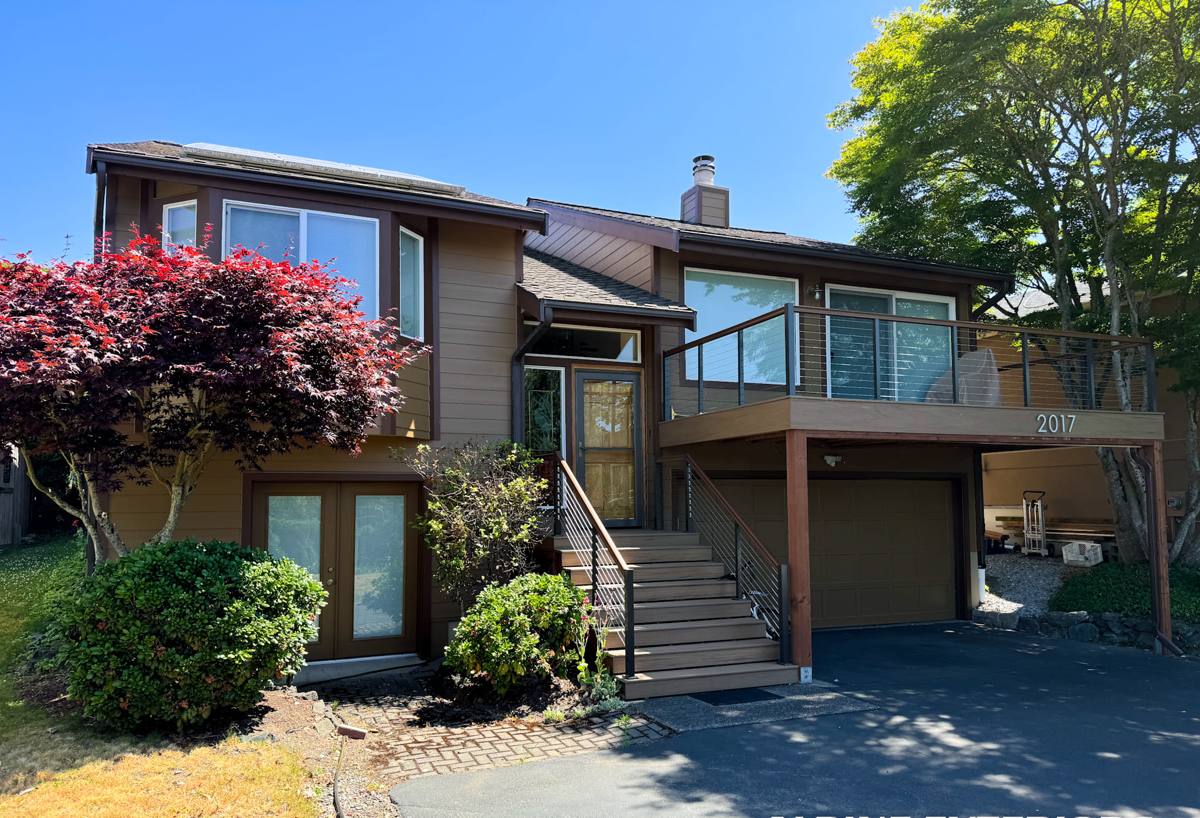
What LP SmartSide Actually Is
LP SmartSide is an engineered wood product. Manufacturers take wood strands or fibers, bind them with resin under heat and pressure, and coat the exterior face with a treated overlay designed to resist moisture and fungal decay better than raw plywood or OSB siding did in decades past. It comes in lap boards, panels, and trim, and it installs faster and lighter than fiber cement because it's a softer, more workable material. It also holds paint well and takes a nail without the pre-drilling or specialty blades fiber cement sometimes requires. Those are real advantages, and we don't pretend otherwise.
For dry climates, or homes with generous roof overhangs and disciplined maintenance schedules, SmartSide can perform reasonably well for a long time. The issue isn't that the product is fraudulent or poorly engineered — it's that its core material is still wood, and wood-based siding has a different relationship with sustained moisture than fiber cement does. In Skagit County, that difference matters more than it does almost anywhere else in the country.
The Moisture Problem: Edge Swelling
Engineered wood siding's most consistent failure point, industry-wide, is the cut edge. The factory coating that protects the face of the board doesn't fully protect the ends and edges once a board is cut and installed on site. If those cut edges aren't sealed correctly — and kept sealed, year after year, as caulk ages and shrinks — water finds its way into the wood strands. Once moisture gets past the surface layer, the strands swell, the paint film cracks along the swollen seam, and the damage becomes visible as a lifted, puffy edge along butt joints and panel seams.
This isn't a rare defect. It's a known characteristic of strand-based wood siding, which is why manufacturers publish detailed field-sealing instructions and rely on installers following them precisely, on every cut, every time, for the life of the product. In a climate that gets occasional hard rain and long dry stretches to let things recover, a missed seal might not matter much. In Skagit County, where driving rain off the Sound and fog rolling up the valley keep siding damp for days at a stretch through much of the fall, winter, and spring, there is very little recovery time. A sealing gap that would be a minor cosmetic issue in eastern Washington becomes a structural one here.
Salt Air and Coastal Exposure
Skagit County sits right up against Puget Sound and Skagit Bay, with homes in Anacortes, La Conner, and along the water in Mount Vernon and Burlington exposed to salt-laden air that drifts inland on a regular basis. Salt air accelerates the breakdown of paint films and caulking faster than inland exposure does, which shortens the window before those critical sealed edges on wood-based siding start to fail. It also tends to hold moisture against surfaces longer, since salt air resists evaporating the way drier coastal winds elsewhere might. None of this is unique to SmartSide — salt air is hard on every exterior material — but it disproportionately affects a product whose long-term performance depends on an intact factory and field seal staying intact for decades.
Moss, Algae, and the Long Wet Season
Anyone who has scraped moss off a roof or a north-facing fence in Skagit County knows how aggressively organic growth establishes itself here. Our wet season runs long — realistically, October through May in most years — and shaded, low-airflow wall sections stay damp for extended periods. That's an ideal environment for moss, algae, and mildew to take hold on any siding surface, but it's a bigger concern on wood-based products because sustained organic growth holds moisture directly against the material and, over time, can work its way into any point where the protective coating has thinned or cracked. Homeowners with SmartSide siding in shaded, tree-lined lots — common throughout the Skagit Valley — often find themselves on a more aggressive cleaning and inspection schedule than they expected when they bought the product, specifically to keep growth from taking hold in the first place.
Fiber Cement vs. Engineered Wood Siding: The Practical Differences
| Factor | LP SmartSide (engineered wood) | James Hardie (fiber cement) |
|---|---|---|
| Core material | Wood strands bonded with resin | Cement, sand, and cellulose fiber |
| Combustibility | Combustible | Non-combustible |
| Cut-edge sensitivity | Requires diligent field sealing on every cut, indefinitely | Not moisture-reactive at cut edges the same way |
| Moss/algae resistance | Standard factory finish; growth adheres readily in shaded, wet areas | ColorPlus finish resists moss and mildew adhesion better |
| Behavior in sustained damp exposure | Prone to swelling if seals fail | Dimensionally stable; does not swell or rot |
| Typical inspection/maintenance cadence | Annual edge and caulk inspection recommended | Lower ongoing maintenance burden |
| Warranty structure | Often prorated and contingent on documented maintenance | Long, largely non-prorated coverage on ColorPlus finish and substrate when installed to spec |
Installation Sensitivity — Why the Installer Matters as Much as the Product
We want to be fair here: a lot of SmartSide's real-world problems trace back to installation shortcuts, not the product itself. Manufacturer specifications call for specific fastener patterns, minimum clearances above rooflines, decks, and grade, factory- and field-sealed cut edges, and careful flashing at every penetration and transition. Skip any of those steps and the product's moisture resistance drops sharply. That's true of nearly every siding product to some degree, but engineered wood is less forgiving of shortcuts than fiber cement is, because wood strands respond to moisture intrusion faster and more visibly than a cement-based board does.
In practice, that means a homeowner's actual outcome with SmartSide depends heavily on whether every installer on the crew treated every single cut edge with the same discipline on day one — and whether whoever maintains the home keeps that seal intact for the next twenty or thirty years. We didn't want to build our business on a product where the margin for error is that thin in a climate this wet.
Warranty Structure Worth Reading Closely
Warranty terms vary by manufacturer and change over time, so we'd encourage any homeowner comparing products to read the current warranty document directly rather than relying on a sales pitch. What we'd flag generally: engineered wood siding warranties often include maintenance obligations — documented painting and caulk inspection on a set schedule — as a condition of coverage, and many are prorated so the payout shrinks the longer you've owned the siding. That's a reasonable structure for the manufacturer, but it puts real responsibility on the homeowner to keep records and stay current, and it means a warranty claim years down the road can be smaller than expected if maintenance wasn't documented precisely. Fiber cement warranties tend to place less of that burden on the homeowner because the material itself needs less intervention to perform as designed.
Why We Standardized on James Hardie Instead
We install James Hardie fiber cement exclusively, on every siding job we take in Skagit County, and it comes down to matching the material to the climate. Hardie's HZ5 product line is engineered specifically for cold, wet climate zones like ours. The fiber cement core is dimensionally stable — it doesn't swell at cut edges the way wood strands can, so a missed touch-up isn't the same kind of ticking clock. The factory-applied ColorPlus finish is baked on and formulated to resist moss and mildew adhesion better than field-applied paint, which matters directly in a county where shaded, damp wall sections are the rule rather than the exception. It's non-combustible, which matters as wildfire smoke and dry-season risk have become a more regular part of Washington summers even on the wet side of the state. And it carries a long, largely non-prorated warranty on both the substrate and the factory finish when installed to Hardie's specifications — which is also why we train our crews specifically on Hardie's installation requirements rather than treating siding installation as interchangeable across brands.
None of that means Hardie is maintenance-free — no siding product is. It means the maintenance burden and the failure mode if something is missed are both smaller, in a climate that doesn't give siding many chances to dry out and recover.
Questions Worth Asking Any Siding Contractor Before You Hire
- What product lines have you personally installed in the last two years, and can you speak to how each performs locally?
- Who seals cut edges on site, and what product and process do they use?
- What clearance do you maintain above rooflines, decks, and grade, and why?
- Is your warranty prorated, and what maintenance documentation does it require to stay valid?
- Will you show me the manufacturer's written installation specifications for this specific product?
- What's your plan for flashing around windows, doors, and other penetrations on this house?
Maintenance Reality Check for Skagit County Homes
Whatever siding a homeowner ultimately chooses, we'd rather set honest expectations than sell a maintenance-free fantasy that doesn't exist in this climate. A few things every Skagit County homeowner should plan around regardless of siding material: gutters and downspouts need to stay clear so water isn't dumping directly onto wall sections; shaded, tree-covered elevations need periodic moss and algae treatment; caulk at trim, corners, and penetrations should get a visual check at least once a year; and any siding showing swelling, bubbling, or soft spots should get looked at promptly rather than waited out, since moisture damage in this climate rarely improves on its own between wet seasons.
The Bottom Line
LP SmartSide is a legitimate product that works fine for a lot of homes in a lot of climates. Skagit County's combination of salt air, sustained driving rain, and a moss season that runs most of the year is a tougher test than most places it's installed, and we didn't want to sell homeowners a product whose long-term performance here depends this heavily on flawless installation and disciplined maintenance being maintained for decades. James Hardie fiber cement gives us a material built for exactly this kind of exposure, backed by a warranty structure we're comfortable standing behind. If you're weighing siding options for a home anywhere in Skagit County, we're glad to walk through what we see on both products and give you a straight answer — reach out for a free, no-pressure estimate and we'll take a look at your specific home and exposure before recommending anything.