 Skagit County
 Exterior Work in Conway's Delta Climate
Conway sits low in the Skagit River delta, close to where fresh water meets Skagit Bay, in one of the wettest and windiest pockets of Skagit County. Homes here take a different kind of beating than houses up in the foothills or inland around Mount Vernon. The air carries salt off the bay, the rain comes in sideways more often than straight down, and the shaded, low-lying lots hold moisture long after a storm has passed. That combination is hard on exterior building materials, and it shows up fastest on siding, trim, and roofing that wasn't built for it.
We've worked on homes throughout the Conway area and the surrounding delta and flood-plain neighborhoods, and the pattern repeats: siding that looks fine from the road but is soft, delaminating, or growing moss at the bottom courses and around window trim. None of that is unusual for this stretch of the county. It's just what happens when a house sits in a marine, low-elevation microclimate for a couple of decades with the wrong siding on it.
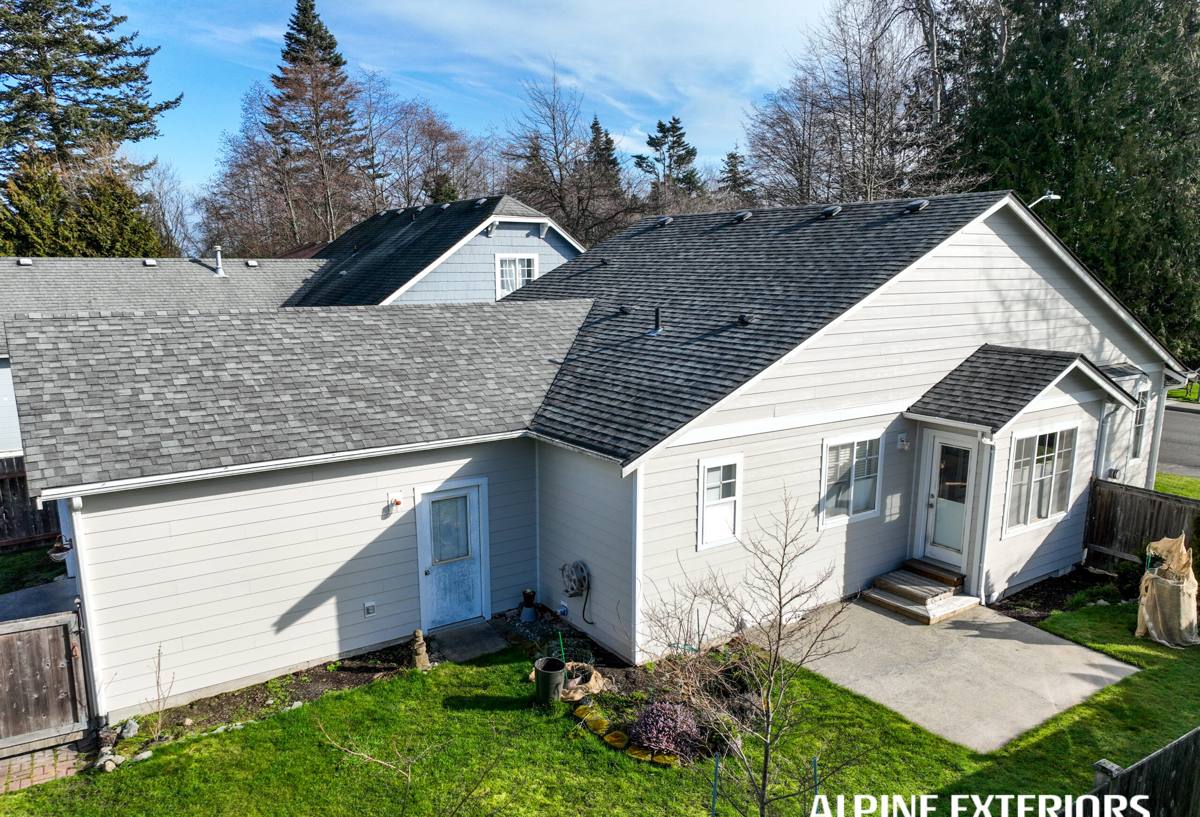
What Salt Air, Driving Rain, and Moss Actually Do to a House
Salt Air
Even a few miles inland from open water, airborne salt accelerates corrosion on fasteners, flashing, and any exposed metal trim. On siding itself, salt-laden moisture speeds up the breakdown of paint films and can worsen swelling in wood-based products. It's a slow, cumulative effect — not something that shows up in year one, but very visible by year fifteen or twenty on the wrong material.
Driving Rain
Wind-driven rain doesn't just wet a wall surface, it pushes water sideways and upward into laps, seams, and butt joints that were designed for water running straight down. Homes on more exposed or open lots around Conway see this constantly during fall and winter storms. Any siding system with weak seams, absorbent edges, or poor lap design is going to take on moisture here faster than the same product would in a drier part of the state.
Moss and Sustained Moisture
Skagit County's moss season is long — shaded north walls, tree-lined lots, and low drainage areas can stay damp for months at a stretch. Moss and algae growth on siding isn't just cosmetic. Sustained organic growth holds moisture against the surface, and on materials that aren't dimensionally stable or that absorb water, that constant dampness is what eventually causes swelling, soft spots, and paint failure.
Why We Install Only James Hardie Fiber Cement
Our crews install James Hardie fiber cement siding exclusively. We don't install vinyl, LP SmartSide, Cemplank, Allura, or primed wood siding like cedar or spruce boards, and that's a deliberate standard, not a limitation on what we're capable of. In a climate like Conway's, the material matters more than almost anywhere else in the state.
Fiber cement is non-combustible and dimensionally stable — it doesn't swell, cup, or absorb water the way wood-based products can, and it holds up to sustained damp conditions far better than materials that rely on a surface coating alone to keep moisture out. James Hardie's ColorPlus finish is baked on at the factory under controlled conditions, which gives it better fade and moisture resistance than field-applied paint, and it's backed by a real transferable warranty. When it's installed correctly — proper flashing, correct clearances, factory-specified fastening — it's the product we trust to actually perform through a Skagit County winter, not just look good the year it goes up.
We're not going to tell you competing products are junk. Vinyl, engineered wood, and other fiber cement brands all have legitimate uses and reasonable price points. What we will say is that after years of doing exterior work in this specific climate, James Hardie is what we've chosen to stand behind on every home we side, and we'd rather turn down a job than install something we don't believe will hold up here.
Correct Installation Is Half the Product
A lot of the siding failures we see in older Conway homes aren't a materials problem at all — they're an installation problem. Fiber cement siding is only as good as the flashing, gapping, and fastening behind it. Getting it right matters more here than in a drier climate because there's less margin for error before trapped moisture becomes a real issue.
What Correct Installation Involves
- Proper weather-resistive barrier and flashing detail at every window, door, and penetration
- Correct clearance between siding and grade, decks, rooflines, and other horizontal surfaces
- Manufacturer-specified fastener type, spacing, and depth — not generic nails driven too tight or too loose
- Properly caulked and sealed joints where the manufacturer calls for sealant, and left open where it doesn't
- Correct panel gapping to allow for expansion without buckling
- Ventilation behind the cladding where the wall assembly calls for it
Skip any one of these steps and you can end up with moisture problems behind good siding — which is worse than moisture problems on cheap siding, because it's hidden until the damage is already done. This is why the crew doing the install matters as much as the product going on the wall.
Full Exterior Protection: Siding, Roofing, Windows, and Decks
Siding doesn't work in isolation. On a house exposed to the kind of wind-driven rain and moisture Conway sees, the roof, windows, and siding all have to work together as one weatherproofing system. A tired roof pushes water toward wall penetrations and fascia. Old or poorly sealed windows push moisture into wall cavities right behind new siding. A deck built tight against the house without the right flashing can rot the wall behind it regardless of how good the siding is.
Because we handle siding, roofing, windows, and decks, we look at the whole exterior envelope rather than treating each piece as a separate project. If we're re-siding a home and notice flashing issues at the roofline or a window that's no longer sealing properly, we'll tell you before it becomes a problem hidden behind brand-new siding.
Signs Your Conway Home May Need New Siding
- Soft or spongy spots when you press on the siding, especially near the bottom courses or window sills
- Paint that's peeling, bubbling, or needs repainting more often than every 6-8 years
- Visible warping, cupping, or gaps opening up at seams and corners
- Persistent moss or algae staining that comes back within a season of cleaning
- Rising energy bills that suggest the wall assembly isn't insulating or sealing the way it used to
- Visible rot at trim boards, corner boards, or anywhere siding meets the roofline or a deck
Any one of these on its own might just need a repair. Several at once, especially on a home that's original from an earlier build era, usually means it's time to talk about full replacement before hidden damage spreads further.
What Affects the Cost of a Siding Project
| Factor | Why It Matters |
|---|---|
| Home size and wall complexity | More corners, dormers, and roof lines mean more cutting, flashing, and labor |
| Extent of hidden damage | Rot found behind old siding has to be repaired before new siding goes on, which affects both cost and timeline |
| Siding profile and trim choice | Lap width, shingle-style panels, and trim detailing all vary in material and labor cost |
| Access and site conditions | Tight lots, tall walls, or difficult grading can add setup and scaffolding time |
| Whether other exterior work is bundled in | Combining siding with roofing, window, or trim work can be more efficient than separate projects |
We don't publish blanket pricing because every home in the Conway area is different, but we're upfront about what's driving the number on any estimate we give you, and we won't pad a quote with work you don't actually need.
Why a Local Crew Matters in a Climate Like This
A crew that mostly works drier, less exposed parts of the state doesn't always get the details right for a delta and near-shore microclimate like Conway's. Flashing details, clearance requirements, and moisture management all need to be treated more carefully here than they would in a place that doesn't deal with salt air, driving rain, and a moss season that can stretch a good chunk of the year. Working throughout Skagit County means seeing the same climate stress repeat across dozens of homes, and building installation habits around what actually holds up here — not just what passes on a spec sheet.
It also means being reachable after the job is done. If a question comes up two years down the line about a warranty item or a piece of trim, you're calling a crew that's still working in the same county, not chasing down someone who did one job in the area and moved on.
Getting Started
If your Conway home is showing signs of wear, or you're just planning ahead for a siding, roofing, window, or deck project, we're happy to take a look and give you a straightforward, no-pressure estimate. There's no obligation — just an honest assessment of what your home actually needs. Use the form below to get in touch and we'll schedule a time to come take a look.