 Skagit County
 Edison Sits Right Where Weather Meets Water
Edison is a small community tucked into the Samish Flats area of Skagit County, close enough to Samish Bay and Padilla Bay that saltwater influence is part of daily life, not an occasional event. That proximity to tidal water, combined with the open, low-lying farmland that surrounds the town, means homes here take on a specific combination of weather stresses: salt-laden air moving in off the water, long stretches of driving rain through fall and winter, and the kind of persistent damp that keeps moss and algae growing on north-facing walls almost year-round. None of that is exotic weather for western Washington, but it adds up faster in a place like Edison than it does further inland.
We've worked on homes throughout Skagit County long enough to know that "coastal Skagit" and "inland Skagit" are not the same environment for exterior materials. A wall assembly that holds up fine in Sedro-Woolley can show fatigue in Edison years earlier, simply because of the added salt exposure and the flat, wind-exposed terrain that lets rain hit siding at an angle instead of falling straight down.
What Salt Air and Moisture Actually Do to Siding
Salt Air
Airborne salt is corrosive to metal fasteners, flashing, and trim, and it accelerates the breakdown of finishes that aren't formulated to resist it. On siding materials with weaker factory coatings, or on fasteners that aren't rated for coastal exposure, you'll see premature rust bleed, finish chalking, and edge deterioration well before the material's expected lifespan is up.
Driving Rain
Wind off the flats pushes rain sideways into wall assemblies rather than letting it run off cleanly. That means water finds its way into laps, seams, and butt joints that would stay dry in calmer conditions. Any siding system with weak seams, poor flashing detail, or a tendency to absorb water at the edges is going to underperform here.
Moss and Algae
Shaded, north- and west-facing walls in Edison's damp climate stay wet longer after every rain event, which is exactly the condition moss and algae need to take hold. Over time, that growth holds moisture directly against the siding surface, which is a problem for any material that isn't dimensionally stable or that swells when wet.
Full Exterior Work, Not Just Siding
We handle siding, roofing, windows, and decks, and in a climate like Edison's those four systems really do function as one envelope. A roof that's shedding water poorly will overload the siding below it. Windows with failing flashing will feed moisture straight into the wall assembly behind the trim. A deck attached to the house creates a ledger connection that has to be flashed correctly or it becomes a moisture path into the structure. We look at the whole exterior, not just the piece the homeowner called about, because problems in one system routinely show up as damage in another.
- Siding replacement and repair, James Hardie fiber cement only
- Roofing replacement and roof-to-wall flashing detail work
- Window replacement with proper flashing and integration into the siding plane
- Decks, including ledger flashing where the deck meets the house
Why We Install Only James Hardie Fiber Cement
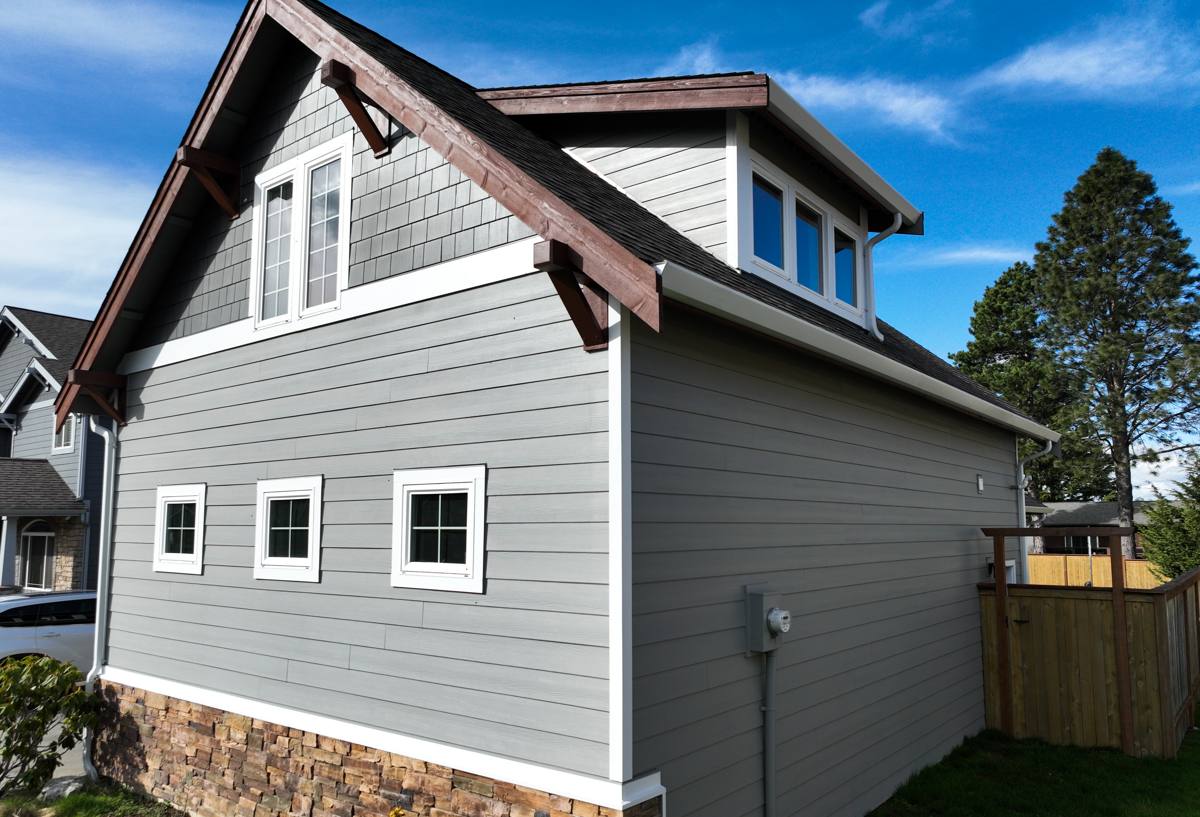
We made a decision as a company to install one siding product: James Hardie fiber cement. We don't install vinyl, LP SmartSide, Cemplank, Allura, or primed wood siding like spruce or cedar. That's not a marketing position, it's a practical one built on what actually holds up in Pacific Northwest coastal conditions over decades, not just the first few years.
Fiber cement is dimensionally stable and doesn't expand and contract with moisture the way wood-based or engineered-wood products can. It's non-combustible, which matters increasingly for insurance and building code considerations. James Hardie's ColorPlus finish is baked on at the factory under controlled conditions, which gives it better fade and chip resistance than field-applied paint, and their HZ5 product line in particular is engineered for wetter, harsher climates like ours. The warranty backing it is transferable and substantial, which protects the investment for whoever owns the home next.
None of that means every other siding product is defective. Vinyl, engineered wood, and other fiber cement brands all have legitimate uses. But when we weigh installation sensitivity, long-term moisture behavior in a salt-air coastal environment, and warranty strength, James Hardie is what we're willing to put our name behind and what we install on every siding job we take, in Edison and everywhere else we work.
How Installation Detail Changes in a Coastal-Influenced Climate
Fiber cement siding performs the way it's supposed to only when it's installed correctly, and installation detail matters more in a place like Edison than it does in a drier, more sheltered location.
- Fastener selection: corrosion-resistant fasteners rated for coastal exposure, not general-purpose fasteners that will rust and stain the face of the siding within a few years.
- Flashing at every penetration: windows, doors, deck ledgers, and roof-to-wall transitions all get flashed to shed water outward, not into the wall cavity.
- Proper gapping and caulking: Hardie's own installation specs call for specific gaps at butt joints and trim, sealed with a high-quality, flexible sealant rated for exterior use. Skipping this is one of the most common ways a fiber cement job fails early.
- Clearance from grade and hard surfaces: siding installed too close to soil, decking, or roofing will wick moisture regardless of how good the material is.
- Ventilation behind the siding: a drainage plane that lets incidental moisture escape rather than trapping it against the wall sheathing.
Skip any one of those steps and even the best siding material on the market will underperform. That's a big part of why manufacturer warranties are tied to installation done to spec, not just the product itself.
Comparing Siding Options for a Coastal Skagit County Home
| Factor | James Hardie Fiber Cement | Vinyl | Engineered Wood (LP-type) | Cedar / Primed Wood |
|---|---|---|---|---|
| Salt air resistance | Strong, factory finish resists chalking and corrosion | Can become brittle and discolor over time | Moisture-sensitive at cut edges and seams | Requires ongoing sealing and maintenance |
| Moisture/rot resistance | Not organic, does not rot | Doesn't rot but seams can trap water | Wood-based core can swell if compromised | Vulnerable without diligent upkeep |
| Fire rating | Non-combustible | Combustible, can melt/deform | Combustible | Combustible |
| Finish durability | Factory-baked ColorPlus finish | Color molded in, can fade | Field or factory paint, needs recoating | Needs regular repainting/staining |
| Maintenance | Low; occasional wash | Low, but cracks/warps | Moderate to high | High, ongoing |
| Typical lifespan when installed to spec | Decades, strong transferable warranty | Decades but performance varies | Shorter if moisture gets in | Shorter without consistent maintenance |
Signs Your Current Siding Is Struggling
If your home in Edison already has siding on it, here's what we'd want you to watch for, especially heading into another wet season:
- Persistent moss or algae staining on north- or west-facing walls that comes back quickly after cleaning
- Soft spots, bubbling, or visible swelling, particularly near the bottom courses or around windows
- Rust streaks running down from fasteners or trim
- Cracking or splitting at butt joints and corners
- Paint or finish that's chalking, peeling, or fading unevenly
- Gaps opening up at trim boards or window flashing
- A musty smell or visible staining on interior walls that share an exterior wall
Any one of these on its own might just mean cleaning or minor repair. Several together, especially combined with age, usually means it's worth having someone look at the whole wall assembly rather than patching the visible symptom.
Why a Local Crew Matters for a Community Like Edison
Edison is small, and it doesn't get the volume of contractor traffic that bigger Skagit County towns do. That can mean homeowners here end up choosing between driving further afield for quotes or working with whoever happens to cover the area. A crew that actually works throughout Skagit County regularly, and understands how the Samish Flats microclimate differs from inland conditions, is going to make better calls on flashing detail, fastener choice, and moisture management than a crew that's never dealt with this specific combination of salt air and driving rain before.
We're not a national franchise cycling through a script. We show up, look at the actual conditions your specific home is dealing with, and install a siding system suited to that reality, with the roofing, window, and deck work integrated into the same plan when it needs to be.
Get a Straight Answer for Your Home
If you're in Edison and dealing with tired, moss-covered, or failing siding, or you're planning ahead before it becomes an emergency, we're happy to come take a look. We'll give you an honest read on what your exterior actually needs, walk you through why we install James Hardie fiber cement and not the alternatives, and put together a free, no-pressure estimate based on what your home is really facing.