 Skagit County
 Exterior Work in Cedardale, Washington
Cedardale sits in the Skagit County landscape of farmland, timber, and river-valley moisture that defines this part of the Pacific Northwest. Homes out here aren't packed into dense subdivisions the way they are closer to the interstate corridors — lots tend to be larger, tree cover is heavier, and a lot of houses sit close enough to fields, sloughs, or wooded buffers that they stay damp longer after a storm than a house in an open, sunny lot would. That combination of shade, moisture, and distance from a quick contractor callback is exactly why exterior materials and workmanship matter more here than in a lot of other places.
We work throughout Skagit County, and Cedardale is inside our regular service area. That means when you call about a soft spot on your siding or a shingle that blew loose, you're getting a crew that already knows the roads, the microclimate, and the kind of moisture problems that show up on homes in this part of the county — not a crew driving in from Seattle or Everett who's never seen how this area weathers.
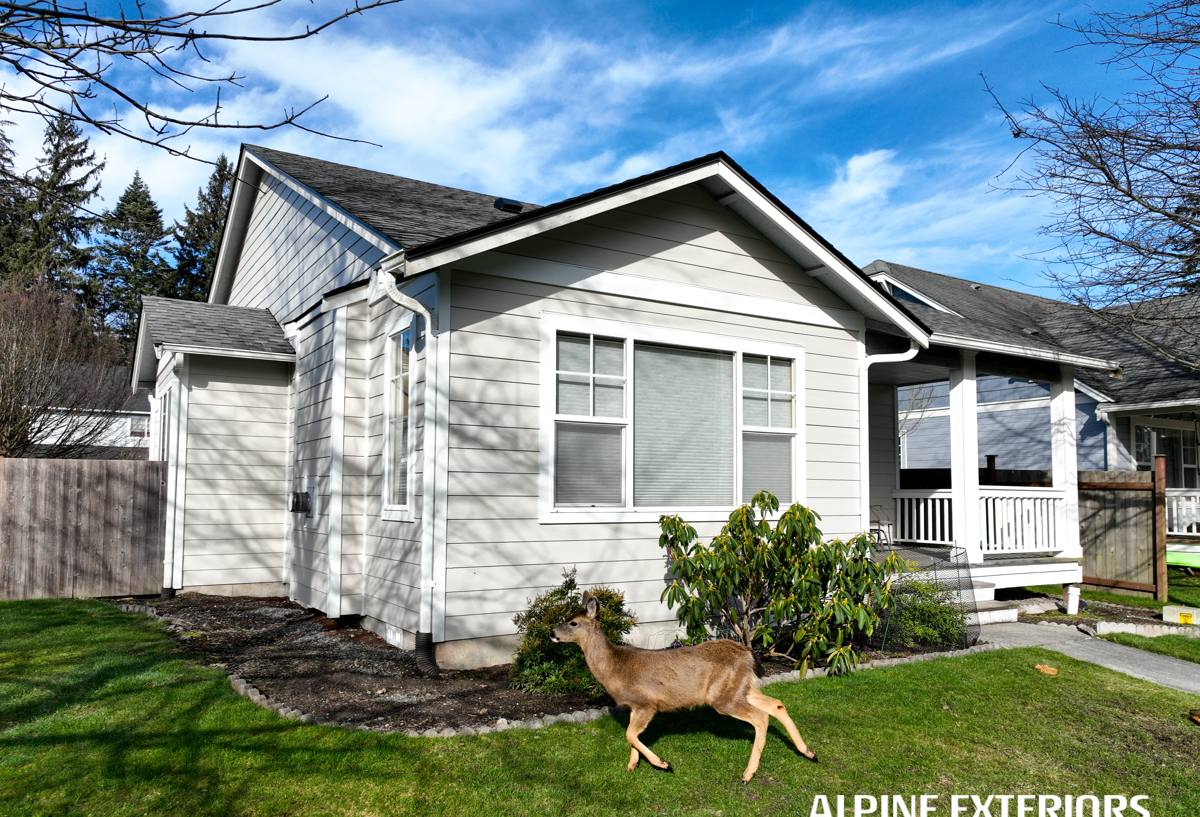
What the Climate Does to Homes Here
Skagit County's climate is defined by a long wet season, moderate but persistent salt-laden air moving in off Puget Sound and the Sound-adjacent lowlands, and driving rain that doesn't just fall straight down — wind off the water pushes it sideways into wall assemblies, trim joints, and anywhere a builder cut a corner. Add in the tree cover common around Cedardale, and you get a long moss season: moss and algae get a foothold on north-facing walls and shaded rooflines and don't fully dry out until late spring some years.
The Three Things We See Most
- Moisture intrusion at seams and butt joints — where siding boards meet, where trim meets siding, and around window and door flashing. This is where poorly installed or moisture-sensitive materials fail first.
- Moss and algae growth — especially on shaded, north- and west-facing walls and roof planes that don't get much direct sun for months at a time.
- Paint and finish breakdown — UV exposure is lower here than in drier climates, but constant damp cycling still degrades field-applied paint faster than a factory-cured finish.
None of this is unique to Cedardale — it's the reality for most of western Skagit County — but it's worth saying plainly instead of glossing over it, because it directly shapes what we recommend for siding, roofing, and trim.
Why We Install Only James Hardie Fiber Cement Siding
We get asked fairly often why we don't offer vinyl, LP SmartSide, or some of the other fiber cement brands on the market. The honest answer is that after years of doing exterior work in this climate, we settled on James Hardie because it holds up to the specific conditions Skagit County throws at a house, and we'd rather install one product well than offer five products and hope each one performs.
What Makes Hardie Different
- Non-combustible core — fiber cement doesn't burn, which matters given wildfire smoke seasons have become more common across Washington in recent summers.
- Engineered for wet climates — Hardie's HZ5 product line is specifically formulated for regions like ours with high moisture and freeze-thaw cycling, resisting moisture absorption and swelling better than wood-based composite products.
- Factory-applied ColorPlus finish — baked on at the factory under controlled conditions rather than field-painted, which means better adhesion and color consistency, and it isn't drying and curing in the middle of a Skagit County rain event.
- Doesn't rot or delaminate — being cement-based rather than wood-fiber-based, it doesn't have the same vulnerability to swelling, edge softening, or fungal decay that engineered wood siding products can develop when installation details aren't perfect or maintenance lapses.
We're not saying every other product is unusable — LP SmartSide, vinyl, and other fiber cement brands all have a place in the market and plenty of installed examples that are doing fine. What we're saying is that for the moisture load, moss exposure, and salt air common around here, we've chosen to stand behind one system rather than sell whatever's cheapest that week. Hardie's warranty structure and long track record in wet Pacific Northwest climates gave us the confidence to make that call.
Comparing Siding Options for a Skagit County Home
| Material | Moisture Performance in Wet Climates | Maintenance | Fire Resistance | Typical Lifespan |
|---|---|---|---|---|
| James Hardie Fiber Cement | Excellent — engineered HZ5 line for wet regions | Low — factory finish resists fading, occasional wash for moss | Non-combustible | 30-50+ years with proper install |
| Vinyl Siding | Fair — can warp, doesn't stop moisture behind it | Low, but cracks/fades over time | Combustible, can melt/deform near heat | 20-30 years |
| LP SmartSide (engineered wood) | Moderate — vulnerable at cut edges and seams if not sealed | Moderate — edge sealing and caulking upkeep | Combustible | 25-30 years |
| Cedar / Wood Siding | Poor to moderate — needs consistent refinishing | High — regular staining/painting required | Combustible | Varies widely, often 15-25 years without diligent upkeep |
This table reflects general industry performance patterns, not lab measurements of every product on every home. Actual results always depend heavily on installation quality — which is the next thing worth talking about.
Installation Quality Matters as Much as the Product
Even the best siding material fails early if it's installed wrong. Fiber cement siding has specific installation requirements — proper nailing patterns, correct clearances above rooflines and grade, sealed and flashed butt joints, and correct fastener spacing — and skipping these details is one of the most common reasons any siding job (Hardie or otherwise) develops problems within a few years instead of a few decades.
What Correct Hardie Installation Looks Like
- Minimum clearance maintained between siding and grade, decks, roofs, and other horizontal surfaces
- Butt joints properly sealed or flashed, not just butted and caulked
- Manufacturer-specified fastener type, spacing, and penetration depth
- Weather-resistant barrier installed correctly behind the siding, not skipped to save time
- Field-cut edges primed or treated per manufacturer spec before installation
A crew that's installed hundreds of these boards in this exact climate catches details a generalist crew might miss — because we're not learning wet-climate fiber cement installation on your house.
Beyond Siding: Roofing, Windows, and Decks
Siding rarely fails in isolation. A roof that's shedding granules or has moss buildup around valleys pushes more water down onto the wall assembly below it. Old, poorly sealed windows let moisture track into the wall cavity right where trim meets siding. A deck ledger board attached without proper flashing is one of the more common hidden moisture entry points we find on older homes. Because we handle siding, roofing, windows, and decks, we look at the whole exterior envelope as one connected system rather than quoting a single component and hoping the rest holds up around it.
That matters in Skagit County specifically because the long wet season doesn't give a house much of a break to dry out between problems. If your roof, windows, and siding aren't working together to shed water, moss and moisture find the weak point eventually — usually in the coldest, wettest part of the year, which is the worst time to discover it.
What to Expect When You Call Us
- A walk-around inspection of your current siding, trim, roofline, and any visible moisture or moss issues
- An honest assessment of whether you need full replacement, partial repair, or just maintenance
- A written estimate that explains material and labor, not just a bottom-line number
- If you move forward, a crew that shows up, protects your landscaping and property, and cleans up daily — not just at the end of the job
Questions Worth Asking Any Contractor Before You Sign
- Are you licensed and insured in Washington State, and can you provide proof?
- Who is actually on the crew — subcontracted labor or your own installers?
- What warranty covers the material, and separately, what warranty covers your labor?
- Can you walk me through your flashing and clearance details before you start?
- How do you handle unexpected issues found once old siding comes off?
Any legitimate exterior contractor in Skagit County should be able to answer all five without hesitating.
A Local Crew That Knows This Ground
There's a real difference between a contractor who drives in from out of the area for one job and a crew that works Skagit County on a regular basis. We see how homes in and around Cedardale actually weather over multiple seasons — which walls hold moss longest, which orientations take the worst of the driving rain, which older homes in the area tend to have the same trim and flashing shortcuts from decades-old construction. That local pattern recognition shapes what we look for during an inspection and what we recommend for your specific property, rather than a generic checklist.
If you're noticing moss buildup, soft spots, fading, or you're just due for an honest look at your siding, roof, windows, or deck, we're happy to come out and take a look. The estimate is free, there's no pressure, and you'll get a straight answer about what your home actually needs.