 Skagit County
 Our Standard, Not a Sales Pitch
Every siding contractor has an opinion about materials. Ours is simple: we install James Hardie fiber cement siding, and we don't install anything else. No vinyl, no LP SmartSide, no Cemplank, no Allura, no primed spruce or cedar. That's not a marketing line — it's a decision we made after years of tearing old siding off houses in Skagit County and seeing, up close, which products held up to this climate and which ones didn't.
This page explains the reasoning, not just the conclusion. We'll walk through what fiber cement actually is, why Hardie's specific engineering matters here, and what separates a siding job that lasts thirty years from one that needs attention in eight.
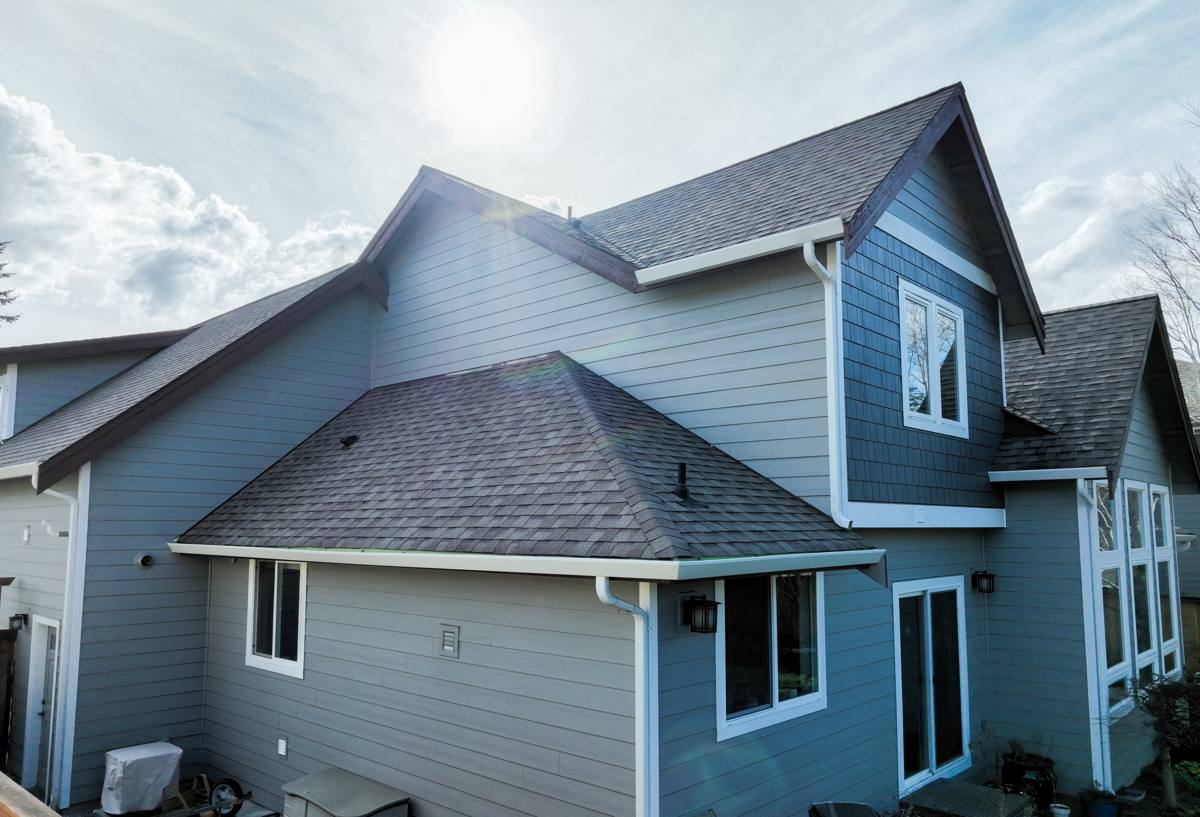
What Skagit County Actually Does to Siding
Skagit County sits in a spot that's tough on exterior building materials in a few specific ways. Proximity to Skagit Bay and the greater Puget Sound means salt-laden air moves inland regularly, especially with westerly weather. Salt air accelerates corrosion on fasteners and finishes, and it's harder on painted wood and some engineered wood products than most homeowners expect.
Then there's the rain. Skagit County doesn't get the heaviest rainfall totals in the state, but it gets a lot of driving, wind-pushed rain off the Sound and the Cascade foothills, plus long stretches of damp, low-sun weather in fall and winter. Add in the moss and algae season that runs long here — often eight or nine months out of the year on north-facing walls and shaded elevations — and you have an environment that's constantly testing a siding product's ability to shed water, resist rot, and keep its finish.
Wood-based products — solid wood, primed spruce, and engineered wood siding like LP SmartSide — are all vulnerable to moisture intrusion at cut edges, fastener points, and seams. Once water gets past the surface, these products can swell, delaminate, or rot from the inside out, often before it's visible from the street. Vinyl doesn't rot, but it flexes and gaps with temperature swings, fades in UV exposure, and can crack in impacts, particularly in colder snaps. None of these are defects exactly — they're trade-offs baked into what the materials are made of.
Why This Isn't Just "Marketing Talk"
We're not saying these products fail on day one. Vinyl and engineered wood siding are installed successfully all over the country, including here. Our position is narrower: given what we see when we open up old siding in this specific climate, we've decided the long-term risk isn't one we want attached to our name. That's a business decision, and homeowners deserve to know it's the reason behind our recommendation.
What Fiber Cement Actually Is
Fiber cement siding is made from a mixture of Portland cement, sand, cellulose fiber, and water, cured into rigid boards, panels, or shingle-style pieces. It's not plastic (like vinyl) and it's not wood-based (like LP SmartSide or cedar). That distinction matters because it changes how the material behaves around moisture and heat.
- It does not rot, because there's no organic wood fiber for fungus to feed on the way there is in solid wood or engineered wood products.
- It is non-combustible, which matters for insurance considerations and for anyone thinking about wildfire exposure risk in drier interior parts of the county.
- It holds paint and factory finishes far longer than wood because it doesn't expand and contract with moisture the way wood does.
- It resists pests — carpenter ants and woodpeckers have nothing to chew on.
Several manufacturers make fiber cement — Cemplank and Allura are two others in the market. We don't install those either. The material category is sound; the difference is in engineering, quality control, and how the specific manufacturer backs the product.
HZ5: Engineered for This Exact Climate
James Hardie makes region-specific formulations under what they call HZ (HardieZone) engineering — different mixes and specifications for different climate zones across the country. The Pacific Northwest, including Skagit County, falls into the HZ5 zone, which is formulated around sustained moisture exposure, freeze-thaw cycling, and the kind of prolonged damp weather we get from October through May.
This isn't a marketing distinction. A fiber cement product engineered for a hot, dry climate and one engineered for the Pacific Northwest are not interchangeable — the moisture and durability performance is tuned differently. When we say we install Hardie, we specifically mean the HZ5 product line, not a generic version of fiber cement pulled off a shelf.
ColorPlus: The Finish Is Half the System
A siding board is only as good as its finish, and this is where a lot of products — including some fiber cement competitors — cut corners. James Hardie's ColorPlus Technology is a factory-applied, baked-on finish process, not a coat of paint rolled on after installation or applied in the field.
Factory finishing matters for a few concrete reasons:
- It's applied in a controlled environment, so coverage and cure are consistent across every board.
- It carries its own dedicated finish warranty, separate from the substrate warranty.
- It holds color and resists fading, chalking, and moss staining far longer than field-applied paint, which is critical given how much shaded, damp wall area exists on a typical wooded Skagit County lot.
- Touch-up and color-matching are more predictable because the color system is standardized at the factory.
Primed wood siding, by contrast, depends entirely on the field paint job — and paint quality, weather at time of application, and repainting schedule all become the homeowner's ongoing responsibility.
The Product Lines We Install
James Hardie isn't one product — it's a system of boards, panels, and trim designed to work together. Here's how the main lines compare:
| Product | Style | Best Use |
|---|---|---|
| HardiePlank | Lap siding, several profiles and textures | Primary wall siding on most home styles |
| HardieShingle | Staggered or straight-edge shingle panels | Craftsman and cottage-style accents or full walls |
| HardiePanel | Vertical large-format panels | Modern facades, gables, accent walls |
| HardieTrim | Boards for corners, window and door trim, fascia | Finishing details that complete the system |
| HardieSoffit | Pre-vented or non-vented panels | Eaves and overhangs |
Using matched trim and soffit products alongside the lap or panel siding isn't just cosmetic — it keeps the whole envelope working as a designed system rather than a patchwork of parts that expand, contract, and weather at different rates.
The Warranty Difference
James Hardie backs its siding with a non-prorated limited warranty on the substrate (commonly 30 years on siding products) and a separate finish warranty on ColorPlus color retention. Both are transferable to a new owner if the home sells within the warranty period, which is a real factor in resale — buyers and their inspectors do ask about siding age and warranty status.
Warranty coverage typically depends on installation following Hardie's published installation instructions, which is part of why installation quality isn't a minor detail — it's what keeps the warranty valid in the first place.
What Correct Installation Actually Requires
Fiber cement siding is unforgiving of shortcuts in a way vinyl often isn't. Getting it right means following the manufacturer's specifications closely, especially around water management. Before we start a job, or when we're evaluating a bid, these are the things that separate a proper install from a problem waiting to happen:
- Correct clearance between siding and grade, decks, patios, and roof lines to prevent wicking moisture.
- Proper flashing at every window, door, and penetration — not caulk used as a substitute for flashing.
- A code-compliant weather-resistive barrier installed behind the siding with correct overlaps.
- Manufacturer-specified fastener type, spacing, and placement — this affects both performance and warranty validity.
- Correct board overlap and gapping at butt joints to allow for expansion.
- Sealed and primed cut edges on any field cuts, since factory finish doesn't extend to a fresh cut.
- Rainscreen or drainage plane detailing appropriate for our wet climate, especially on shaded and north-facing walls.
None of this is exotic, but it's easy to skip when a crew is moving fast, and the mistakes don't usually show up for a few years — long after the crew is gone.
What This Costs Compared to Alternatives
Homeowners comparing bids should look past the sticker price and think about what drives cost differences between products.
| Factor | Vinyl | LP SmartSide / Wood | James Hardie |
|---|---|---|---|
| Material cost | Lowest | Mid-range | Mid to upper |
| Expected repaint cycle | Rarely painted, fades instead | 5-10 years | Not required with ColorPlus |
| Moisture/rot risk in this climate | Low rot risk, but gapping/warping possible | Higher, especially at cut edges and seams | Very low when installed to spec |
| Fire rating | Combustible | Combustible | Non-combustible |
| Typical warranty | Prorated, often shorter | Varies by manufacturer | Non-prorated, transferable |
The upfront gap between vinyl and Hardie is real, and we won't pretend otherwise. What we've found over time is that the maintenance and repaint costs on wood-based and painted products, plus the risk of moisture damage in a climate like ours, tend to close that gap over the life of the siding — and Hardie still looks and performs like new fiber cement long after cheaper products need attention.
Get a Straight Answer for Your Home
Every house in Skagit County — its exposure to weather, its shade, its wall orientation — is a little different, and that affects which Hardie product and detailing make sense for your project. If you'd like a straightforward look at your siding, no pressure and no obligation, we're happy to walk the property, explain what we see, and put together a written estimate using the form below.