 Skagit County
 Why Clear Lake Homes Wear Out Siding Faster Than People Expect
Clear Lake sits in a pocket of Skagit County that gets the full package: lake-effect humidity hanging in the trees, long stretches of driving rain off the valley, and a moss season that can run eight or nine months out of the year. Add the salt-tinged air that drifts inland from Puget Sound on a west wind, and you've got a combination that's genuinely rough on exterior materials. Homeowners here often call us not because their siding "broke," but because it's been slowly failing for years without anyone noticing — soft spots behind the trim, moss holding moisture against a north wall, paint that won't hold past three or four years no matter how many coats go on.
None of that is unusual for this area. It's just what siding replacement has to account for if it's going to last. A product or installation that works fine in a drier part of the state can fail early here, and a lot of the siding problems we see in Clear Lake trace back to work that was done without that in mind.
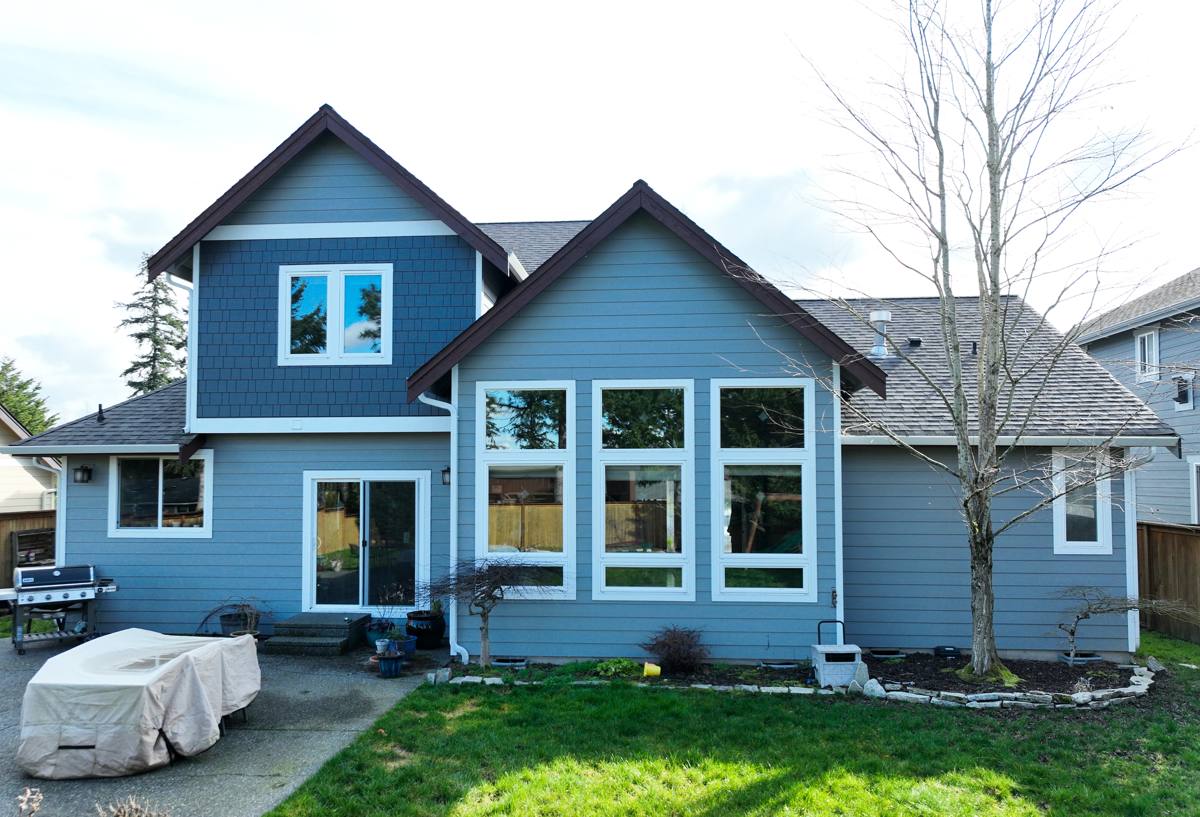
What This Climate Actually Does to a Wall
Moisture that never fully leaves
Clear Lake's tree cover and proximity to water keep humidity elevated even between rain events. Siding here rarely gets a long dry stretch to fully release moisture, which matters more than the rain itself. Materials that absorb water and swell — or that trap moisture behind them due to poor flashing — stay wet longer and start breaking down from the inside out.
Moss and organic growth
Moss doesn't just look bad. It holds water directly against the siding surface, keeps that surface shaded and cool, and accelerates rot in anything wood-based or wood-derived. North- and east-facing walls, and anything under overhangs or near trees, take the worst of it.
Salt-influenced air
Skagit County isn't oceanfront, but the marine air that moves up through the valley carries enough salt to matter for fasteners, flashing, and paint film over a couple of decades. Cheap or under-spec metal components corrode faster than homeowners expect.
Freeze-thaw cycling
Winters here aren't brutal, but they're damp and they do dip below freezing repeatedly. Any siding that's already absorbed moisture is vulnerable to that cycle pushing cracks wider and loosening joints.
What a Correct Siding Replacement Involves in Clear Lake
Replacing siding well here is less about the siding panel itself and more about everything underneath it. We see plenty of homes where the old siding looked fine on the surface but the sheathing behind it was compromised because of shortcuts in the original install.
- Full tear-off and inspection: Every square foot of sheathing gets checked once the old siding is off — soft spots get replaced, not papered over.
- Correct weather-resistive barrier: A properly lapped, sealed house wrap or building paper system, installed so water sheds down and out, not behind the cladding.
- Rainscreen or drainage gap where it's warranted: Giving water a way to drain and air a way to circulate behind the siding matters more in a humid, low-sun-exposure area like this than it does in drier parts of the state.
- Flashing at every penetration: Windows, doors, hose bibs, light fixtures, and vents are where most siding failures actually start. Flashing has to be layered correctly so water is always directed outward.
- Fastener and trim material matched to the climate: Corrosion-resistant fasteners and trim details that don't create moisture traps at butt joints or corners.
- Factory-finished cladding: A finish that's baked on at the factory holds up to UV and moisture cycling far longer than a field-applied paint job, which is one of the biggest maintenance differences homeowners notice within the first five years.
Why We Install James Hardie and Nothing Else
We standardized on James Hardie fiber cement siding for every job we do, including here in Clear Lake, and it's a decision built around exactly the conditions described above. Hardie's fiber cement is non-combustible and dimensionally stable — it doesn't absorb and swell with moisture the way wood-based products do, which matters enormously in an area where the siding rarely gets a long dry period. Its ColorPlus factory finish is baked on and warranted separately from the substrate, so it resists the fading and peeling that field-painted products struggle with in this humidity.
James Hardie also engineers specific product lines (their HZ5 line, for example) for wetter, more variable climates like the Pacific Northwest, which means the product itself is formulated with this kind of weather in mind rather than being a general-purpose product used everywhere. Combined with a strong transferable warranty, it gives homeowners a siding system that's proven over decades, not something we're hoping performs well.
We don't install LP SmartSide, vinyl, Cemplank, Allura, primed spruce, or cedar. Each of those has legitimate uses and reasonable people choose them, but they each carry trade-offs — moisture sensitivity, maintenance burden, installation tolerances, or warranty structure — that we're not willing to put our name behind in a climate this demanding. Standardizing on one product line also means our crews install it correctly every time instead of switching techniques between five different systems.
Signs a Clear Lake Home Needs Siding Replacement Soon
- Paint that's failing, chalking, or peeling within a few years of the last paint job
- Soft or spongy spots when you press on siding, especially near the bottom courses or under windows
- Persistent moss or algae staining that comes back within a season of cleaning
- Visible warping, cupping, or gaps opening at seams and corners
- Interior signs like peeling paint, musty smell, or discoloration on walls that back up to exterior siding
- Rising energy bills that suggest the wall assembly is no longer doing its job
Our Process for a Clear Lake Siding Replacement
- On-site assessment: We walk the exterior, check problem areas (especially shaded, moss-prone sides), and look at trim, flashing, and any visible rot before quoting anything.
- Scope and product selection: We talk through Hardie's plank profiles, textures, and colors, and settle on the right combination for the home's exposure and style.
- Tear-off and sheathing repair: Old siding comes off, sheathing gets inspected and repaired as needed — this step is where hidden problems get caught and fixed, not hidden again.
- Weather barrier and flashing installation: Done to manufacturer spec, with extra attention to any window, door, or fixture penetration.
- Hardie installation: Installed to James Hardie's fastening and clearance specifications, which is also what keeps the manufacturer's warranty intact.
- Final walkthrough: We go over the finished work with the homeowner and flag anything worth watching, like drainage paths or landscaping that should stay clear of the wall.
Cost Factors for Siding Replacement in Clear Lake
| Factor | Why It Matters Here |
|---|---|
| Extent of hidden damage | Homes with long-term moss or moisture exposure often need sheathing repair, which adds cost but is not optional to skip |
| Home size and wall complexity | Dormers, multiple stories, and cut-up wall lines all add labor time regardless of material |
| Siding profile and trim details | Board-and-batten, wider reveals, and custom trim take more time than standard lap siding |
| Accessibility | Tree-lined lots and lake-adjacent properties sometimes require more staging or hand-carrying materials |
| Existing drainage conditions | Adding a rainscreen system where none existed is worth the added cost on chronically damp walls |
We don't quote a number without seeing the house — anyone who does is guessing. What we can say is that a correctly installed Hardie system, priced honestly up front, tends to cost less over 20 years than repeated cycles of repainting, patching, or replacing a lesser product twice.
Why Hiring a Crew That Already Works Clear Lake Matters
Clear Lake isn't a huge area, but it has its own microclimate quirks compared to, say, Mount Vernon proper or the coastal side of the county. A crew that's already worked homes here knows which walls typically take the worst moss buildup, how the lake's humidity behaves differently than a more open, wind-exposed lot, and what flashing details tend to fail first on homes built in different eras around the area. That local pattern recognition is worth more than it sounds — it's the difference between a crew guessing at a generic install and one that's already seen how this specific area's weather finds the weak points in a wall system.
Get a Free, No-Pressure Estimate
If your Clear Lake home's siding is showing its age — or you just want an honest read on where it stands — we're happy to take a look. The estimate is free, there's no pressure, and you'll get a straight answer about whether replacement makes sense now or can wait. Use the form below to get started.