 Skagit County
 Building a Deck That Actually Holds Up in Alger
Alger sits in that stretch of Skagit County where thick fir and cedar canopy, proximity to Puget Sound, and a long wet season all combine to work against outdoor structures. A deck built here doesn't fail the same way one fails in a dry climate — it doesn't usually break under load, it rots, corrodes, or grows a slick coat of moss before its time. If you're planning a custom deck for a home in Alger, the design and material choices matter more than they would somewhere drier, and the details that get skipped are exactly the ones that show up as problems in year three or four, not year one.
We build decks as part of a siding and exterior business, which matters more than it sounds like it should. A deck that ties into the house — through a ledger board, through flashing, through the same wall assembly your siding protects — is a water management problem as much as it's a carpentry project. Get that connection wrong and you're not just risking the deck, you're risking rot in the wall behind it.
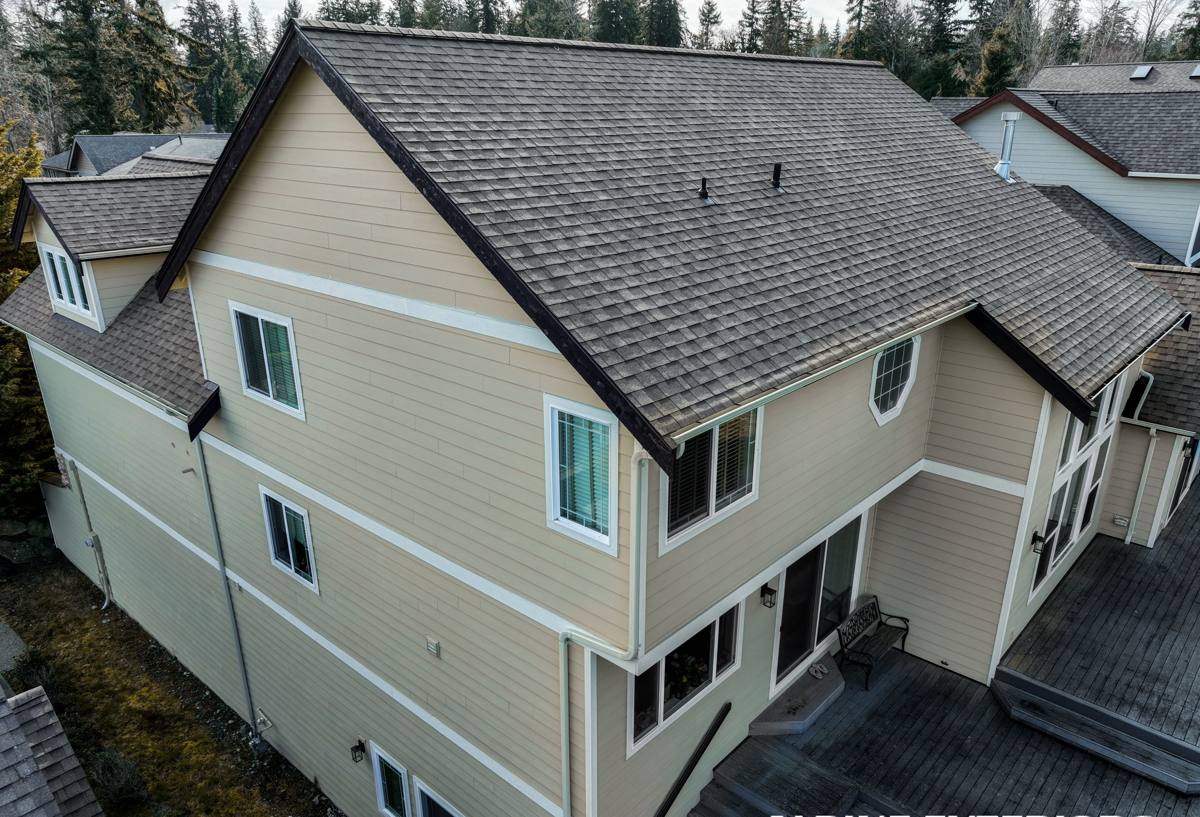
What Skagit County's Climate Does to a Deck Over Time
Three things drive almost every deck problem we see in this part of the county:
Driving rain
Storms here often come with wind, which pushes rain sideways into ledger connections, under railings, and into any gap where end grain is exposed. A deck designed for straight-down rain in a milder climate doesn't always hold up to rain that's being driven horizontally against the house.
Moss and algae season
Skagit County's moss season runs long — shaded, damp surfaces can stay wet for days at a time between fall and spring. Decking that doesn't shed water quickly, or that sits under heavy tree cover, builds up moss and algae film that's not just unsightly — it's slippery and it holds moisture against the wood or composite surface, accelerating wear.
Salt air
Being close enough to Puget Sound and Samish Bay means homes in and around Alger get some exposure to salt-laden air, especially on windier days. Salt accelerates corrosion in fasteners and metal hardware faster than most homeowners expect, which is why hardware choice on a coastal-influenced deck isn't a place to cut costs.
Decking Material Choices for This Climate
There's no single "right" material for every project — it depends on budget, how much maintenance you want to do, and how much shade the deck gets. Here's how the common options actually perform under Skagit County conditions:
| Material | How it handles our climate | Maintenance | Typical lifespan |
|---|---|---|---|
| Pressure-treated fir/hem-fir | Affordable, but end grain and cut edges need resealing or they absorb moisture and check | Annual cleaning, re-stain/seal every 2-3 years | 15-20 years with upkeep |
| Cedar | Naturally rot- and insect-resistant, but softer surface shows moss and weathering faster under heavy shade | Cleaning plus periodic oil/stain to hold color and shed water | 20-25 years with upkeep |
| Composite (capped) | Sheds water well, resists rot entirely, but can still grow surface algae in deep shade if not cleaned | Periodic washing, no staining or sealing | 25-30+ years |
| Tropical hardwood (ipe and similar) | Extremely dense and rot-resistant, handles moisture well, but installation is unforgiving of mistakes and pre-drilling is mandatory | Occasional oiling if you want to keep the color; otherwise low | 30+ years |
For homes with heavy tree cover — common around Alger — we lean people toward composite or cedar with a real maintenance plan, since both handle the on-and-off dampness better than treated lumber left unsealed. For a full-sun deck with less moss pressure, treated lumber or cedar is often the more budget-sensible call.
The Ledger Connection: Where Most Deck Failures Actually Start
The single most important — and most commonly rushed — part of a deck build is where it attaches to the house. This is the ledger board connection, and it's also where our siding background changes how we build.
- Flashing has to be installed so it directs water out and away from the house wall, not just tucked behind the siding and hoped for.
- The ledger board needs a water-resistant barrier and proper fasteners rated for exterior, load-bearing use — not just deck screws.
- Where the ledger meets existing siding, that siding often needs to be cut back and re-flashed correctly, not just caulked around. Caulk is not a substitute for flashing; it fails long before flashing does.
- Joist tape over the top of every joist reduces the moisture that gets trapped under decking boards and behind rim joists — cheap insurance against rot that's expensive to fix later.
We've opened up decks where the ledger flashing was skipped or done wrong, and the wall sheathing behind it was soft before the deck was even ten years old. In a climate that gets as much driving rain as Skagit County does, that mistake shows up faster than in drier regions.
Drainage and Moss Design — Built In, Not Bolted On
Moss and standing water are largely design problems, not just maintenance problems. A few decisions made at the design stage make a real difference over the life of the deck:
Board spacing and airflow
Slightly wider gaps between boards, along with joist framing that allows air to move underneath, lets a deck dry out between rain events instead of staying damp. Under heavy tree cover this matters even more, since sun exposure alone can't do the drying.
Under-deck drainage
For decks with usable space underneath — a patio, storage, or a lower-level entry — an under-deck drainage system channels water off the top surface and away, keeping the space below dry and reducing the amount of standing moisture the deck structure sits in.
Orientation and sun exposure
Where the lot allows it, we look at how much direct sun a deck will realistically get given the surrounding tree line. A deck that's shaded most of the day will need either a more moss-resistant material or a maintenance routine built around it from day one — that's a conversation worth having before construction, not after the moss shows up.
Hardware and Fasteners: The Detail Homeowners Never Think About
Given the salt air exposure that comes with being near Puget Sound and the Samish/Skagit waterways, we don't use standard-grade fasteners on structural connections. Stainless steel or heavy hot-dip galvanized hardware costs more up front but resists the corrosion that shows up as rust streaks and, eventually, weakened connections at critical structural points like ledger bolts, joist hangers, and post bases. This is one of those line items that's easy to shave off a bid and hard to notice until years later, when it matters most.
Permits, Setbacks, and Skagit County Requirements
Most custom decks above a certain height or attached to the house require a building permit in Skagit County, and there are specific requirements around guardrail height, baluster spacing, and footing depth that inspectors check. Footings also need to be set below the local frost line and bear on undisturbed or properly compacted soil — something that varies lot to lot depending on how the property was graded. We handle the permit process and inspections as part of the build, so you're not the one tracking down requirements or scheduling inspections yourself.
Our Process for a Custom Deck Build
- Site visit and assessment — we look at the house's existing siding and wall assembly where the deck will attach, the slope and soil at the site, and how much shade the location gets through the year.
- Design and material selection — we walk through material trade-offs based on your budget, maintenance appetite, and how the space will be used.
- Permitting — we prepare and submit what Skagit County requires and schedule the inspections tied to the project.
- Demolition and prep — if there's an existing deck or siding to cut back for the ledger connection, that work is done carefully to protect the rest of the house.
- Framing and flashing — structure, ledger flashing, and joist protection go in before decking, since these are the parts you won't see again once the project is finished.
- Decking, railing, and finish work — final surface material, railings to code, and any stairs or lighting are installed.
- Final walkthrough and inspection — we confirm everything passes and walk you through basic care for whatever material you chose.
Why a Crew That Already Works Alger Is Worth Something
A contractor who works this specific area regularly already understands things that take an outside crew time to figure out: how much moss pressure a shaded lot near the tree line is going to see, which parts of Skagit County have soil that drains poorly and needs extra footing attention, and what the county permitting office actually wants to see on a submittal. That local familiarity shortens the guesswork and reduces the chance of a design choice that looks fine on paper but doesn't hold up to how this area actually behaves through a wet winter.
Keeping a New Deck in Good Shape
Whatever material you choose, a small amount of regular care goes a long way in this climate:
- Sweep off leaves, needles, and debris regularly — trapped organic matter holds moisture and feeds moss growth.
- Wash the surface at least once or twice a year with a deck-safe cleaner to break up algae and moss film before it gets established.
- Check railings, stair connections, and the ledger area annually for loosening hardware or early signs of rust staining.
- Reseal or re-stain wood decking on the schedule appropriate to the product — don't wait until it's visibly gray and weathered.
- Keep gutters and downspouts near the deck clear so roof runoff isn't dumping extra water onto or near the structure.
If you're planning a custom deck in Alger or elsewhere in Skagit County, we're glad to come look at your site, talk through material options honestly, and put together a free, no-pressure estimate using the form below.