 Skagit County
 Why La Conner Roofs Wear Differently Than Roofs Inland
La Conner sits close enough to the water that roofs here deal with a combination most inland Skagit County homes don't: salt-laden air, wind-driven rain that gets pushed sideways under normal flashing details, and a moss season that runs long because the shade, humidity, and mild temperatures never really let a roof dry out and stay dry. Any one of those on its own is manageable. Together, they speed up problems that would otherwise take years to show up.
Salt air is corrosive to exposed metal — nails, flashing edges, gutter hardware, and the fasteners holding ridge caps and vents down. Driving rain doesn't need a big hole to get in; it needs a lapped seam facing the wrong direction or a nail head that's backed out a sixteenth of an inch. And moss doesn't just look bad — its root structure works into shingle mat and lifts tabs, and the mats it forms hold water against the roof deck far longer than open air would.
A repair that doesn't account for all three is a repair that comes back. That's the standard we hold every La Conner roof repair to.
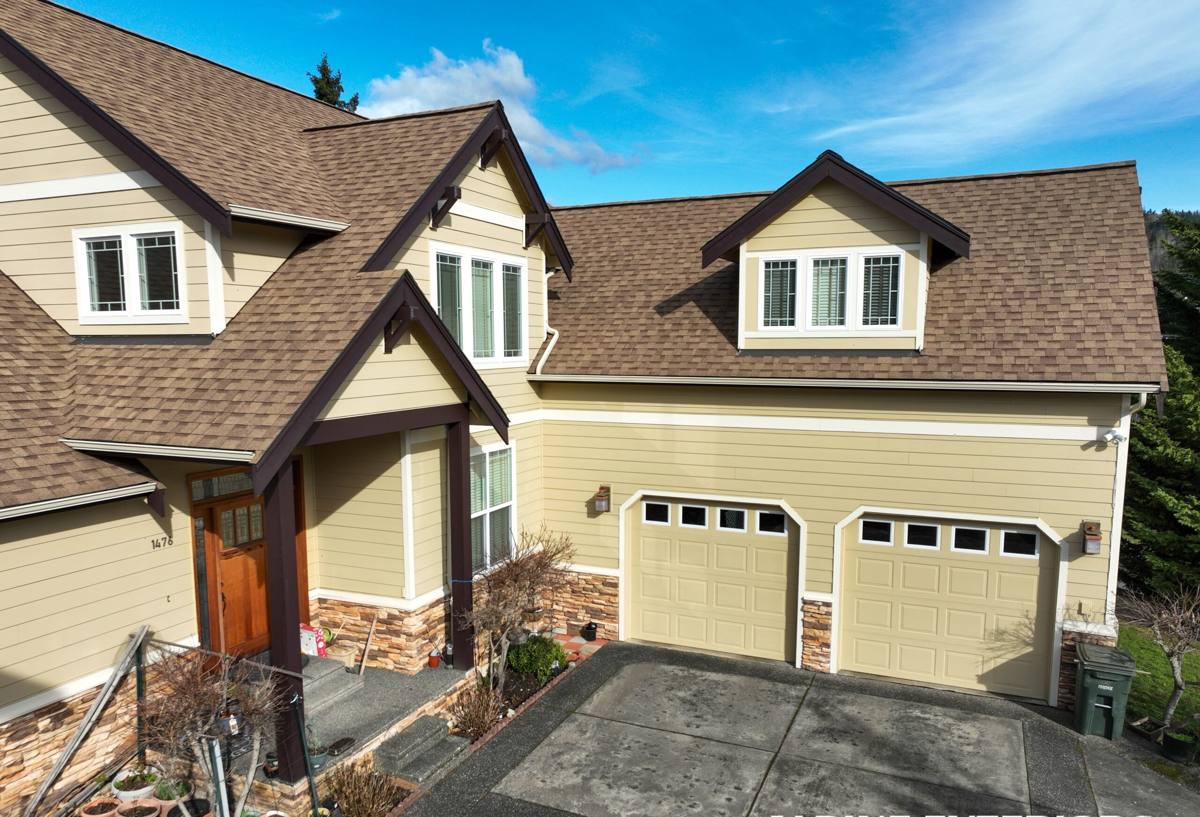
Signs a La Conner Roof Needs Repair, Not Just a Cleaning
Homeowners often call about moss and end up finding out the moss was hiding something else. Here's what we look for, and what you can check yourself before calling anyone out.
- Dark streaking or green growth concentrated on north-facing or shaded slopes
- Granules collecting in gutters or at downspout outlets (a sign of asphalt shingle wear)
- Soft spots or slight sponginess when walked on, especially near valleys
- Water stains on interior ceilings, particularly after a windy rainstorm rather than a calm one
- Lifted, cracked, or missing shingle tabs near ridges, hips, or where two roof planes meet
- Rust streaking below metal flashing or vent boots
- Daylight visible through the attic roof deck at nail holes or seams
If what you're seeing is limited to surface moss and light staining with no interior signs, a cleaning and treatment may be all that's needed. Once you're seeing granule loss, lifted shingles, or interior staining, that's a repair conversation.
Wind-Driven Rain vs. Standing Moisture
These two failure modes look similar from inside the house but need different fixes. Wind-driven rain intrusion shows up during or right after a storm with wind, often at a specific spot near an edge, valley, or penetration. Standing moisture from moss and debris shows up gradually, tends to be worse after a stretch of grey, damp weeks rather than one storm, and is usually paired with visible growth on the roof surface itself.
What a Correct Roof Repair Actually Involves
A patch job that only addresses the visible symptom is common — and it's why some repairs don't last through a second wet season. A repair done right in this climate has a few non-negotiable steps.
1. Find the Real Entry Point
Water travels before it stains. A stain on a ceiling is rarely directly below the actual leak. We trace the path from the interior sign back up through the attic (where accessible) to the deck, and cross-reference that against the exterior — flashing, valleys, penetrations, and shingle condition in that area.
2. Clear and Assess Moss Damage Separately from the Leak
Moss removal has to happen before the roof surface can be properly inspected — you can't evaluate shingle condition under a mat of growth. We remove it using methods that don't strip granules or force water further under the shingles, then assess what's actually left of the shingle underneath.
3. Replace, Don't Just Reseal
Sealant over a lifted or cracked shingle buys a season, not a fix. Correct repair means replacing the damaged shingles or sections, re-lapping them properly with the surrounding roof, and using corrosion-resistant fasteners set correctly — not overdriven, not underdriven.
4. Check Flashing and Underlayment, Not Just Shingles
A large share of the leaks we find in this area trace back to flashing — around chimneys, skylights, vent pipes, and where roof planes meet — rather than the shingle field itself. Salt air accelerates flashing corrosion, so a repair that reuses failing flashing because "the shingles were the real problem" is a repair that leaks again within a year or two.
Roofing Materials Common in Skagit County: What Holds Up Near the Water
Every material used on Skagit County homes can perform well here — the difference is in installation detail and maintenance expectation, not brand loyalty. Here's how the common options compare for a coastal-influenced climate like La Conner's.
| Material | Moss Resistance | Salt Air / Corrosion Notes | Repair Considerations |
|---|---|---|---|
| Asphalt composition shingle | Moderate — depends on shade and slope | Fasteners and flashing need corrosion-resistant hardware | Easiest to patch section-by-section; widely available match colors |
| Metal (standing seam or panel) | Good — sheds moss more easily on steep slopes | Coating and fastener quality matter more near salt air | Repairs require matching panel profile and correct sealant compatibility |
| Cedar shake | Poor without maintenance — moss-prone in shade | Metal fasteners and flashing still need corrosion protection | Requires more frequent inspection; individual shake replacement is skilled work |
| Synthetic/composite shingle | Good — resists moisture absorption | Low corrosion concern for the material itself; hardware still matters | Fewer local contractors stock exact match profiles |
We don't push one material as universally "better" — a well-maintained cedar roof and a well-installed asphalt roof can both do fine here. What matters more is whether the original installation accounted for this climate, and whether repairs since then have been done to the same standard.
Our Roof Repair Process for La Conner Homes
- Inspection and honest assessment — We look at the whole roof, not just the spot you called about, and tell you plainly if it's a repair, a partial re-roof of one section, or something that doesn't need us at all yet.
- Written scope before any work starts — What's being replaced, what's being reused, and why.
- Moss and debris removal where it's contributing to the problem, done without damaging sound shingle underneath.
- Repair of the deck, flashing, and shingle/roofing material as needed, using fasteners and flashing rated for coastal-influenced exposure.
- Cleanup and a final walk-through so you can see what was done and ask questions before we consider the job finished.
Repair vs. Replacement: How We Help You Decide
Not every roof with a leak or moss damage needs a full replacement, and not every roof with cosmetic moss staining is fine as-is. These are the factors that actually drive the decision.
| Factor | Leans Toward Repair | Leans Toward Replacement |
|---|---|---|
| Age of roof | Under roughly half its expected material lifespan | Near or past expected lifespan for the material |
| Extent of damage | Localized to one section, valley, or penetration | Widespread granule loss or moss damage across multiple slopes |
| Deck condition | Deck is sound where inspected | Soft, delaminated, or rotted decking found in multiple areas |
| History of past repairs | First or second repair on the roof | Repeated patch jobs in the same or nearby areas |
| Budget planning | Repair is a fraction of replacement cost — a few hundred to a few thousand dollars depending on scope | Replacement cost is close to what several more repairs would total anyway |
We'll tell you if a repair is the right call even when a replacement would be the bigger job for us — a roof that only needs a repair doesn't need to be sold a replacement.
Why a Crew That Already Works in La Conner Makes a Difference
Roofing crews unfamiliar with this specific stretch of Skagit County sometimes underestimate how much the combination of salt air, driving rain, and moss changes the math on a repair. A contractor used to drier, inland conditions may spec standard fasteners where corrosion-resistant hardware is worth the small extra cost, or may not think to check flashing condition as closely because it's not the first thing that fails where they usually work.
A crew that regularly works La Conner and the surrounding water-adjacent parts of the county knows which roof orientations hold moss longest, which flashing details tend to fail first in this exposure, and roughly how often a given material needs a maintenance check here versus somewhere drier. That local pattern recognition shortens the diagnostic part of the job and reduces the odds of a repair having to be revisited.
Maintenance That Extends a Repair's Life
A good repair can be undone by the same conditions that caused the original problem if nothing changes afterward. A few habits make a real difference in this climate:
- Keep gutters and downspouts clear so water doesn't back up under the roof edge
- Trim back overhanging branches to reduce shade and debris buildup on moss-prone slopes
- Have moss treated before it establishes a heavy mat, not after
- Schedule a roof check after major windstorms, not just on a calendar schedule
- Address small flashing or fastener issues promptly rather than waiting for a leak to show inside
Get an Honest Look at Your Roof
If you're dealing with moss buildup, a leak that only shows up during windy rain, or you just want a second, honest opinion on whether a spot on your roof needs attention, we're glad to take a look. The form below gets you a free, no-pressure estimate — we'll tell you what we actually find, what it needs, and what it doesn't.