 Skagit County
 Anacortes Roofs Face a Different Kind of Weather
Anacortes sits out on Fidalgo Island, exposed to the open water of Rosario Strait and Guemes Channel in a way most of inland Skagit County isn't. That position gives the town its views and its marine climate — and it's also why roofs here take a beating that a roof forty minutes inland in Mount Vernon or Sedro-Woolley never sees in the same way. Salt-laden wind off the water accelerates corrosion on exposed metal fasteners, flashing, and vents. Winter storms bring driving rain that comes in sideways rather than straight down, which finds weaknesses that a calm-weather leak test would never catch. And the long, damp shoulder seasons — fall through spring — keep roofs wet enough, long enough, for moss to take hold and start working its way under shingle edges.
Storm damage repair here isn't just "patch the hole." It's understanding how wind-driven rain, salt exposure, and moss pressure interact on a roof that rarely gets a real chance to fully dry out between storms.
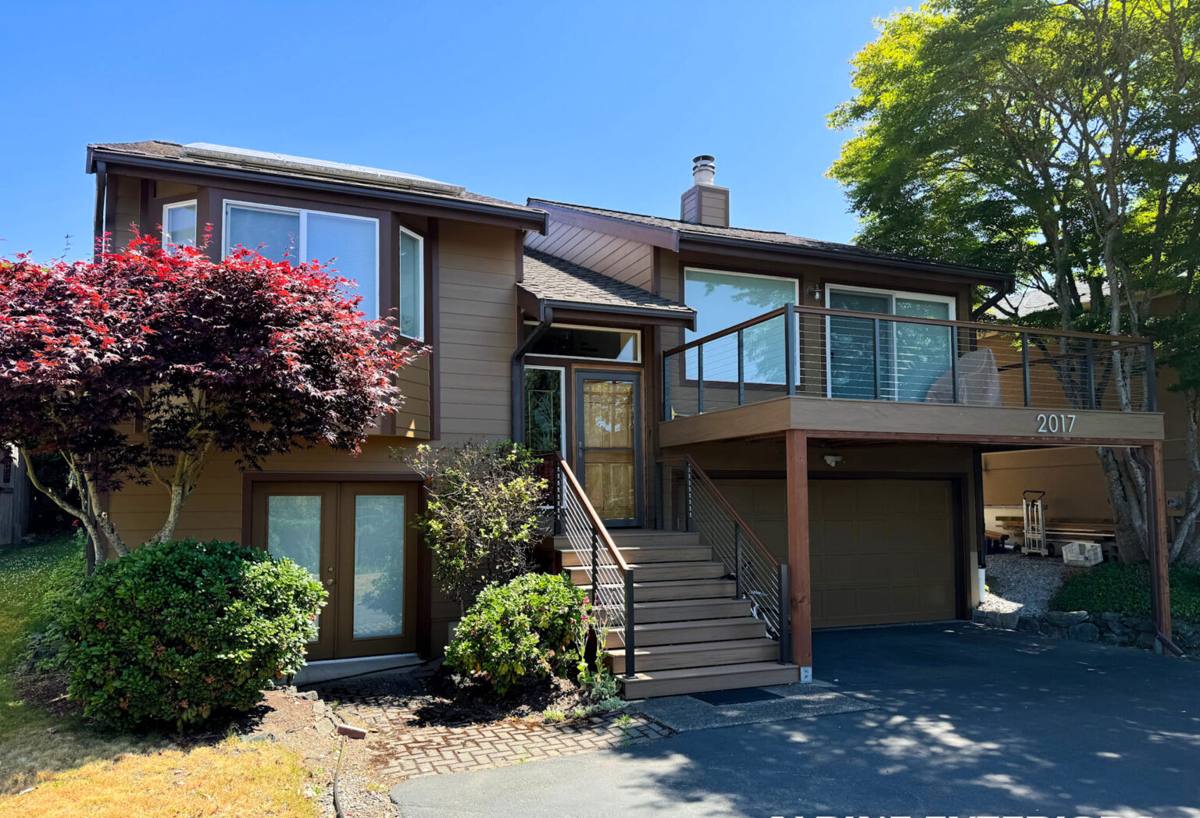
What We Mean by "Storm Damage" in Anacortes
Storm damage covers more ground than most homeowners expect. On Fidalgo Island, the most common categories we see are:
- Wind uplift — shingles or shakes lifted, cracked, or torn loose along ridges, hips, and eaves where wind pressure concentrates.
- Wind-driven rain intrusion — water pushed sideways and upward under shingle tabs, around flashing, and through vents during a strong blow off the water, even when the roof surface itself looks intact.
- Falling debris — limbs and branches from mature fir and cedar trees common on Fidalgo Island properties, which can puncture roofing or crack sheathing without an obvious hole from the ground.
- Flashing failure — chimney, skylight, and valley flashing that's been slowly weakened by salt air corrosion, then finally gives way during a storm.
- Gutter and edge damage — fascia, drip edge, and gutters torn or bent loose in high wind, which then lets water track back into the roof edge and fascia board.
Hail is uncommon in this part of Washington, so most of what we're called out for after a storm is wind and water related, not impact damage — which changes both how we inspect and how we repair.
Signs a Skagit County Homeowner Should Check For
Not every storm-damaged roof announces itself with an obvious leak. A lot of the damage we find on Anacortes homes has been sitting quietly for weeks before it shows up as a stain on a ceiling. After any significant wind or rain event, it's worth doing a visual check from the ground, or having us do a proper inspection if the roof is steep or hard to see.
- Shingles or shake pieces in the yard, gutters, or against fences after a windstorm
- Curled, lifted, or cracked shingle tabs visible from the ground or a second-story window
- Granules collecting in gutters or at downspout outlets (a sign of shingle wear accelerated by wind abrasion)
- Ceiling stains, especially near chimneys, skylights, or where two roof planes meet in a valley
- Visible daylight through the attic decking, or damp insulation on an attic check
- Bent, missing, or separated flashing around penetrations
- New or thicker moss growth concentrated on the north-facing or shaded slopes
- Sagging or soft spots underfoot in areas that shouldn't flex
If you see more than one or two of these after a storm, it's worth getting a look before the next round of weather moves through — Skagit County rarely gives a roof much recovery time between systems in the fall and winter.
Our Storm Damage Repair Process
We run the same process on every storm call, whether it's a single lifted shingle or a section that needs to come off and be rebuilt. The order matters — skipping steps is how a repair looks fine for a season and then fails.
- Stabilize. If there's an active leak or an open section, our first job is stopping water intrusion — tarping or temporary sealing so the interior and structure aren't taking on more damage while we plan the permanent fix.
- Inspect beyond the obvious damage. We check the full roof plane, not just the spot that's visibly torn up. Wind damage often has a pattern — if one section failed, nearby fasteners and seams are usually under the same stress and worth checking.
- Check the deck, not just the surface. Once shingles are pulled back from a damaged area, we look at the sheathing underneath for rot, soft spots, or water staining that predates the storm. Repairing over compromised decking just moves the problem down the road.
- Match materials correctly. We match shingle type, exposure, and color as closely as possible so a repair doesn't stand out as a patch, and so the repaired section weathers at a similar rate to the surrounding roof.
- Rebuild flashing and edges properly. Storm damage repair is one of the most common places we find shortcuts from prior work — flashing reused instead of replaced, or sealant used in place of proper step flashing. We don't patch over failed flashing; we rebuild it.
- Final check for wind and water path. Before we call a repair done, we trace how wind and rain would actually move across that section in a storm off the water, not just whether it looks sealed on a dry day.
Temporary Protection vs. the Permanent Fix
After a bad windstorm, especially one that hits Anacortes overnight, the priority is often getting a tarp or temporary seal on before the next system arrives — Skagit County storms frequently come in back-to-back clusters through late fall and winter. A tarp is a stopgap, not a repair. It buys time to do the permanent work correctly, including ordering matched materials if needed, rather than rushing a patch that has to be redone in a month.
Moss, Salt Air, and Why Repairs Fail Differently Here
A storm-damaged roof in a dry inland climate mostly just needs the physical damage fixed. On Fidalgo Island, we're also repairing into an environment that's actively working against the roof year-round. Two factors drive most of the long-term problems we see:
Moss Pressure
Anacortes gets enough shade, moisture, and mild temperatures to support moss growth for much of the year, especially on north-facing slopes and under tree cover. Moss holds moisture against the shingle surface, lifts tabs as it grows under the edges, and can hide the early stages of the exact kind of granule loss and cracking that makes a roof vulnerable to wind damage in the first place. Any storm repair we do includes a look at moss buildup nearby — repairing a wind-torn section next to a heavily mossed area without addressing the moss just sets up the new repair to fail the same way.
Salt Air Corrosion
Metal components — nails, flashing, vent boots, gutter fasteners — corrode faster this close to salt water than they would even a few miles inland. A flashing failure that triggers a storm leak is often the end point of years of slow corrosion, not something the storm itself caused outright. Where we can, we use corrosion-resistant fasteners and flashing material suited to a coastal environment rather than standard inland-grade hardware, because standard-grade components have a shorter honest lifespan out here.
Matching Repair Materials to a Coastal Skagit County Roof
When a repair calls for replacing more than a shingle or two, it's worth understanding how the common roofing materials in this area actually perform against wind, rain, and moss over time. We don't push one material over another — the right call depends on the home, the roof's exposure, and the homeowner's priorities.
| Material | Wind Performance | Moss Resistance | Salt Air Durability |
|---|---|---|---|
| Architectural composition shingle | Good, especially with proper nailing pattern and sealant strip activation | Moderate — benefits from zinc/copper strips or regular cleaning | Good when hardware is corrosion-resistant |
| Standard 3-tab shingle | Fair — more prone to tab lift in sustained wind | Moderate, same moss risks as architectural | Fair — thinner profile ages faster near salt air |
| Cedar shake | Good when properly fastened, but individual shakes can crack under debris impact | Lower — natural wood is more moss-prone without maintenance | Fair — needs more upkeep in coastal, damp conditions |
| Standing seam metal | Excellent — few seams for wind to catch | Excellent — moss struggles to establish on metal | Good with marine-grade coatings, but fastener quality matters most |
We're honest about trade-offs rather than steering every homeowner toward one product. Metal costs more up front but shrugs off both wind and moss better than any other option. Cedar shake fits certain home styles well but asks for more regular upkeep in a climate like this one. Composition shingle remains the most common and cost-effective repair-and-match option for homes that already have it installed.
What Drives the Cost of a Storm Repair
Every storm repair is different, so we don't quote a number without seeing the roof, but a few factors consistently move the price up or down.
| Factor | Why It Matters |
|---|---|
| Extent of the damaged area | A few shingles versus a full section changes both material and labor scope significantly. |
| Deck condition underneath | Rotted or soft sheathing found during the repair adds material and time to replace before roofing can go back on. |
| Roof pitch and access | Steeper roofs and limited access (tight lots, mature trees) take longer and require more safety setup. |
| Material matching | Matching an older or discontinued shingle color/style can add cost or require a slightly larger repair area for a clean blend. |
| Flashing and edge work | Full flashing replacement is more involved than a shingle-only repair, but it's often the difference between a repair that lasts and one that doesn't. |
| Insurance involvement | Documentation and adjuster coordination can add steps to the timeline, though not usually to the homeowner's out-of-pocket cost. |
Working With Your Insurance Claim
Most storm damage repairs in Skagit County involve an insurance claim, and the process goes smoother when the documentation is solid from the start. We photograph the damage before any temporary tarping covers it, note the likely cause consistent with the storm event, and provide a written scope that adjusters can work from. We're not a public adjuster and we don't negotiate your claim for you, but we'll give you an honest, detailed assessment of what's damaged and what it takes to repair it correctly — which is the foundation a fair claim is built on.
Why a Crew That Already Works Anacortes Matters
Storm damage repair rewards familiarity with the specific conditions of a place. A crew that regularly works Fidalgo Island roofs already knows which flashing details tend to fail first in salt air, which slopes on a typical Anacortes home hold moss longest, and how wind off the water tends to hit a roof compared to a more sheltered inland property. That's not something a crew coming from outside the area picks up on the first visit — and on a storm repair, the details you don't think to check are usually the ones that come back as a second leak.
Being local also matters for response time. After a significant windstorm, tarping and emergency stabilization on time-sensitive damage is far easier to coordinate with a crew that's already working in the area than one dispatching from out of county.
Get a Free, No-Pressure Estimate
If a recent storm has left you with lifted shingles, a new leak, or damage you're not sure how to assess, we're happy to take a look. The estimate is free, there's no pressure to move forward, and you'll get a straight answer about what's actually wrong and what it takes to fix it right — not just the fastest patch. Use the form below to get started.