 Skagit County
 Why Burlington Siding Takes a Beating
Burlington sits in a part of Skagit County where weather doesn't do anything halfway. You get driving rain off the Sound, damp air that never fully clears in winter, and long stretches of shade and moisture that turn north-facing walls and fence lines green with moss almost every year. None of that is unusual for this part of Washington — but it's exactly the combination that wears out siding faster than homeowners expect, especially siding that wasn't built for it in the first place.
We see the same failure patterns over and over on Burlington homes: swollen bottom edges where boards sit too close to grade, soft spots under gutters that overflow during a hard rain, cupped or delaminating panels on walls that get the most weather, and moss and algae staining that homeowners assume is just cosmetic but is often a sign that the surface is holding water longer than it should. Siding repair here isn't just patching a hole — it's addressing why that section failed and making sure the fix doesn't fail the same way again.
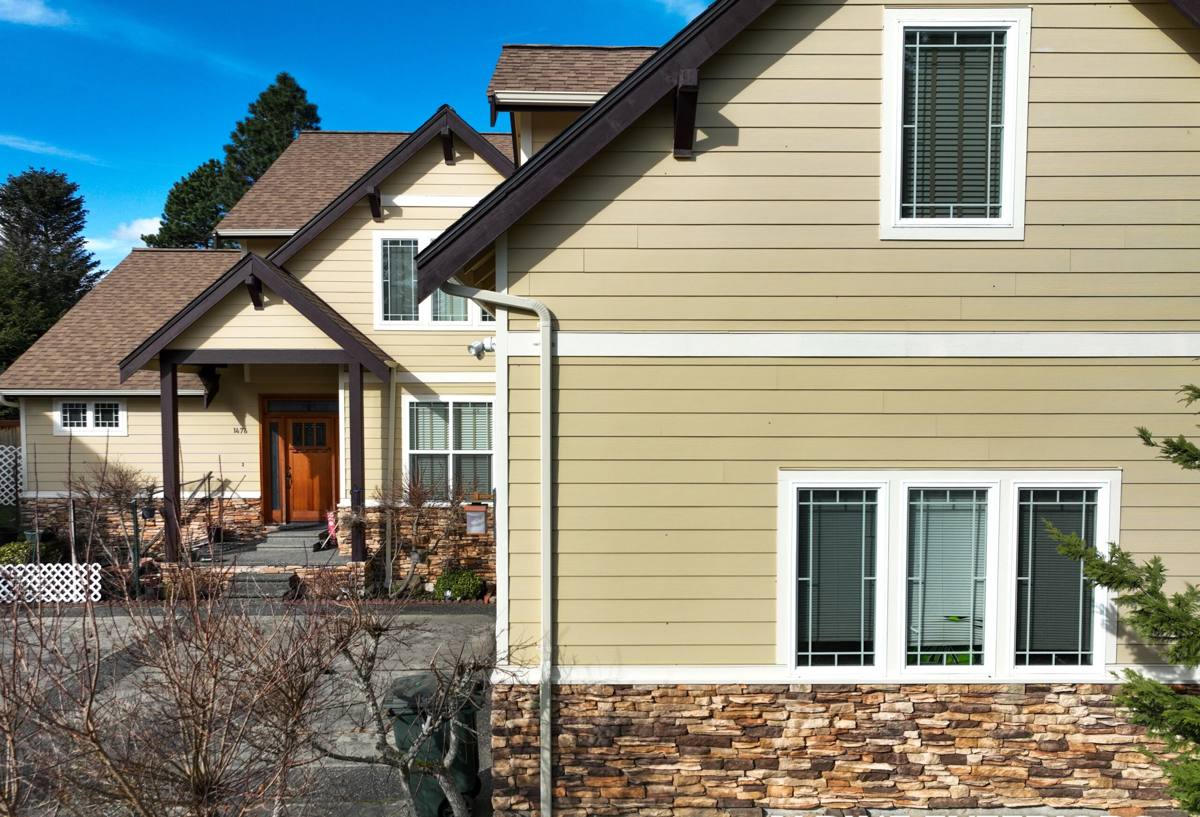
What "Correct" Siding Repair Actually Involves
A lot of siding repair in this region is done fast and cheap: cut out the bad section, nail in a patch, caulk the seams, call it done. That works for a season or two. Then the same spot fails again, because the underlying cause — usually moisture getting behind the siding, not just sitting on top of it — was never dealt with.
Our repair process starts with diagnosis, not patching
- Identify whether the damage is surface-level (paint failure, moss, minor cracking) or structural (rot, delamination, water intrusion behind the cladding)
- Check the water-resistive barrier and flashing at the damaged area — most repeat failures trace back to a flashing detail, not the siding material itself
- Inspect the sheathing and framing behind severely damaged sections before covering anything back up
- Match repair materials and fasteners to the existing siding system so the patch performs the same as the surrounding wall, not worse
- Re-seal and re-paint or re-finish to blend with the existing exterior, not just slap on a mismatched patch
If we open a wall and find rot has spread further than the visible damage, we'll tell you honestly rather than patch over a problem that's going to resurface. Sometimes that means a larger repair than originally expected; sometimes it means the smart move is replacing a full wall section instead of chasing rot board by board.
Common Repair Scenarios We See in Burlington
| Issue | Likely Cause | What We Check |
|---|---|---|
| Soft or swollen bottom edge of siding | Siding too close to grade or hardscape, wicking moisture | Clearance from grade, drainage plane, bottom flashing |
| Staining or rot below windows | Failed or missing window flashing | Flashing integrity, caulk joints, sill pan |
| Cupping, cracking, or delamination on wall panels | Moisture cycling through a material not engineered for constant damp/dry swings | Panel material, paint/finish condition, ventilation behind cladding |
| Persistent moss or algae growth | Shade, low airflow, and a surface that holds moisture | Surface porosity, gutter overflow points, nearby vegetation |
| Nail pops or fastener staining | Wrong fastener type or spacing for the material and exposure | Fastener corrosion resistance, spacing against manufacturer spec |
Why We Only Repair (and Recommend) James Hardie Fiber Cement
We don't install vinyl, LP SmartSide, primed spruce, cedar, or off-brand fiber cement products like Cemplank or Allura. That's a deliberate standard, not a sales pitch, and it matters most when we're talking about repair rather than new installation.
Here's why it matters: repairing damaged siding is only as good as the material you're repairing it with. Wood-based products like LP SmartSide and cedar are engineered wood or solid timber — even with treated strand board or good milling, they're still organic material that swells, checks, and eventually rots when it stays wet for extended periods, which is exactly the climate pattern Burlington gets every winter. Vinyl doesn't rot, but it warps and becomes brittle with age and UV exposure, and it can't be color-matched or repaired invisibly the way a factory-finished product can. Off-brand fiber cement products vary a lot in formulation and factory finish quality, and inconsistent quality makes long-term performance a gamble.
James Hardie fiber cement is non-combustible, engineered specifically for wet regional climates through its HZ5 product line (built for the Pacific Northwest's freeze-thaw and moisture cycles), and finished at the factory with ColorPlus technology — a baked-on finish that resists fading and chipping far better than field-applied paint. When we repair a Hardie wall, we're working with a material that was designed to shed water and hold up to constant damp exposure in the first place, and the color match on a ColorPlus repair is dramatically better than trying to match field-mixed paint on wood or vinyl.
What this means for your repair specifically
- If your home already has James Hardie siding, we can typically source matching ColorPlus boards for a near-invisible repair
- If your home has a different siding material and is due for repair in multiple spots, we'll walk you through what a partial Hardie replacement on the worst-affected walls looks like versus a full re-side
- We won't repair a failing wood or vinyl section with more of the same material if it's clear the material itself is the reason it's failing again
How Our Process Works, Start to Finish
- Free on-site inspection. We look at the damaged area and the surrounding wall, not just the obvious spot, and check flashing, grade clearance, and moisture readings where relevant.
- Honest scope and estimate. You'll get a clear breakdown of what's cosmetic, what's structural, and what your real options are — patch, panel replacement, or larger section replacement.
- Material match or upgrade discussion. If you have Hardie siding, we match it. If you don't, we'll explain what repairing with Hardie in that section would involve, with no pressure either way.
- The repair itself. Removal of damaged material, correction of any underlying flashing or moisture issue, installation of new material to manufacturer spec, and finish work to blend with the surrounding siding.
- Final walkthrough. We show you what was found, what was fixed, and what (if anything) to keep an eye on going forward.
Why Local Experience in Skagit County Matters
Siding repair isn't the same job in Burlington as it is in a drier inland climate. A crew that mostly works dry-climate repairs will patch a moss-stained wall and call it cosmetic; a crew that works Skagit County every week knows that moss and algae growth is often the first visible sign of a moisture problem that's been building behind the surface for a while. Local experience also means knowing which details tend to fail first on homes built in this area — grade clearance, gutter placement, and flashing around windows and doors — because we've opened up enough walls in this county to see the pattern repeat.
We're not guessing at how Skagit County's climate affects siding. Salt air, driving rain, and a moss season that can stretch several months a year are the baseline conditions we plan every repair around, not an exception we occasionally run into.
What a Repair Typically Costs to Plan For
Every repair is different, but the honest range depends on scope, not just square footage. A small, caught-early spot repair with no underlying moisture damage is a modest job. A repair that involves opening the wall, addressing rot in the sheathing, and correcting a flashing detail costs more because it's fixing the actual cause, not just the symptom. We'll never quote a number without seeing the damage first — anyone who does is guessing, and repair estimates that skip the inspection step are a red flag when you're vetting a contractor.
Questions worth asking any siding repair contractor before you hire
- Will you check for flashing or drainage issues, or just patch what's visible?
- What happens if you open the wall and find more damage than expected?
- Can you match the existing siding material and finish, or will the patch be visibly different?
- Do you carry manufacturer certification for the material you're repairing with?
- What's your warranty on the repair itself, separate from the material warranty?
Signs You Shouldn't Wait On
Some siding issues can wait for a convenient time. Others get worse every wet season they're ignored. Soft or spongy siding, visible gaps or separation at seams, dark staining that spreads rather than stays put, and any siding near a window or door that feels damp to the touch are worth having looked at before the next round of fall or winter rain rather than after.
If you're noticing any of these signs on your Burlington home, we'll come take a look and give you a straight answer about what's going on — no pressure, no upsell, just a clear read on what the siding actually needs. Reach out for a free, no-obligation estimate using the form below.