 Skagit County
 Siding Repair in Clear Lake: What Makes This Job Different
Clear Lake sits inland from Sedro-Woolley, but it still gets Skagit County's full mix of weather: heavy fall and winter rain funneling down from the foothills, damp marine air moving up the valley from the Salish Sea, and long stretches of gray, low-sun months that let moss and algae take hold on anything shaded. Homes here are often set back among mature trees, which is part of what makes the area appealing to live in — and part of what makes siding repair more complicated than a quick patch job. A repair that ignores the local moisture pattern usually fails again within a year or two, in the same spot, for the same reason.
This page is about one job — siding repair — for one place: Clear Lake homes. Not a full re-side, not a generic overview of siding in general. If a section of your wall is soft, stained, cracked, or pulling away from the house, here's what we look at, what a correct repair involves, and how we approach the work when we're out at a Clear Lake property.
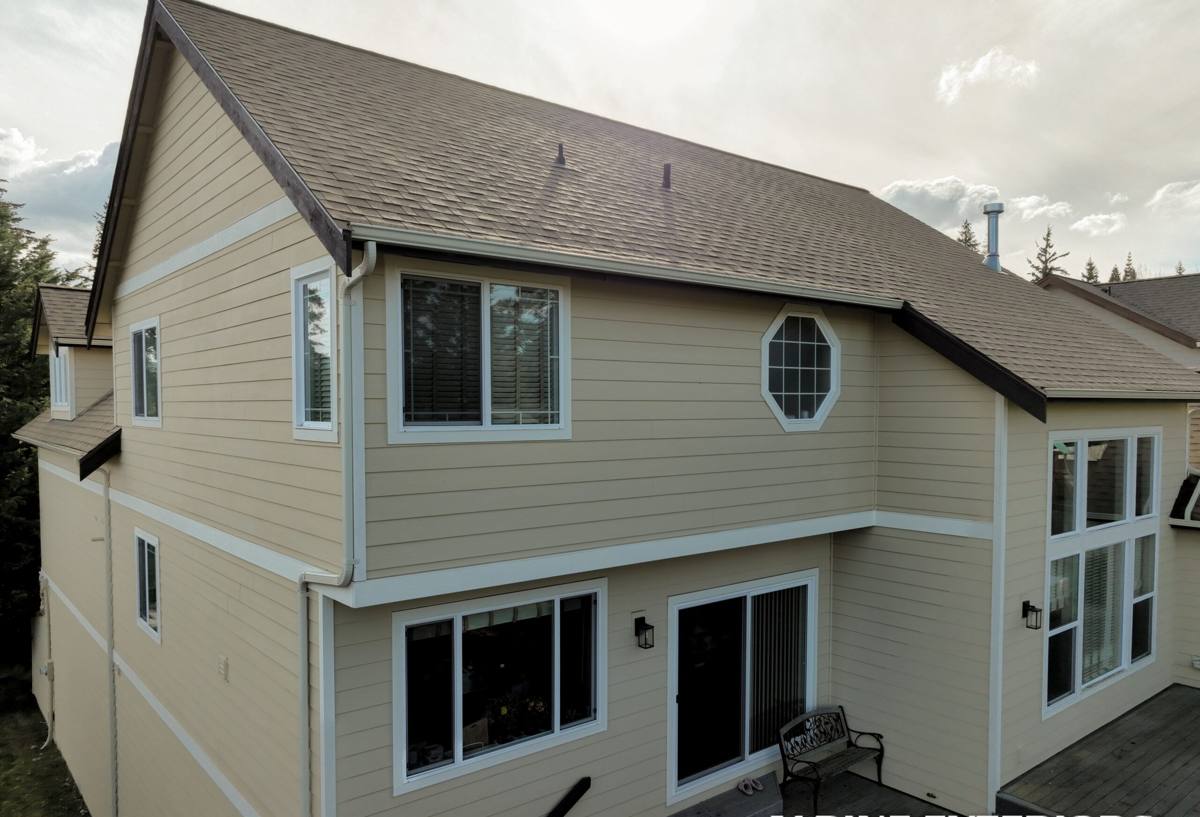
What Skagit County's Climate Does to Siding Here
Shade, Moss, and Standing Moisture
Wooded and semi-wooded lots around Clear Lake hold moisture longer than open, sun-exposed sites. North-facing walls and sections shaded by trees or fences can stay damp for days after a storm passes. That extended dampness is exactly what moss, algae, and mildew need to establish themselves on siding, trim, and the caulked joints between them. Left alone, moss doesn't just look bad — it holds water against the surface, and on materials that aren't built to handle constant moisture, that water eventually finds a way behind the siding.
Driving Rain and Wind-Driven Water
Skagit County storms often come with real wind behind the rain, which pushes water sideways into laps, seams, and anywhere the siding meets a window, door, or trim board. Siding that's lapped correctly and flashed correctly sheds that water. Siding that's been repaired with the wrong technique — caulk smeared over a gap instead of proper flashing — tends to trap water instead of shedding it, which turns a small cosmetic issue into hidden rot.
Salt Air and Fastener Corrosion
Skagit County's proximity to the Salish Sea means salt-laden air reaches further inland than people expect, especially during windier stretches of the year. Over time, that air accelerates corrosion on exposed nail heads, staples, and lower-grade trim fasteners. A repair that reuses corroded fasteners, or doesn't account for this at all, is a repair that's already on a shorter clock than it should be.
Signs Your Siding Needs Repair
Not every issue means a full re-side. Here's what typically points to a repair rather than a replacement, and what tends to mean the damage has spread further than it looks:
- Soft or spongy spots when you press on the siding, especially near the bottom courses or below windows
- Visible cracking, chipping, or delamination in one section while the rest of the wall looks sound
- Persistent moss or dark staining that keeps coming back in the same spot after cleaning
- Gaps opening up at seams, corners, or around trim where caulk has failed
- Nail heads popping or streaking rust down the face of the siding
- Visible daylight or drafts near penetrations like hose bibs, vents, or light fixtures
- Interior signs — a musty smell, peeling paint, or a soft spot on drywall — near a wall that's had visible exterior siding damage
A single cracked panel from an impact is usually a straightforward, isolated repair. Widespread soft spots, especially on more than one wall or elevation, usually mean moisture has been getting in for a while, and the repair needs to start with finding out how far it's traveled.
What a Correct Repair Actually Involves
Diagnosing the Cause, Not Just Patching the Symptom
The most common mistake in siding repair isn't bad workmanship on the visible patch — it's stopping at the visible patch. If a section of siding failed because water was getting behind it, replacing the damaged board without fixing the water path just buys a year or two before the same spot fails again. A correct repair starts by pulling back enough surrounding material to see what's underneath: the house wrap, the flashing, the framing, and how water was actually moving before it caused the damage you can see.
Matching Material and Finish
Repairs stand out when the replacement piece doesn't match the surrounding siding in profile, texture, or color. On factory-finished fiber cement, this means using matching product lines and, where color match matters, working with the manufacturer's finish system rather than field-painting a patch a shade off from sun-faded original siding around it.
Flashing and Water Management First
Any repair around a window, door, corner, or penetration needs correct flashing and drainage behind the new material — not just sealant over the gap. Caulk is a maintenance item, not a waterproofing system on its own. A repair that relies on caulk alone to keep water out is a repair that will need to be redone.
Repair or Replace? How We Make the Call
Homeowners understandably want to know whether a repair is really the right call, or whether it's just delaying a bigger job. We look at scope, cause, and how much of the wall assembly is affected:
| Situation | Usually a Repair | Usually Points to Replacement |
|---|---|---|
| Damage extent | Isolated to one board, panel, or corner | Recurring or spread across multiple walls |
| Cause | Impact damage, one failed seal, isolated flashing gap | Widespread moisture intrusion, systemic installation errors |
| Underlying sheathing | Sound once opened up | Soft, delaminated, or rotted framing or sheathing found |
| Age and material | Newer siding, matching material still available | Original material discontinued, brittle, or failing generally |
| Cost relative to whole wall | Repair cost is a small fraction of a full re-side | Repair cost approaches what a full re-side would run |
We'll always tell you plainly which side of that line your house falls on, and why — including when the honest answer is that a repair is all you need right now.
Why We Only Repair and Install James Hardie Fiber Cement
We standardized on James Hardie fiber cement siding for every job we do, repairs included, and we don't install or patch with vinyl, LP SmartSide, primed spruce, cedar, or comparable fiber cement alternatives. That's a decision built around the climate this siding has to survive here, not a sales preference. Hardie's HZ product lines are engineered for moisture and freeze-thaw cycling, the material is non-combustible, and the factory-applied ColorPlus finish holds color and resists the kind of fading and chalking that leaves a field-painted repair looking mismatched a year later. It also carries a strong transferable warranty when installed to spec — something that matters on a repair as much as a full install, because a repair done wrong can void coverage on the surrounding siding too.
We won't do a repair with a mismatched or lesser material just because it's what's already on the wall. If your home has a different siding product and needs a repair, we'll tell you honestly what your options are, including when a Hardie-based repair or partial re-side makes more sense than patching in a product we don't stand behind.
Our Process for Clear Lake Repair Calls
- On-site inspection. We look at the damaged area and open it up enough to see the cause, not just the surface.
- Honest scope and estimate. You get a plain explanation of what's actually wrong, what it will take to fix it correctly, and a written estimate — no pressure toward a bigger job than you need.
- Correct the water path first. Flashing, house wrap, and any damaged sheathing get addressed before new siding goes back on.
- Repair with matched material. We use Hardie product and, where possible, matching profiles and factory finish so the repair blends in rather than standing out.
- Final check. We walk the repair with you before we call the job done.
Why Hiring a Crew That Already Works Clear Lake Matters
A repair crew that regularly works Skagit County properties has already seen how moss establishes on shaded, tree-lined lots like the ones common around Clear Lake, how far wind-driven rain travels up a wall during a real fall storm, and where salt-influenced air tends to accelerate fastener corrosion on this side of the county. That local pattern recognition shortens the diagnostic part of the job — we're not guessing at causes we've never encountered before, we're checking the spots that consistently cause trouble on homes near yours. It also means we're realistic about scheduling: repair work outdoors here is weather-dependent, and a crew that knows the local rain and moss patterns plans around them instead of getting caught mid-repair with an open wall.
What Affects the Cost of a Siding Repair
| Factor | Why It Matters |
|---|---|
| Size and location of damage | A single ground-level panel is far simpler than a second-story section requiring staging |
| Underlying damage found | Rotted sheathing or framing behind the siding adds carpentry work beyond the siding itself |
| Material matching | Matching an existing profile and color may involve special ordering versus using stock material |
| Flashing and trim work involved | Repairs around windows, corners, or penetrations take more time than a flat wall section |
| Access | Steep sites, dense landscaping, or tall walls affect equipment and labor time |
We give a written estimate after seeing the damage in person — we don't quote repairs sight unseen, because the real cost driver is almost always what's found once the damaged section is opened up, not the size of the visible crack or stain.
Get a Straight Answer on Your Clear Lake Siding Repair
If you've got a section of siding that's cracked, soft, stained, or just not sitting right anymore, we're happy to come take a look. We'll tell you plainly whether it's a repair or something bigger, walk you through what caused it, and give you a written, no-pressure estimate below.