 Skagit County
 Why Siding Replacement in Concrete Isn't a One-Size-Fits-All Job
Concrete sits along the Skagit River in the foothills of the North Cascades, and that location shapes everything about how siding ages here. Homes in this stretch of Skagit County deal with more annual rainfall than the lowlands closer to the coast, dense tree cover that keeps siding shaded and damp longer after a storm, and a river valley that traps humidity well into the afternoon on many days. Add in wider temperature swings between summer heat and winter cold at this elevation, and you have a climate that is genuinely harder on exterior materials than a generic "Pacific Northwest" description suggests.
That's the backdrop for any siding replacement decision here. A product or installation approach that holds up fine in a drier, more open part of the county can fail years early on a shaded, damp lot outside Concrete. This page walks through what local homes actually need, what a correct replacement job looks like, and how our process is built around those conditions.
What Concrete's Climate Does to Siding Over Time
Driving rain and long stretches of wet weather are the baseline for western Washington, but a few local factors make Concrete's exposure a bit different from siding on the open coast or in town centers with more sun and airflow:
- Extended moss and mildew season — heavy tree canopy and river-valley humidity keep north-facing and shaded walls damp for days after rain stops, which is exactly the environment moss, algae, and mildew need to take hold.
- Slower drying cycles — less direct sun on wooded lots means siding stays wet longer, which matters a lot for any material that can absorb moisture or swell.
- Wider seasonal temperature swings — foothill locations see colder winter nights and hotter summer days than lowland Skagit County, which stresses siding through repeated expansion and contraction.
- Wind-driven rain against unprotected walls — storms funneling through the river valley can drive water sideways into seams, laps, and trim joints that aren't detailed correctly.
None of this means siding is doomed here — it means the material and the installation both have to be matched to the conditions, not just to the building code minimum.
Signs Your Siding Is Due for Replacement
Most siding failures don't show up as one dramatic problem — they show up as a pattern of small issues that add up. Before assuming a repair will do the trick, walk your home's exterior and check for these:
- Soft, spongy, or crumbling spots when you press on the siding, especially near the bottom courses and around window trim
- Paint that's peeling, bubbling, or needing repainting far more often than it used to
- Persistent moss or dark streaking that comes back within weeks of cleaning, particularly on shaded or north-facing walls
- Visible warping, cupping, or gaps opening up between boards or panels
- Rising energy bills with no other explanation, which can point to moisture-compromised insulation behind the siding
- Musty smells or visible staining on interior walls that share an exterior wall line
- Siding that's simply reached the end of its expected service life, even if it "looks okay" from the street
Any one of these on its own might be a minor fix. Several together, especially on a home that's ten or more years old, usually means the siding system as a whole is failing rather than one board being unlucky.
What a Correct Siding Replacement Actually Involves
Tear-Off and Inspection
Replacement starts with full removal of the old siding, not covering it up. That's the only way to actually see the sheathing, framing, and existing moisture barrier underneath. In a climate like Concrete's, it's common to find some degree of hidden water damage behind old siding — especially around window and door openings, at wall penetrations, and near the ground line — even when the exterior looked fine. Any rotted sheathing or framing needs to be repaired before a single new panel goes up, because new siding installed over a compromised wall just hides the same problem again.
Water Management Comes Before Aesthetics
The single biggest factor in how long a siding job lasts in this climate isn't the siding itself — it's the water management behind and around it. That means a correctly installed weather-resistive barrier, properly lapped and taped seams, flashing at every window, door, and roofline intersection, and clearance where siding meets decks, patios, and grade so water has somewhere to go instead of wicking upward. Skipping or rushing this stage is the most common reason siding fails early, regardless of brand.
Installation to Manufacturer Spec
Fastener type and spacing, joint treatment, caulking at the right joints (and not at the wrong ones), and correct clearances all affect how a siding system performs over ten, twenty, and thirty years. This is where a lot of installation-sensitive products run into trouble — the material can be sound, but if it's hung a half-inch too tight to the ground or fastened incorrectly, the warranty and the performance both suffer. Following the manufacturer's actual installation manual, not a shortcut version, is non-negotiable on every job we do.
Material Choice Matters More Here Than You'd Think
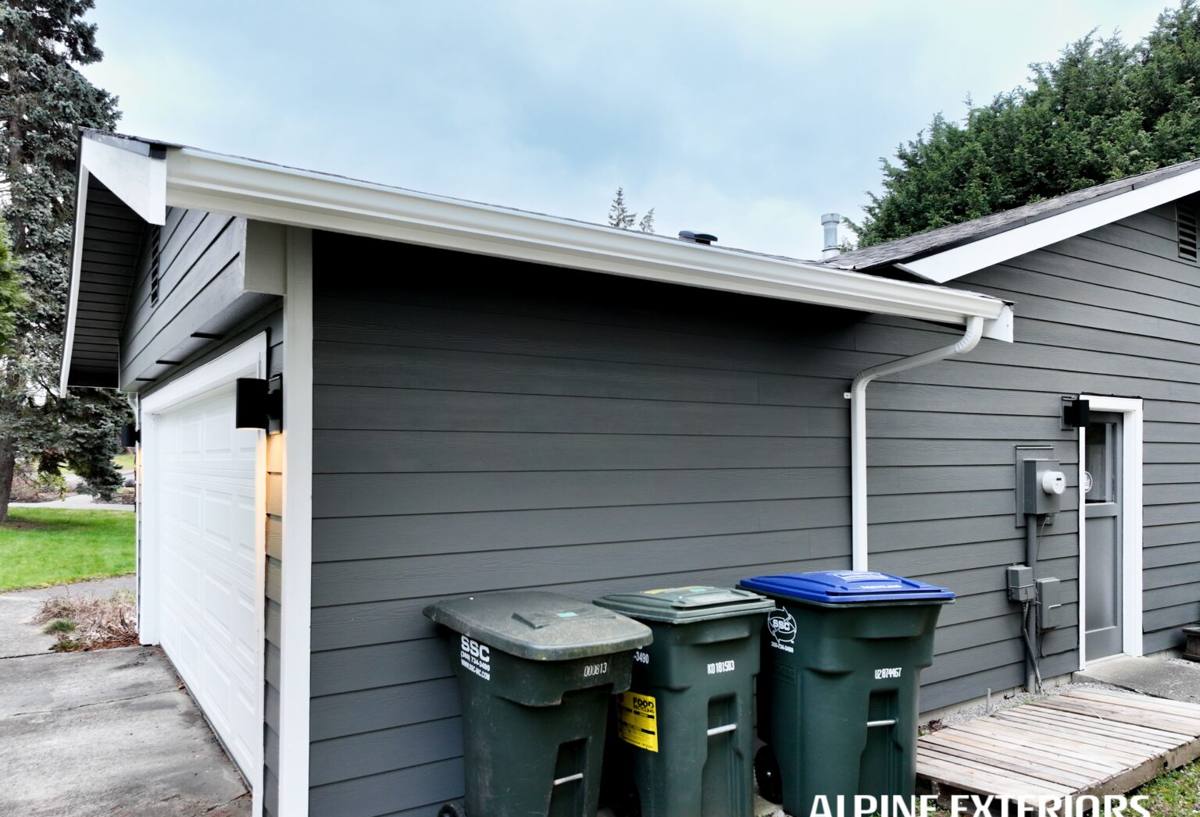
We install James Hardie fiber cement siding exclusively. We don't offer vinyl, LP SmartSide, or other engineered wood or fiber cement alternatives, and we think homeowners deserve an honest reason why, not just a sales pitch. Here's how the common options compare on the factors that actually matter in a wet, shaded, foothill climate like Concrete's:
| Factor | Vinyl | Engineered Wood (e.g. LP SmartSide) | James Hardie Fiber Cement |
|---|---|---|---|
| Moisture behavior | Doesn't absorb water, but can warp or buckle with heat and trap moisture behind it | Wood-based core is vulnerable to swelling and rot if the factory seal is breached | Non-combustible cement composite; doesn't rot or swell from moisture exposure |
| Moss and mildew resistance | Surface can host algae/moss film in shaded, damp spots | Similar surface growth risk, plus core damage if moisture gets in | Factory-baked finish resists moss and mildew better and cleans up more easily |
| Performance in temperature swings | Expands/contracts noticeably; can crack in cold | More stable than vinyl but seams are a weak point | Dimensionally stable across our seasonal temperature range |
| Finish longevity | Color is baked into a thin material; fades over time | Painted finish needs ongoing maintenance | ColorPlus factory finish is engineered to resist fading and chipping |
| Warranty structure | Varies widely by manufacturer and product tier | Manufacturer warranty, often shorter than Hardie's | Strong, transferable manufacturer warranty when installed to spec |
Vinyl and engineered wood aren't bad products in every situation — they have real strengths, including up-front cost. But given what we see happen to siding in shaded, damp, temperature-swinging conditions like Concrete's, we standardized on Hardie because it holds up to exactly those stresses with less long-term maintenance and a warranty that backs it up.
Our Siding Replacement Process
- On-site assessment — we walk the exterior with you, check for the warning signs above, and look at drainage, grade, and shading that affect how the new siding will perform.
- Scope and product selection — we recommend the right Hardie product line and profile for your home's exposure and style, and give you a clear, itemized estimate.
- Full tear-off — old siding comes off completely so we can inspect and repair the wall assembly underneath, not just the surface.
- Sheathing and framing repair — any rot or damage found during tear-off gets addressed before moving forward.
- Weather barrier and flashing installation — this is the step that determines whether the job lasts; we install it to spec, not to the minimum.
- Hardie siding installation — installed per manufacturer instructions for fastening, spacing, and joint treatment.
- Trim, caulking, and final detailing — the finish work that protects seams and gives the job a clean, factory-quality look.
- Final walkthrough — we go over the finished work with you before calling the job done.
What Siding Replacement Costs in Concrete
Every home is different, but the same factors tend to drive cost up or down across jobs in this area:
| Cost Factor | Why It Matters |
|---|---|
| Home size and wall complexity | More square footage, gables, and corners mean more material and labor |
| Existing wall condition | Rotted sheathing or framing found during tear-off adds repair cost, but skipping it costs far more later |
| Siding profile and trim detail | Lap width, shingle-style accents, and trim complexity affect both material and labor time |
| Site access | Wooded lots, steep driveways, and limited staging space around Concrete can affect crew logistics and time on site |
| Tear-off and disposal volume | Full removal of old siding, especially multiple layers, adds to labor and disposal costs |
We don't publish blanket per-square-foot pricing because it genuinely varies by these factors — but we'll give you a clear, itemized number after seeing your home in person, with no pressure to sign on the spot.
Why Hiring a Crew That Already Works in Concrete Matters
Siding installers who mostly work in drier, more open parts of the county sometimes underestimate what a shaded, river-valley property needs — extra attention to drainage at grade, more conservative clearances where siding meets decks and landscaping, and a real plan for how tree cover will keep certain walls damp longer after every storm. A crew that regularly works in and around Concrete already accounts for those realities in how they scope and install a job, rather than treating every property the same as one in full sun on flat, open ground.
Local familiarity also matters for the practical side of a project: knowing what site access typically looks like on wooded or sloped lots in this area, planning around the region's wetter stretches of the year, and being realistic with homeowners about timelines when weather is a factor. None of that shows up on a spec sheet, but it shows up in how smoothly the job goes and how the siding performs five and ten years down the road.
Ready to Talk Through Your Siding?
If your home's siding is showing wear, or you just want a straight answer about whether repair or replacement makes more sense, we're happy to take a look. Fill out the form below for a free, no-pressure estimate — we'll walk your property, answer your questions honestly, and give you a clear picture of what your home actually needs.