 Skagit County
 Windows Built for Cedardale's Weather, Not Just Its Openings
Cedardale sits in that stretch of Skagit County where the weather doesn't pick a lane — you get wind off the water, long stretches of driving rain, and enough shade and moisture from November through April to keep moss and algae growing on anything that holds dampness. Windows here take a beating that a lot of manufacturers' standard testing never accounts for. Salt-tinged air corrodes hardware and finishes faster than it does thirty miles inland. Driving rain finds gaps in flashing and trim that would never leak in a dry climate. And a long moss season means anything with a horizontal ledge — a sill, a mulled joint, a poorly sloped sub-sill — becomes a place for organic growth to take hold and hold water against wood and frame.
A "custom windows" job in Cedardale isn't really about fancy shapes or specialty glass, though that's part of it. It's about getting a window that's sized, flashed, and sealed correctly for a house that's probably not perfectly square, in a climate that punishes shortcuts. That's the job we're actually being hired to do.
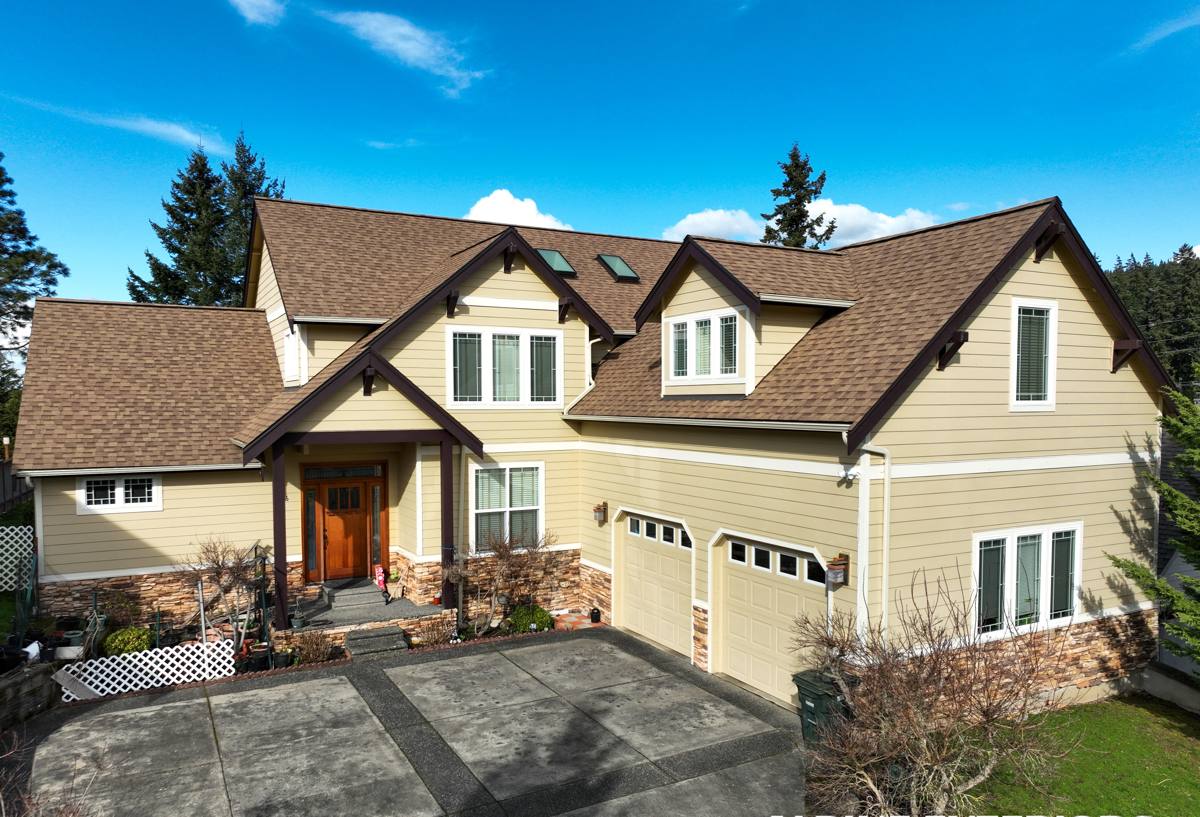
What "Custom" Actually Means on a Job Like This
Most of the window work we do in and around Cedardale isn't new construction — it's replacement and remodel work on homes that were built decades ago, sometimes with additions or updates tacked on over the years. That means:
- Rough openings that are out of square, out of level, or slightly different sizes from one window to the next even when they look matched from the outside
- Older wood-framed openings with hidden rot behind the trim that only shows up once the old unit comes out
- Non-standard sizes — tall narrow openings, oddly proportioned bays, or openings built around a stock window size that hasn't been manufactured in years
- Additions where the window has to match sightlines and trim details from the original part of the house
Off-the-shelf stock sizing works fine for a lot of new builds. For the older and modified housing stock common in this part of Skagit County, custom-sized units — built to the actual opening instead of the opening being reshaped to fit a stock size — are usually what keeps the job looking right and performing right long-term.
Custom Doesn't Mean More Exotic — It Means More Precise
We're not pushing unusual shapes or novelty glass. The goal is a window that fits the opening it's actually going into, flashes correctly the first time, and doesn't require field modifications that compromise the factory seal or warranty.
Frame Material: The Trade-Offs That Matter Here
Every frame material has a maintenance profile, and in a salt-air, high-moisture climate that profile matters more than it does somewhere dry. We'll walk through the honest trade-offs rather than push one option as universally "best."
| Frame Material | How It Handles This Climate | Maintenance Burden |
|---|---|---|
| Vinyl | Good moisture resistance, won't rot; can be more prone to expansion/contraction with temperature swings | Low — occasional cleaning to keep moss/algae from sitting on sills and tracks |
| Fiberglass | Very stable dimensionally, holds paint and finish well, handles moisture and salt air with minimal degradation | Low to moderate — durable finish but a higher upfront cost |
| Wood (unclad) | Best appearance for older/historic homes but most vulnerable to moisture intrusion and moss-related surface breakdown if not maintained | High — needs regular painting/sealing, especially on north- and west-facing walls |
| Wood-clad (aluminum or vinyl exterior) | Combines interior wood look with a weather-resistant exterior shell; cladding must be installed and flashed correctly or moisture gets trapped behind it | Moderate — exterior needs little upkeep, but installation quality is critical |
We steer people away from unclad exterior wood on any wall that takes direct weather in this area — not because the material is bad, but because it demands a maintenance schedule most homeowners realistically won't keep up with in a climate this wet. That's a maintenance-burden call, not a knock on the product.
The Part That Actually Determines Whether a Window Leaks: Flashing and Sealing
The window unit itself is usually not what fails first. What fails is the installation detailing around it — and in a driving-rain climate, that detailing has to be right, not just "close enough."
What a Correct Install Involves
- Inspecting and repairing the rough opening — including any hidden rot — before the new unit ever goes in
- Installing a proper sloped sill pan so any water that gets past the window sheds outward instead of sitting against the frame
- Flashing tape and house wrap integration done in the correct shingle-lap order (top piece over the one below it) so water is directed out, not funneled in
- Backer rod and quality exterior sealant at the trim joint, sized and tooled correctly instead of just caulked over a gap
- Insulating the gap between the frame and rough opening properly — too little leaves cold spots and condensation risk, too much (packed too tight) can bow the frame
Skip any one of these steps and the window can look fine for a year or two before a leak shows up inside a wall cavity where it's expensive to find and fix. That's the real cost of a rushed install — it just shows up later.
Signs Your Current Windows Are Losing the Fight
Homeowners often call us after noticing one of these — worth checking your own windows for the same signs before they get worse:
- Fogging or moisture between the panes (a failed seal on a double- or triple-pane unit)
- Soft or discolored trim/sill wood, especially on walls that face prevailing wind and rain
- Moss or dark streaking building up on sills or in corners that never fully dry out
- Drafts or noticeable temperature difference near the window on windy days
- Difficulty opening/closing, or hardware that's stiff, corroded, or pitted
- Visible gaps or cracking in the exterior caulk/sealant line around the trim
How We Handle a Custom Windows Job in Cedardale
1. On-Site Assessment
We look at the actual openings, not just a photo or a phone description. That means checking for square, level, hidden moisture damage, and how each wall takes weather — a south-facing wall and a wind-exposed west wall often need different attention even on the same house.
2. Measuring and Ordering
Openings get measured individually rather than assumed to match. Custom units are ordered to the real dimensions, with the frame material and glass package matched to that specific wall's exposure.
3. Removal and Opening Prep
Old units come out carefully, and any rot or damage found behind the old trim gets repaired before anything new goes in. We don't install a new window over a compromised opening — it just relocates the problem.
4. Installation with Full Weatherproofing Detail
Sill pan, flashing sequence, insulation, and sealant — done in that order, every time, regardless of whether it's one window or a whole-house replacement.
5. Trim, Cleanup, and Walkthrough
Interior and exterior trim finished to match the surrounding house, job site cleaned up, and a walkthrough so you know how the new windows operate and what (if any) maintenance they need.
Why Local Experience in This Area Actually Matters
A crew that regularly works Cedardale and the surrounding Skagit County area has already seen how houses of a certain age and construction type in this region tend to be built, what typically hides behind the trim, and which walls on a given lot orientation take the worst of the weather. That's not something you can fully substitute with a generic install checklist. It also means we're not guessing at permitting requirements or inspection expectations for the county — we've been through that process before, on homes like yours, in this same weather.
What Drives the Cost
| Factor | Why It Matters |
|---|---|
| Number and size of openings | More or larger windows means more material and labor, but per-unit pricing often improves with volume |
| Frame material chosen | Vinyl, fiberglass, and clad-wood carry different material costs and long-term maintenance savings |
| Condition of existing openings | Hidden rot or out-of-square framing adds repair time before the new window can even go in |
| Glass package | Double vs. triple pane, low-E coatings, and impact considerations for exposed walls all affect price |
| Trim and finish matching | Matching existing exterior trim profiles or interior casing adds labor beyond a basic swap |
We give straightforward, itemized pricing so you can see exactly what's driving the number — no vague lump-sum estimates.
Living With Custom Windows in a Salt-Air, High-Moss Climate
Once new windows are in, a little seasonal attention goes a long way in this environment:
- Rinse sills and tracks periodically to clear salt residue and organic buildup before moss gets a foothold
- Keep gutters and nearby drainage clear so runoff isn't sheeting directly across window walls
- Check exterior caulk lines once a year, typically before the wet season sets in
- Operate hardware occasionally through the winter so mechanisms don't seize from disuse and moisture
None of this is heavy maintenance — it's the kind of upkeep that keeps a properly installed window performing for its full service life instead of fighting the climate from day one.
If you're dealing with drafty, foggy, or aging windows anywhere in Cedardale, we're happy to take a look and talk through honest options — no pressure, no obligation. Use the form below to request a free estimate.