 Skagit County
 Why Clear Lake Siding Has to Work Harder
Clear Lake sits back in the timber off the Skagit Valley floor, and that setting cuts both ways. The tree cover and lake proximity that make the area appealing are the same conditions that put extra stress on exterior siding. Homes here deal with driving rain that comes in sideways during fall and winter storms, salt-tinged marine air pushing inland from Puget Sound, and long stretches of shade that keep siding damp far longer than it would stay damp on a home out in open farmland closer to Mount Vernon or Burlington. That combination is exactly what drives moss growth, and moss is not just a cosmetic problem — it holds moisture against a wall system for weeks at a time.
Skagit County winters rarely get cold enough to freeze hard, which sounds like an advantage, but it means moss spores never really get knocked back. On a shaded, north-facing wall near Clear Lake, it is common to see moss establish itself within a couple of years on a siding product that isn't built to shed water and resist organic growth. That's the backdrop for every siding decision a homeowner out here makes, and it's why we treat this as a local specialty rather than a generic install.
What This Means in Practice
A siding product that performs fine in a drier part of the state, or even in a sunnier part of Skagit County, can underperform at Clear Lake if it wasn't designed with sustained moisture exposure in mind. The wrong choice shows up as swelling at seams, paint failure, soft spots at the bottom courses, and moss that keeps coming back no matter how often it's cleaned off.
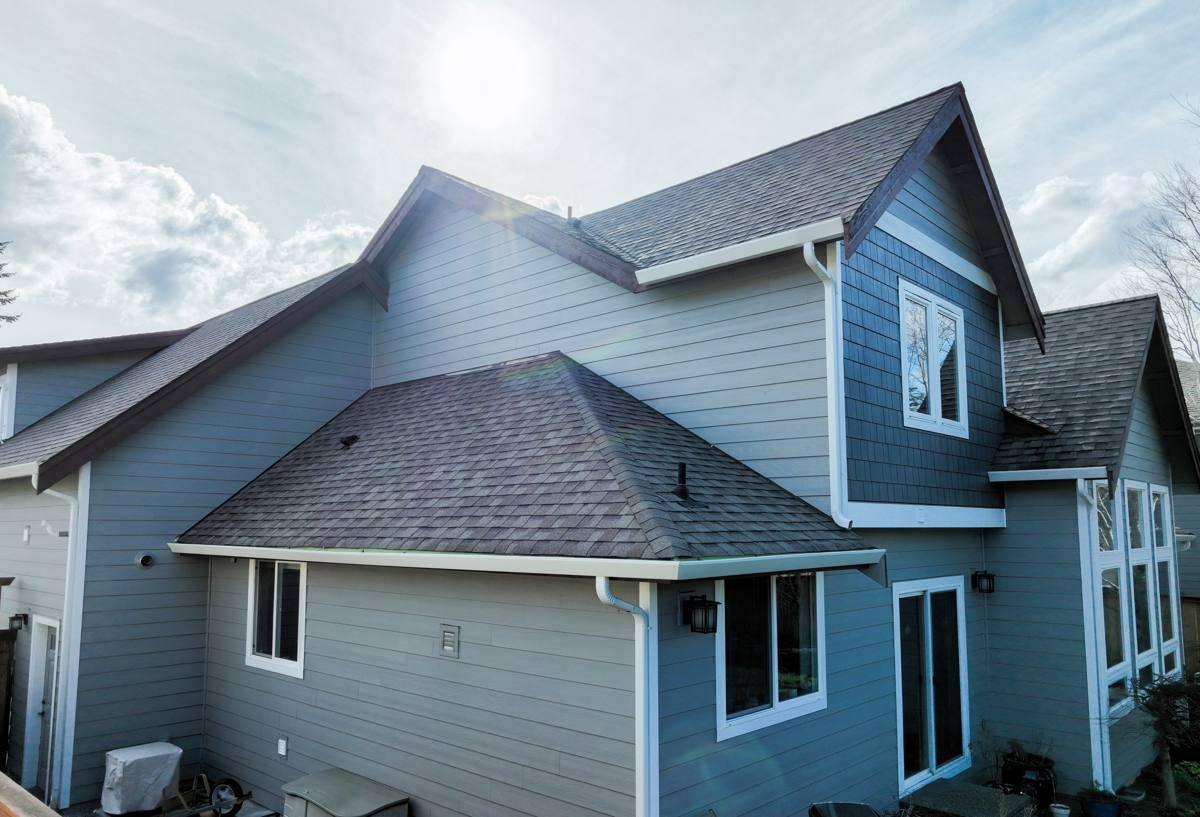
What Fiber Cement Actually Solves Here
Fiber cement is a mix of cement, sand, and cellulose fibers, and it behaves fundamentally differently than wood-based or vinyl siding in a wet, shaded environment. It doesn't rot, it doesn't provide a food source for the organisms that cause mildew and moss to spread, and it holds its shape when it gets wet and dries out repeatedly — which is exactly the cycle Clear Lake siding goes through most of the year.
Moisture Behavior
Fiber cement absorbs some moisture at the surface but does not swell, delaminate, or lose structural integrity the way engineered wood products can when water gets past the paint film. That matters at Clear Lake specifically because shaded walls stay damp longer after every rain event, giving water more time to find any weak point in the cladding.
Fire Resistance
Fiber cement is non-combustible. That's less of a wildfire concern in this particular part of Skagit County than it would be east of the mountains, but it's still a real, permanent advantage over wood-based siding products and one reason we don't compromise on it.
Finish Durability
James Hardie's ColorPlus finish is baked on at the factory under controlled conditions, rather than field-painted on site. In a marine, high-humidity climate, factory-cured finishes hold color and resist the chalking and peeling that field-applied paint is prone to once it's exposed to repeated wet-dry cycles.
The James Hardie Product Lines We Install
We install James Hardie exclusively, and even within that single manufacturer there are choices that matter for a Clear Lake home. The table below covers the lines we use most and where each one fits.
| Product | Best Use at Clear Lake | Key Trait |
|---|---|---|
| HardiePlank Lap Siding (HZ5 climate engineering) | Primary field siding on most homes | Engineered for the moisture and moderate-freeze conditions of the Pacific Northwest |
| HardieShingle | Accent gables, dormers, feature walls | Staggered or straight-edge shingle profile without the moisture vulnerability of cedar shingle |
| HardieTrim | Corners, fascia, window and door surrounds | Matches plank profile, resists the swelling that drives caulk joint failure |
| HardiePanel | Accent sections, some garage and shop exteriors | Vertical panel option for mixed-material designs |
Washington falls in James Hardie's HZ5 climate zone, and every plank we order is manufactured to that specification rather than a generic national spec. That's a detail worth asking about if you're comparing bids — some installers don't order climate-specific product because it takes more lead time to source correctly.
What a Correct Installation Involves
Fiber cement is only as good as the installation behind it. Most of the failures we get called out to inspect on other companies' work trace back to a handful of installation shortcuts, not the material itself. In a wet, shaded environment like Clear Lake, these details matter more than they would in a drier climate.
- Correct clearance between the bottom edge of the siding and the ground, roofline, deck, or patio surface — Hardie's published minimums exist specifically to keep splashback and standing water off the material
- Weather-resistive barrier installed and lapped correctly behind the siding, not just stapled up as an afterthought
- Flashing at every window, door, and horizontal trim transition, directing water out and away from the wall assembly
- Fasteners driven flush, not overdriven, at the manufacturer's specified spacing and location on the plank
- Factory-cut ends re-sealed and field cuts primed before installation, so raw edges aren't left exposed to moisture
- Proper joint treatment at butt seams — either a manufacturer-approved sealant system or engineered joint flashing, never just caulk alone
- Ventilation gap maintained where required so moisture that does get behind the cladding can dry out instead of getting trapped
Every one of these is spelled out in James Hardie's installation manual, and every one of them affects whether the manufacturer's warranty is actually valid if something goes wrong down the line. Skipping even one is often invisible for a year or two — the problems show up later, which is part of why cutting corners on siding is such an easy mistake to make and such an expensive one to catch late.
Our Process for a Clear Lake Project
The steps below are the same order we follow on every Clear Lake home, adjusted for the specific exposure and condition of that property.
- Site and wall assessment. We look at sun exposure, tree cover, drainage patterns, and existing moss or mildew staining to understand what that specific wall has been dealing with.
- Existing siding and sheathing check. Before any tear-off, we check for soft spots, rot, or trapped moisture in the sheathing underneath the current siding. This is where hidden problems get found, and it needs to happen before new siding goes up, not after.
- Tear-off or overlay decision. Most Clear Lake homes with any sign of moisture intrusion get a full tear-off so the sheathing and weather barrier can be inspected and corrected. We don't recommend installing over compromised sheathing just to save a step.
- Weather barrier and flashing installation. This is the layer that does the real waterproofing work; the siding itself is the second line of defense, not the first.
- Hardie installation to manufacturer spec. Correct fastening, clearances, and joint treatment as outlined above.
- Trim, caulking, and paint touch-up. Factory-finished ColorPlus product needs minimal field paint, which keeps the finish consistent and reduces future maintenance.
- Final walkthrough. We go over clearances, drainage, and finish quality with the homeowner before calling the job done.
What Drives Cost on a Clear Lake Home
Every home is different, but the factors below are what actually move the price on a fiber cement project in this area. We can give a firm number only after walking the property, but this is what we're weighing.
| Factor | Why It Matters |
|---|---|
| Tear-off vs. install over existing siding | Removal, disposal, and sheathing repair add labor that a straightforward overlay doesn't require |
| Sheathing condition | Hidden rot or moisture damage found during tear-off requires repair before new siding can go on |
| Home size and number of stories | More wall area and taller walls increase both material and labor, plus scaffolding needs |
| Trim and architectural detail | Homes with more corners, dormers, and window surrounds take more cutting and fitting time |
| Accessibility | Tree cover, slope, and tight lot lines around some Clear Lake properties can affect staging and equipment access |
| Siding profile mix | Combining lap siding with shingle accents or panel sections adds material variety and labor |
Living With Fiber Cement in This Climate
Fiber cement is low-maintenance compared to wood-based siding, but "low-maintenance" doesn't mean "no maintenance," especially somewhere as damp and shaded as Clear Lake. A simple annual routine keeps it performing the way it's designed to:
- Rinse the siding once a year with a garden hose and soft brush, focusing on shaded and north-facing walls where moss and mildew are most likely to start
- Avoid pressure washers on the siding directly — high pressure can force water behind joints and trim
- Keep gutters clear so overflow doesn't run down the wall face and feed algae growth
- Trim back vegetation and tree limbs that keep a wall section shaded and damp longer than necessary
- Walk the exterior once a year and check caulk joints at trim and window surrounds for cracking or separation
None of this is heavy lifting, but skipping it in a climate like this one lets moss and mildew get a foothold faster than it would in a drier part of the state.
Why a Crew That Already Works Clear Lake Matters
Siding installation isn't uniform across Skagit County. A crew that mostly works drier, more open sites doesn't necessarily think about clearances, flashing detail, and drying time the same way a crew that works shaded, lake-adjacent properties does. Working this area regularly means we already know how aggressively moss and mildew show up on north-facing walls here, how tree cover changes drying time after a storm, and what the local permitting and inspection process expects for exterior work in unincorporated Skagit County.
It also matters after the job is done. James Hardie's product warranty and our own workmanship coverage are only useful if a contractor is realistically going to be available to address a question or a warranty item years down the road. A crew based in and around Skagit County, already doing regular work in the Clear Lake area, isn't a stretch drive away if that ever comes up.
A Note on Why We Only Install James Hardie
We get asked fairly often why we don't offer vinyl, LP SmartSide, or other fiber cement brands as cheaper alternatives. The honest answer is that we've made a standard for ourselves based on what holds up in this exact climate over the long term: non-combustible material, factory-cured finish that doesn't rely on field paint holding up in constant damp conditions, and a manufacturer warranty structure we trust enough to put our own name behind. That standard doesn't flex project to project, because the climate here doesn't flex either.
If you're planning a siding project on a Clear Lake home, we're happy to walk the property, look at what your walls are actually dealing with, and put together a straightforward estimate — no pressure, no obligation. Use the form below to get started.