 Skagit County
 Siding in Hamilton: A Different Set of Conditions Than You'd Guess
Hamilton sits inland along the Skagit River, tucked against the forested foothills that lead up toward the Cascades. That location matters more for siding than most homeowners realize. You get less of the open, wind-driven exposure of the coastal towns closer to Puget Sound, but you get more standing shade, more surrounding tree cover, and more days where the siding simply never fully dries out between rain events. Add in the moist marine air that still pushes up the valley from the Sound, and you have a climate that's just as hard on exterior materials as anywhere else in Skagit County — it's just hard on them in a slightly different way.
The practical result: siding on Hamilton homes deals with prolonged dampness, shaded north and east walls that stay wet for days after a storm, and a moss and algae season that can run most of the year on the shadier elevations. Siding that isn't engineered for that combination — or isn't installed with the right details — shows it early, usually as staining, soft spots, or paint failure well before the material is actually worn out.
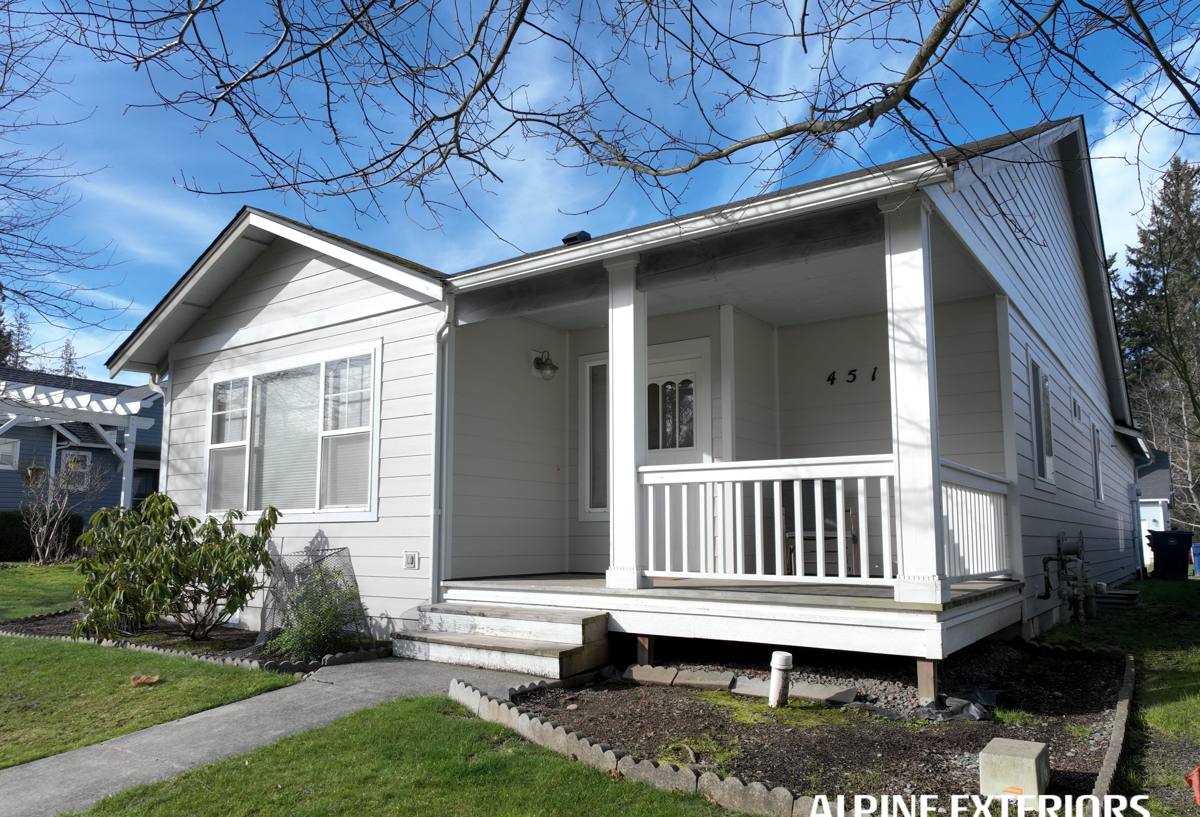
What Hamilton's Climate Actually Does to Siding
Moisture That Doesn't Leave
In a lot of Western Washington, siding gets wet and dries between storms. In shaded, tree-lined lots typical of the Skagit River valley, that drying window shrinks. Wood-based products swell, delaminate at the edges, or take on moss and mildew faster than the same product would on an open, sunny lot. Fiber cement doesn't absorb water the way wood or wood-fiber composites do, which is a big part of why it holds up better here.
Moss and Algae Season
Moss doesn't just grow on roofs. On shaded walls, especially anything facing away from the afternoon sun, it takes hold on siding, trim, and especially on any horizontal ledge — window sills, trim boards, the tops of skirt boards. Once moss gets a foothold on a porous or poorly sealed surface, it holds moisture against the wall constantly, which accelerates whatever damage the moisture was already going to cause.
Driving Rain and Wind-Pushed Water
Storms moving through the valley can push rain sideways into wall assemblies, particularly at gable ends and around window and door openings. This is a detailing problem as much as a material problem — the siding itself matters less here than the flashing, the water-resistive barrier behind it, and how the trim is sealed.
Why James Hardie Fiber Cement Is What We Install
We install James Hardie fiber cement siding exclusively — not vinyl, not LP SmartSide, not Cemplank or Allura, not primed spruce or cedar. That's not a marketing preference; it's a decision based on what actually performs under conditions like Hamilton's.
Fiber cement is non-combustible and doesn't absorb water the way wood-based sidings do, so it doesn't swell, rot, or delaminate at cut edges the way wood-fiber composite products can when they take on repeated moisture. James Hardie's HZ5 product line is specifically engineered for the wetter, more temperate climate zones the Pacific Northwest falls into — the formulation and factory finish are built around exactly the freeze-thaw-light, rain-heavy conditions Skagit County sees most winters.
The factory-applied ColorPlus finish is also a real advantage in a climate like this. It's baked on under controlled conditions and backed by its own finish warranty, which matters on a home that's going to spend a lot of its life sitting damp in the shade — field-applied paint on any siding material fails faster under those conditions, and repainting a house surrounded by trees and moss growth is not a job most homeowners want to repeat every several years.
How the Main Siding Materials Compare in This Climate
| Material | Moisture/Moss Behavior | Maintenance in Shaded, Wet Lots | Typical Warranty Structure |
|---|---|---|---|
| James Hardie fiber cement | Non-combustible, doesn't absorb water; resists moss-driven decay | Occasional wash; factory finish holds up in shade | Strong transferable product warranty |
| Vinyl | Doesn't rot, but traps moisture behind it if not detailed correctly; can warp | Low, but repairs and color-matching are limited | Prorated, often weaker over time |
| LP SmartSide | Wood-strand product; more vulnerable to edge swelling and moisture intrusion if seams aren't sealed | Requires attentive caulk/paint upkeep | Moisture-related exclusions common |
| Cedar | Attractive but absorbs moisture readily; prone to moss and rot in constant shade | High — regular refinishing needed | No manufacturer warranty; workmanship only |
What a Correct Siding Installation Involves Here
The material is only part of the equation. In a climate like Hamilton's, the installation details are what actually determine whether the siding performs for decades or starts showing problems in year five. A correct job includes:
- A properly lapped weather-resistive barrier behind the siding, with no gaps at seams or penetrations
- Rainscreen or drainage gap where the wall assembly calls for it, so water that does get behind the cladding can drain and the wall can breathe
- Flashing at every window, door, and horizontal trim transition — the most common point of failure on any siding job, regardless of material
- Fastener placement and spacing that follows James Hardie's published requirements for the HZ zone the home is in
- Factory cut-edge sealing wherever boards are field-cut, so raw edges aren't left exposed to moisture
- Correct clearance between the bottom of the siding and grade, decks, and roof lines to keep splashback and standing water off the material
- ColorPlus touch-up done to spec at any field-cut or fastener location, rather than skipped or done with mismatched paint
Skip any one of these and the siding itself can be top-tier material and still fail early. This is the part of the job that separates a crew that occasionally does siding from one that specializes in it.
How Our Process Works
Assessment
We start by walking the exterior and looking specifically at what the current siding and trim are telling us — where moisture has been sitting, where moss has taken hold, where flashing has failed or was never installed correctly. This tells us what's driving in the moisture, not just where the cosmetic damage shows up.
Prep and Water Management
Before any new siding goes up, we address the water-resistive barrier, flashing, and drainage details. This is the stage most likely to get shortchanged on a rushed job, and it's the stage that matters most for a home sitting in a damp, shaded valley setting.
Installation
We install James Hardie panels and trim to manufacturer spec — fastener pattern, clearances, and joint treatment included — because that's what keeps the product warranty valid and keeps the wall assembly performing the way it's designed to.
Finish and Walkthrough
We finish with proper caulking at trim transitions, touch-up where needed, and a walkthrough so you know exactly what was done and why.
What Drives Cost on a Hamilton Project
| Factor | Why It Matters |
|---|---|
| Tear-off and disposal of existing siding | Older wood or composite siding often needs full removal, especially where moisture damage is present |
| Hidden sheathing or framing repair | Long-term moisture exposure in shaded areas sometimes means rot repair is discovered once old siding comes off |
| Home size and wall complexity | Gables, dormers, and multiple trim transitions all add labor and flashing detail |
| HZ5 product selection and profile | Lap width, texture, and trim choices affect material cost |
| Site access | Wooded lots, slopes, or limited equipment access common in river-valley properties can add labor time |
We give straightforward, itemized estimates rather than a single vague number, so you can see what you're actually paying for.
Why It Matters That We Already Work in Hamilton and Skagit County
A crew that works this area regularly already knows which details matter most on a given lot — where shade and moisture sit longest through the year, how local permitting and inspection works, and what a correctly built wall assembly needs to hold up through another Skagit County winter. That's different from a crew learning the region's quirks on your project. We also know what James Hardie's HZ5 line requires in practice, not just on paper, because we install nothing else — it's the only siding system we install, in Hamilton and everywhere else we work in the county.
Signs Your Current Siding Is Losing the Fight
- Persistent moss or dark streaking on shaded walls that comes back shortly after cleaning
- Soft or spongy spots, especially near the bottom courses or below windows
- Paint that's peeling, bubbling, or chalking faster than it should
- Visible gaps, warping, or cupping at board edges or seams
- Musty smell or visible moisture damage on interior walls that back up to exterior siding
Any of these is worth a look before it becomes a larger repair. Catching moisture intrusion early is almost always cheaper than dealing with rotted sheathing later.
If you're weighing a siding replacement on a Hamilton home, we're happy to take a look and give you a straight, no-pressure estimate — what we'd recommend, what it would cost, and why. There's a form below to get that started.