 Skagit County
 Why La Conner Homes Take a Different Kind of Beating
La Conner sits right on the water, and that changes how siding ages here compared to homes a few miles inland in Skagit County. The combination of salt-laden air off the Swinomish Channel and Puget Sound, near-constant winter rain blowing in off the water, and long stretches of shade and dampness that feed moss growth means siding here is working harder than siding on a dry, sheltered lot ever will. Repairs that would be simple cosmetic fixes elsewhere can be a sign of real moisture problems underneath when they show up on a La Conner home.
None of this means La Conner is a bad place to own a home with wood-look siding — it just means the siding, the flashing behind it, and the fasteners holding it on all need to be matched to the environment, and repairs need to be diagnosed correctly instead of just patched over. That's the difference between a repair that lasts and one you're paying for again in three years.
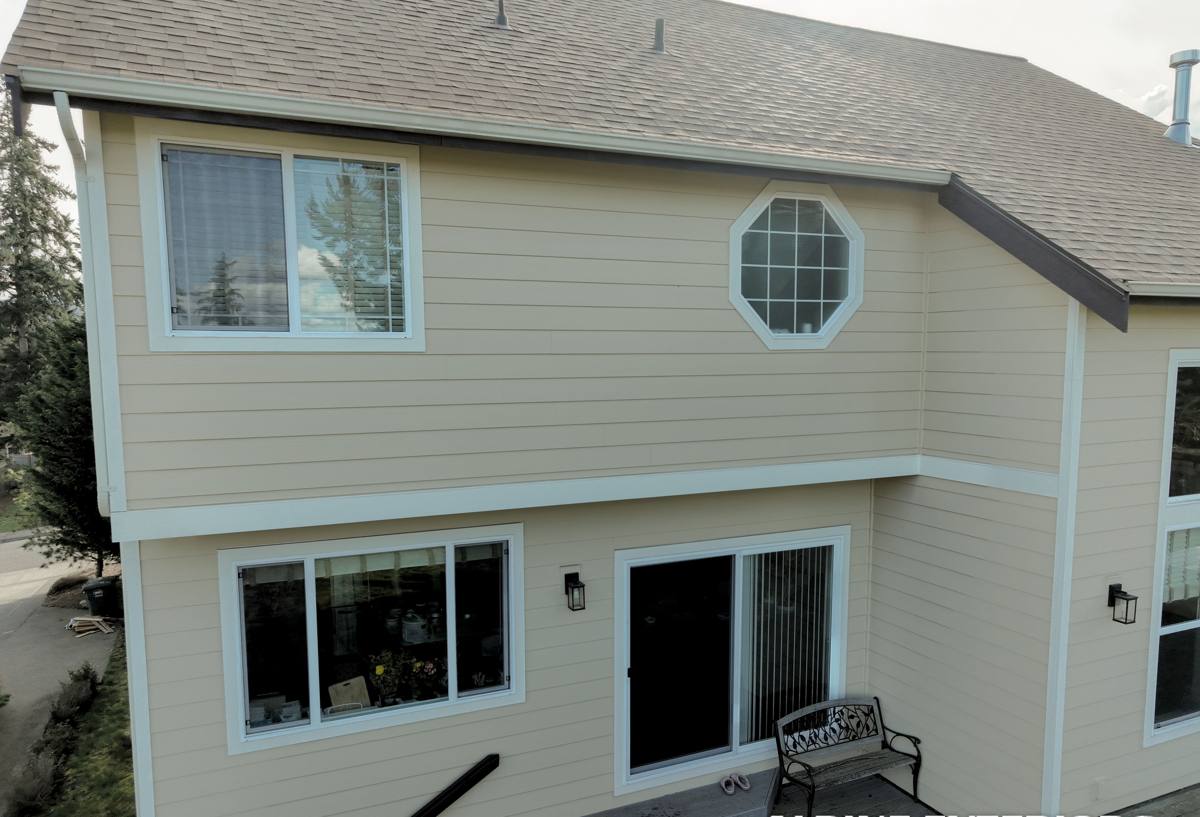
What Salt Air, Driving Rain, and Moss Actually Do to Siding
Salt Air
Airborne salt doesn't just sit on the surface — it works into hairline cracks, fastener heads, and any spot where paint or factory finish has worn thin, accelerating corrosion in nails, screws, and any exposed metal trim or flashing. On siding materials that rely on a field-applied paint job for protection, salt exposure shortens the repaint cycle and makes peeling and chalking show up sooner than a manufacturer's paint warranty would suggest.
Driving Rain
Skagit County's winter storms don't fall straight down — wind off the water pushes rain sideways into wall assemblies, which is exactly the condition that exposes weak caulk joints, under-lapped seams, and gaps around trim, windows, and utility penetrations. Water that gets behind siding in a wind-driven rain event doesn't always show up as a stain right away; it can travel and soak sheathing before anyone notices a problem from the outside.
Moss and Algae
Shaded north and west walls, mature tree cover, and a long wet season give moss and algae months at a time to establish themselves on siding surfaces. Beyond the cosmetic green-black staining, moss holds moisture directly against the siding surface far longer than open air would, which is a slow but steady contributor to paint failure, caulk breakdown, and rot in any wood-based components nearby.
Signs a La Conner Home Needs Siding Repair
Most siding problems in this climate start small and stay hidden until they're not. Here's what we look for, and what homeowners should watch for between inspections:
- Soft or spongy spots when you press on siding near the bottom courses, around windows, or at trim boards
- Visible gaps, cracks, or separated caulk joints at corners, window trim, and where siding meets trim boards
- Persistent moss or dark streaking on shaded walls that keeps returning after cleaning
- Peeling, bubbling, or chalking paint, especially on walls facing prevailing wind and rain
- Rust streaks below fastener heads or trim connectors
- Warping, buckling, or panels that no longer sit flat against the wall
- A musty smell or rising energy bills that suggest moisture intrusion behind the wall
- Damage clustered near ground level, downspouts, or areas where sprinklers or landscaping keep siding consistently wet
Any one of these on its own might be a minor, localized repair. Several of them together, or damage that keeps recurring in the same spot after a previous patch, usually means the underlying water management — not just the visible siding — needs attention.
What a Correct Siding Repair Actually Involves
Diagnosis Before Demolition
A repair that just replaces the damaged board and moves on is guessing. Before we cut into anything, we check how far moisture has traveled, whether the sheathing underneath is sound, and whether the original flashing and house wrap detailing are doing their job. In a coastal Skagit County setting, it's common to find that the visible siding damage is a symptom of a flashing gap or caulk failure a few inches away, not the actual cause.
Matching Materials and Finish
Because we install James Hardie fiber cement exclusively, repairs on a home we've worked on before are straightforward — we match the existing ColorPlus finish and profile so the repair blends in rather than standing out as an obvious patch. On homes with older siding of another type, we're upfront about what can be feathered in versus where a color or texture mismatch is unavoidable, and we'll walk through whether a broader section replacement makes more sense than a visible patch.
Water Management Details
This is the part that actually determines whether a repair holds up through another Skagit County winter. That means correct flashing at horizontal joints, properly lapped house wrap, weep paths that let any incidental moisture drain back out instead of pooling, and fasteners set to manufacturer spec so they don't create a wicking path for water. Caulk gets used at true joints, not as a substitute for proper flashing.
Fasteners and Hardware
In a salt-air environment, fastener choice matters more than it does a few miles inland. We use corrosion-resistant fasteners rated for the exposure, and we check existing hardware for early rust during every repair — catching a corroding fastener before it fails is far cheaper than dealing with the water damage it eventually causes.
Repair or Replace? How We Actually Decide
Not every damaged section needs a full re-side, and not every homeowner needs to hear a sales pitch when a targeted repair will genuinely hold up. Here's the general framework we use:
| Situation | Usual Recommendation | Why |
|---|---|---|
| Isolated impact damage or a single cracked board, sound sheathing underneath | Targeted repair | Localized problem, no sign of wider moisture intrusion |
| Recurring rot or soft spots in the same wall section after a prior patch | Repair with flashing correction, sometimes a larger section | Underlying water path was never fixed, not just the visible board |
| Moss and paint failure limited to one or two shaded walls | Cleaning, repaint or refinish, spot repair as needed | Cosmetic and maintenance issue rather than structural |
| Siding is original, near or past its expected service life, with damage spread across multiple walls | Full replacement | Patching aging siding piecemeal costs more over time than one correct installation |
| Extensive rot found behind siding during a repair estimate | Replacement of affected wall sections at minimum | Structural sheathing and framing take priority over cosmetic siding fixes |
We'll always tell you honestly which category your home falls into, including when the answer is that a repair is all you need.
Why We Only Repair With James Hardie Fiber Cement
We install and repair James Hardie fiber cement siding exclusively — we don't work in vinyl, LP SmartSide, or primed wood siding, and that's a deliberate standard, not a limitation of what we're capable of installing. In a marine climate like La Conner's, the trade-offs of other materials show up faster: vinyl can become brittle and distort with sun and temperature swings and offers little resistance to wind-driven debris; engineered wood products depend on unbroken factory coatings and careful sealing at every cut edge to resist moisture, which is a harder standard to maintain in a wet coastal climate over decades; primed wood siding needs a disciplined repaint schedule that only gets more demanding with salt air and shade-driven moss.
James Hardie fiber cement is non-combustible, doesn't support moss growth the way wood-based products can, and comes with a factory-applied ColorPlus finish that's baked on and warranted separately from the substrate — meaning the color layer is engineered for UV and weather exposure rather than relying on a field-applied paint job. Hardie also engineers its HardiePlank and HardiePanel lines by climate zone; homes in Western Washington fall under Hardie's HZ5 specification, built around the region's rain and moisture exposure. When we repair a Hardie home, we're working with a product designed for exactly the conditions La Conner throws at it, backed by a transferable manufacturer warranty.
Our Siding Repair Process
- Inspection and diagnosis — we look at the damaged area and the water path around it, not just the visible symptom, including a check of flashing, house wrap, and fastener condition
- Written scope and honest recommendation — you get a clear explanation of what we found, what needs to happen, and why, including whether a repair or a larger fix is the right call
- Material matching — for existing James Hardie siding, we match ColorPlus finish and profile; for other siding types, we discuss what will and won't blend
- Correct water management first — flashing, house wrap laps, and drainage get fixed before new siding goes back on, not after
- Installation to manufacturer spec — proper fastener type, spacing, and clearances, because a repair installed to spec is what keeps the warranty intact and keeps water out
- Final walkthrough — we show you what was done and what to keep an eye on going forward
Why Local Experience in La Conner Matters
A siding repair that looks fine in a dry inland town can fail fast on a waterfront lot in La Conner if it doesn't account for salt exposure, wind-driven rain, and the shade patterns that keep moss coming back. Crews that already work this part of Skagit County know which walls in this kind of setting take the worst weather, which flashing details actually hold up near the water, and how to match repairs into older homes without creating a new weak point. That local pattern recognition is what separates a repair that lasts through a few more Skagit County winters from one that's back on the schedule next year.
We also know the practical side of working in a small waterfront community — respecting tight lots, protecting landscaping and walkways during work, and keeping the job site clean in a town where neighbors and foot traffic are part of daily life.
Maintaining Repaired Siding in a Coastal Climate
A good repair still benefits from basic upkeep, especially given La Conner's exposure:
- Rinse salt residue and moss buildup off siding periodically, particularly on shaded or water-facing walls
- Keep gutters and downspouts clear so water isn't running down or pooling against siding
- Trim back vegetation and tree limbs that keep walls shaded and damp
- Re-inspect caulk joints and trim connections annually, since these are the first points to fail under repeated wind-driven rain
- Address small issues — a loose piece of trim, a hairline caulk crack — before winter storm season rather than after
If your La Conner home has siding damage, discoloration that won't clean off, or you're just not sure whether what you're looking at is cosmetic or something more, we're happy to take a look. Reach out for a free, no-pressure estimate using the form below.