 Skagit County
 Why March Point Decks Wear Out Faster Than Decks Inland
March Point sits out on the water, exposed to weather that decks further inland in Skagit County simply don't deal with. Salt-laden air off the bay accelerates corrosion on fasteners, hardware, and any metal flashing that isn't rated for it. Driving rain, pushed sideways by wind off the water, gets up under railings and into end grain in ways a straight-down rain never would. And the long, wet moss season here means anything horizontal — deck boards, stair treads, the tops of railings — stays damp far longer than it should, which is exactly what rot and mildew need to take hold.
Put those three things together and you get decks that look fine from a distance but are quietly failing underneath: rusted-out joist hangers, soft framing under boards that still look okay on the surface, and fasteners that have corroded to the point of losing their grip. We see this pattern often enough in March Point specifically that we treat it as a different job than deck replacement anywhere else in the county — not because the carpentry is different, but because the materials and details have to account for what the site throws at them.
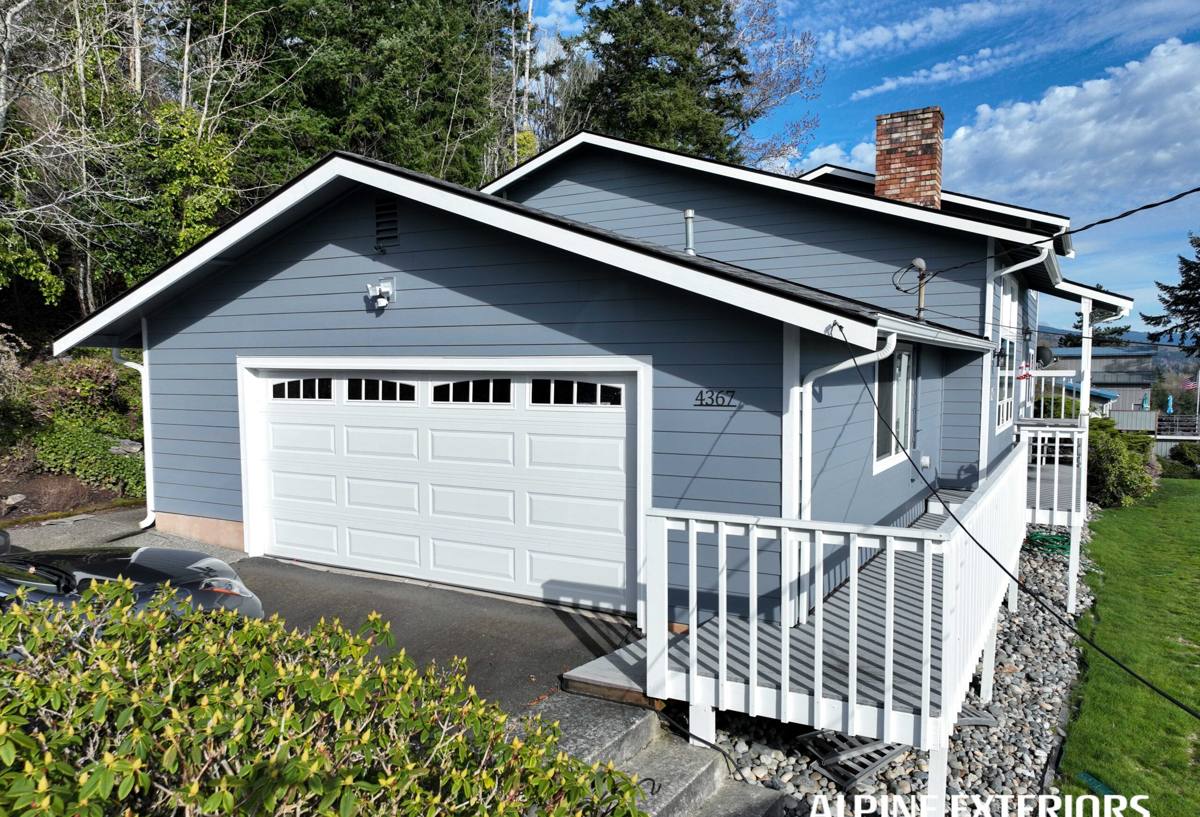
Signs a March Point Deck Needs Replacement, Not Just Repair
Not every tired-looking deck needs to come out. But there's a point where patching boards is throwing money at a structure that's already compromised underneath. Here's what tells us a deck is past the point of repair:
- Soft or spongy spots when you walk across the deck, especially near the house or at stair landings
- Rust streaks running down from fasteners, joist hangers, or railing posts
- Gaps or movement where the ledger board meets the house
- Persistent moss or dark staining that comes back within weeks of cleaning
- Railings or posts that flex or wiggle when pushed
- Boards that have cupped, split, or pulled away from fasteners
- A deck more than 15-20 years old built with the fastening and flashing standards common at the time
Cosmetic Wear vs. Structural Failure
Gray, weathered wood on its own isn't a red flag — that's just sun and moisture doing what they do. The real question is what's happening at the connections: the ledger-to-house attachment, the joist hangers, the post bases. Those are the points where water collects, salt air corrodes fastest, and failure actually starts. A deck can look rough and be structurally sound, or look decent and be dangerously undersized underneath. That's why we check framing before we quote anything, not just the visible decking.
What a Correct Deck Replacement Actually Involves
A deck replacement done right is mostly about what you don't see once it's finished. The visible decking is the easy part; the framing, flashing, and fasteners underneath are what determine whether the new deck lasts 10 years or 25.
Ledger Board and Flashing
The ledger board — where the deck attaches to the house — is the single most common point of water intrusion and failure on any deck, and it matters even more here given how much wind-driven rain March Point gets. Proper flashing at this connection, installed so water sheds away from the house rather than behind the ledger, is not optional. This is also where a lot of older or budget deck work cuts corners, because it's hidden once the decking goes down.
Framing and Joists
We size and space joists for the actual load and span of the deck, not just what "looks about right." In a salt-air environment, we pay particular attention to joist hangers and structural fasteners — this is where corrosion shows up first and does the most damage, since a failing hanger can mean a section of deck losing support without much visible warning.
Fasteners and Hardware
Standard hot-dip galvanized hardware doesn't hold up as well this close to salt water as it does further inland. We use fasteners and connectors rated for coastal or corrosive exposure — stainless steel or higher-grade coated hardware, depending on the application — because replacing a deck's structural hardware in eight years instead of twenty is a false economy nobody should have to pay for twice.
Choosing Decking Material for a Salt-Air, High-Moss Site
There's no single "best" decking material — there's a best fit for the site, the budget, and how much maintenance the homeowner actually wants to do. For a March Point property, we weigh moisture behavior and moss resistance more heavily than we would for a dry, inland lot.
| Material | How It Handles Moss & Moisture | Maintenance | Typical Lifespan |
|---|---|---|---|
| Pressure-treated wood | Absorbs moisture; needs sealing to resist moss staining | Annual cleaning, periodic re-sealing | 10-15 years |
| Cedar | Naturally moisture-resistant but still needs upkeep near water | Regular cleaning, re-staining every few years | 15-20 years |
| Composite decking | Doesn't absorb water; moss can still grow on the surface film and needs washing off | Periodic washing, no sealing or staining | 25-30 years |
| PVC/capped composite | Fully sealed surface, sheds water and resists moss growth best of the options here | Occasional washing | 25-30+ years |
We're honest about trade-offs rather than pushing one product. Composite and PVC decking cost more up front but ask far less of the homeowner in a climate like this — less time spent scrubbing moss off boards every spring, less risk of the surface staining before you get to it. Wood costs less initially but only holds up here if someone stays on top of cleaning and sealing on a real schedule. We'll walk through what fits your budget and how much maintenance you actually want to sign up for.
Our Deck Replacement Process
- On-site assessment. We inspect the existing deck's framing, ledger connection, and hardware condition — not just the surface decking — to confirm replacement is the right call.
- Honest scope and estimate. You get a clear breakdown of what's being removed, what's being rebuilt, and what materials are being used, with no vague allowances.
- Removal and disposal. The old deck comes out completely, including any hidden rot or damaged framing that gets found once we open things up.
- Framing and flashing, done to hold up here. New ledger flashing, properly spaced joists, and corrosion-rated hardware throughout.
- Decking installation. Installed per manufacturer spacing and fastening specs, which matters for both warranty coverage and how the material handles seasonal moisture movement.
- Final walkthrough. We go over the finished deck together before we call the job done.
Moss, Drainage, and Keeping a New Deck Looking That Way
A well-built deck still needs the site around it to drain properly. Standing water under a deck, or gutters dumping runoff right next to the footings, will undercut even the best framing and hardware over time. As part of a replacement, we look at how water moves around and under the structure — grading, gaps between boards, and airflow underneath all affect how fast moss and mildew take hold on the surface above.
Once the deck is in, a simple seasonal rinse-off before moss gets a real foothold does more than any product applied after the fact. We'll tell you honestly what your chosen material needs and how often — some homeowners are fine doing this themselves, and for others it's worth having it done for you once or twice a year.
Permits and Code Considerations in Skagit County
Deck replacements, especially ones involving structural changes to framing height, size, or attachment to the house, typically require a permit under Skagit County's building code. Requirements can vary depending on the deck's size, height above grade, and whether it's attached to the structure. We handle the permit process as part of the job so you're not left figuring out county requirements on your own, and so the finished deck is inspected and documented correctly.
Why Hire a Crew That Already Works March Point
General contractors who don't spend much time out on this stretch of Skagit County often default to standard hardware and standard details — the kind that work fine most places but fall short here. A crew that already works March Point knows to spec corrosion-rated fasteners without being asked, knows how the moss season here behaves differently than it does even a few miles inland, and has already made (and learned from) the material trade-offs that come with building this close to salt water. That familiarity shows up in fewer callbacks and a deck that's still solid well past the point a generic build would start showing problems.
Getting a Fair, Honest Estimate
Deck replacement cost depends on size, framing condition, decking material, and railing style — anyone quoting a firm number without seeing the site is guessing. What we can tell you upfront is what drives the price:
- Deck size and height above grade (taller decks need more substantial framing and often railings that meet code)
- Condition of the existing structure — how much of the framing is salvageable versus needing full replacement
- Decking material chosen, from pressure-treated wood up through PVC/capped composite
- Railing style and material
- Stairs, landings, or multi-level layouts, which add labor and material
- Permit and inspection requirements for the scope of work
If you're seeing soft spots, rust stains, or a deck that just hasn't held up to the weather out here, we're happy to come take a look. We'll give you a straight read on whether it's a repair or a full replacement, and a no-pressure estimate based on what your home and site actually need — just fill out the form below to get started.