 Skagit County
 Why Metal Roofing Gets a Second Look in Mount Vernon
Mount Vernon sits in a part of Skagit County where the roof over your head does real work most of the year. The Skagit Valley's low elevation and closeness to Puget Sound mean homes here deal with salt-laden air, long stretches of driving rain, and a moss season that can run from fall through spring. Asphalt shingles can handle that environment for a while, but they're also the roofing material most affected by it — granule loss from wind-driven rain, moss roots working into the mat, and algae staining that never fully washes out. Metal roofing is worth considering here specifically because it responds to those three stressors differently than shingles do, not because it's fashionable or trendy.
Salt Air and Coastal Exposure
Homes closer to the water and lower-lying parts of the valley see more airborne salt than homes further inland or at elevation. Salt air doesn't destroy a roof overnight, but it accelerates corrosion on anything with exposed, unprotected metal — fasteners, flashing, and cheap trim pieces in particular. This matters more for a metal roof than for a shingle roof, because with metal, the fasteners, flashing, and panel coating are the whole ballgame. Get those wrong and salt air will find the weak point.
Driving Rain and a Long Moss Season
Rain in this part of Washington doesn't always fall straight down — wind off the valley pushes it sideways into laps, seams, and fastener heads. Combine that with shaded, north-facing roof sections that stay damp for days at a time, and you get the long moss season that's typical of this area. Moss needs a rough surface and organic debris to get a foothold. That's a structural difference in metal's favor, but it's not a magic shield — more on that below.
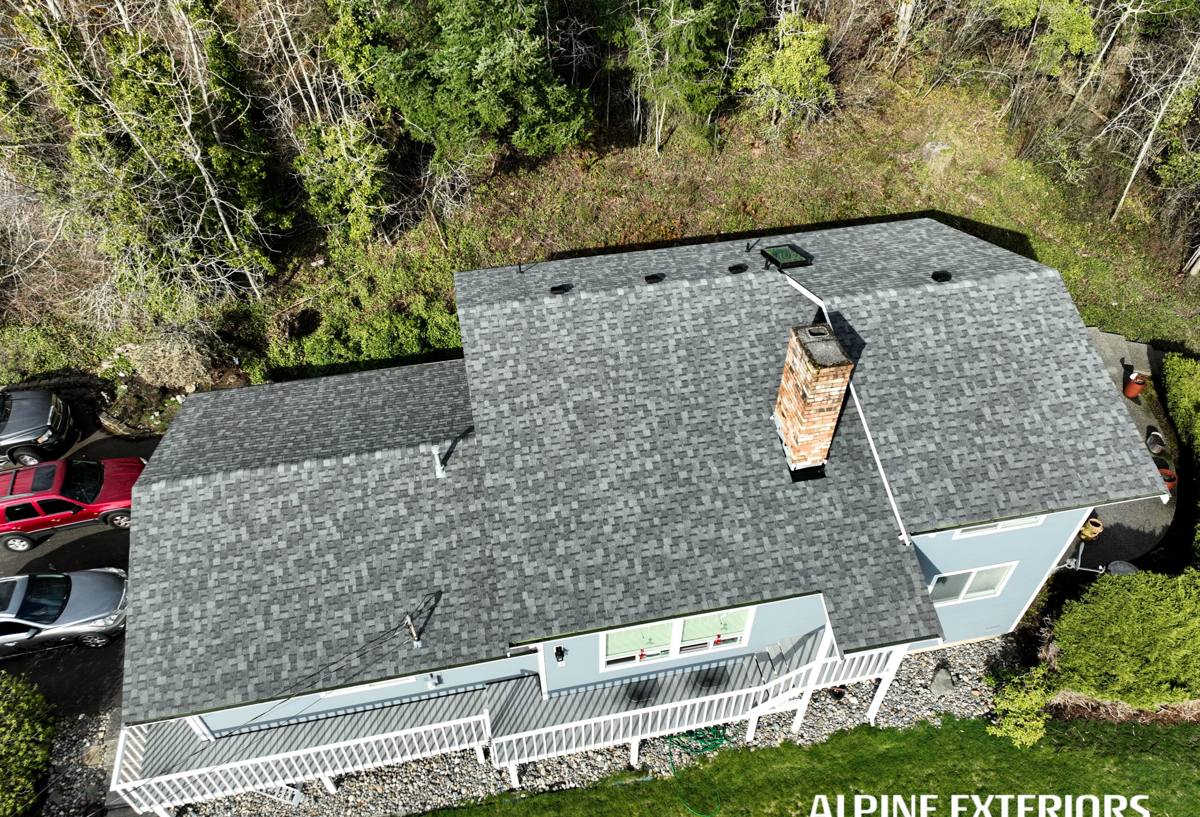
What Metal Roofing Actually Solves — and What It Doesn't
It's worth being honest about this instead of overselling it. Metal roofing does a few things very well in a climate like ours, and a few things it does no better than a well-installed shingle roof.
- Sheds wind-driven rain better when panels and flashing are installed with the right laps and sealant — the smooth, continuous surface gives water fewer places to work its way underneath.
- Resists moss anchoring better than a granulated shingle surface, since there's no rough mat for spores and roots to grab onto — though moss and organic debris can still collect in valleys, behind chimneys, and anywhere leaves pile up.
- Holds up longer under UV and freeze-thaw cycling than asphalt, without the granule loss that thins shingles over time.
- Does not eliminate the need for gutter maintenance — debris still builds up in valleys and at eaves, and a clogged gutter backs water up under any roofing material.
- Does not stop corrosion on its own — the coating, fasteners, and flashing determine how well a metal roof handles salt air, not the base panel material alone.
Panel Types: How the Common Options Compare
"Metal roofing" covers a range of products, and they're not interchangeable in terms of cost, appearance, or how they hold up here. The table below is a general comparison — actual pricing depends on your roof's size, pitch, and complexity, which we'll walk through at an in-person estimate.
| Panel Type | Typical Look | Fastening | Best Suited For |
|---|---|---|---|
| Standing seam | Vertical raised seams, clean lines | Concealed clips, no exposed fasteners on the field | Homes wanting the longest maintenance interval and cleanest appearance; better resistance to wind-driven rain at seams |
| Exposed-fastener panel | Ribbed panel, screws visible | Screws through the panel face into decking or purlins | Budget-conscious projects, outbuildings, and simpler roof lines; requires periodic fastener checks |
| Stone-coated steel | Mimics shingle or tile profile | Nailed similar to shingles, interlocking panels | Homeowners who want a metal roof's durability with a more traditional shingle or tile appearance |
Exposed-fastener panels cost less up front but rely on the gaskets under each screw head staying compressed and intact for decades — in a climate with this much rain and temperature swing, those gaskets are one of the first things we check on any older exposed-fastener roof.
What a Correct Metal Roof Installation Actually Involves
Underlayment and Ice/Water Protection
A synthetic underlayment across the whole deck, with self-adhered ice-and-water membrane at eaves, valleys, and around penetrations, gives the roof a backup layer if wind-driven rain ever gets past the panel seams. In a climate that sees as much sustained rain as ours, skipping this step — or using felt paper alone — is one of the most common shortcuts we see on older installs.
Flashing and Dissimilar-Metal Separation
Flashing at valleys, chimneys, skylights, and wall intersections has to be formed to actually shed water downhill, not just caulked and hoped for. Just as important near the coast: metals that touch each other need to be compatible, or separated with an underlayment layer. Mixing incompatible metals — say, an aluminum panel against uncoated steel flashing — sets up galvanic corrosion that eats away at the less-noble metal, and salt air speeds that reaction up considerably.
Fasteners and Sealant
Fasteners should match the panel's coating chemistry and carry a rating suited for coastal exposure, not the cheapest box on the shelf. Sealants at laps and penetrations need to be a product rated for the panel material and for UV exposure, since a sealant that hardens and cracks within a few years defeats the point of a fifty-year panel.
Ventilation
Metal roofs still need balanced intake and exhaust ventilation underneath them. Without it, moisture from the living space can condense on the underside of cold metal panels during our damp winters, which causes deck rot from the inside — a problem that has nothing to do with the roof surface itself and everything to do with airflow.
Signs of a Problem We See on Older or Poorly Installed Metal Roofs
If you're evaluating an existing metal roof — yours or one on a home you're buying in the Mount Vernon area — these are the things worth checking before assuming it's in good shape:
- Rust streaks running down from screw heads or panel seams, which usually means the coating or gasket at that fastener has failed
- Panels that flex or "oil-can" more than expected, which can point to thin gauge material or insufficient fastening pattern
- Moss or dark streaking concentrated at shaded valleys, north-facing slopes, or behind chimneys — not a defect by itself, but a sign that debris is collecting and should be cleared
- Loose or missing fasteners, especially on exposed-fastener panels that haven't been checked in several years
- Flashing that's been caulked over repeatedly instead of properly reformed or replaced
- Gaps or daylight visible at ridge caps and end walls
Our Process for a Mount Vernon Metal Roof
Inspection and Estimate
We start by getting on or above the roof to look at deck condition, existing flashing, ventilation, and any trouble spots specific to your home's layout and exposure. We'll talk through panel options and give you a written estimate that accounts for your roof's pitch, complexity, and whether a tear-off is needed versus, in some limited cases, installing over an existing layer.
Tear-Off and Deck Prep
Any deck sheathing that's soft, delaminated, or water-stained gets replaced before anything new goes down — installing a metal roof over a compromised deck just hides the problem. This is also when we address ventilation gaps and confirm flashing details at valleys and penetrations.
Installation
Underlayment first, ice-and-water membrane at the vulnerable spots, then panels installed with the fastening and flashing approach appropriate to that panel type. We keep an eye on job-site cleanup throughout — loose metal shavings and screws left in gutters or landscaping are a common source of rust stains and clogged downspouts down the line.
Final Walkthrough
Before we consider the job done, we walk the roof and the property with you, cover the manufacturer's warranty paperwork and what it does and doesn't cover, and point out anything you should keep an eye on going forward.
Maintenance for a Marine, Moss-Prone Climate
Metal roofing needs less maintenance than shingles, but "less" isn't "none." In Skagit County's climate, a short annual routine keeps a metal roof performing the way it's supposed to:
- Clear gutters and valleys of needles, leaves, and moss debris at least once a year, more often if you're under conifers
- Do a visual check of fastener heads and flashing after the first heavy wind-driven storm of the season
- Trim back overhanging branches that keep shaded sections of roof damp longer than the rest
- Rinse off heavy moss or algae buildup rather than letting it sit indefinitely — a soft wash, not pressure-washing directly at seams and fasteners
- Have flashing and sealant at penetrations checked every few years, since sealant is the one component with a shorter service life than the panels themselves
What Affects the Cost
Metal roofing costs more up front than asphalt shingles, and the range within metal roofing itself is wide. Rather than quote a number that won't match your specific roof, here's what actually moves the estimate:
| Factor | Why It Matters |
|---|---|
| Panel type | Standing seam typically costs more than exposed-fastener panel or stone-coated steel due to labor and material |
| Roof pitch and complexity | Steep pitches, multiple valleys, and dormers all add labor time and material waste |
| Tear-off vs. deck repair | Rotted or damaged decking found during tear-off adds cost but shouldn't be skipped |
| Access and site conditions | Tight lots, tall homes, or limited staging area affect crew time and equipment needs |
| Ventilation and flashing upgrades | Bringing an older roof's ventilation or flashing up to a proper standard is worth the added cost |
Why Hire a Crew That Already Works in Skagit County
Metal roofing is less forgiving of installation mistakes than shingles — a poorly lapped seam or the wrong fastener choice may not show a problem for a year or two, by which point water has already found its way into the deck. A crew that regularly works in Mount Vernon and the surrounding Skagit Valley has already seen how local conditions play out on real roofs: which north-facing slopes hold moss longest, how much of a role salt air plays depending on how close a property sits to the water, and how the area's rain patterns stress flashing details differently than a drier climate would. That local track record matters more with metal roofing than with almost any other exterior product, because so much of its performance depends on installation details that don't show up on a spec sheet.
If you're weighing metal roofing for a home in Mount Vernon or elsewhere in Skagit County, we're happy to take a look and walk you through what makes sense for your roof — no pressure, no obligation. Use the form below to request a free estimate.