 Skagit County
 Big Lake's Climate Is Harder on Siding Than It Looks
Big Lake sits in a pocket of Skagit County where the weather does a lot of quiet damage over time. It's not one big storm that wrecks a home's exterior here — it's the accumulation. Moist marine air moves in off the Puget Sound lowlands and settles around the lake, driving rain comes in sideways during fall and winter systems, and the tree cover and lake humidity keep north- and west-facing walls damp long after a storm has passed. That combination is exactly what breeds moss, mildew, and slow moisture intrusion behind siding that wasn't installed with this climate in mind.
Homes around Big Lake also see a wider mix of exposure than a typical subdivision. Some sit close to the water with almost no wind break, others are tucked into fir and cedar stands that hold shade and moisture against the walls for most of the day. Both situations punish siding differently, but they share the same root problem: siding installation here has to manage water, not just repel it.
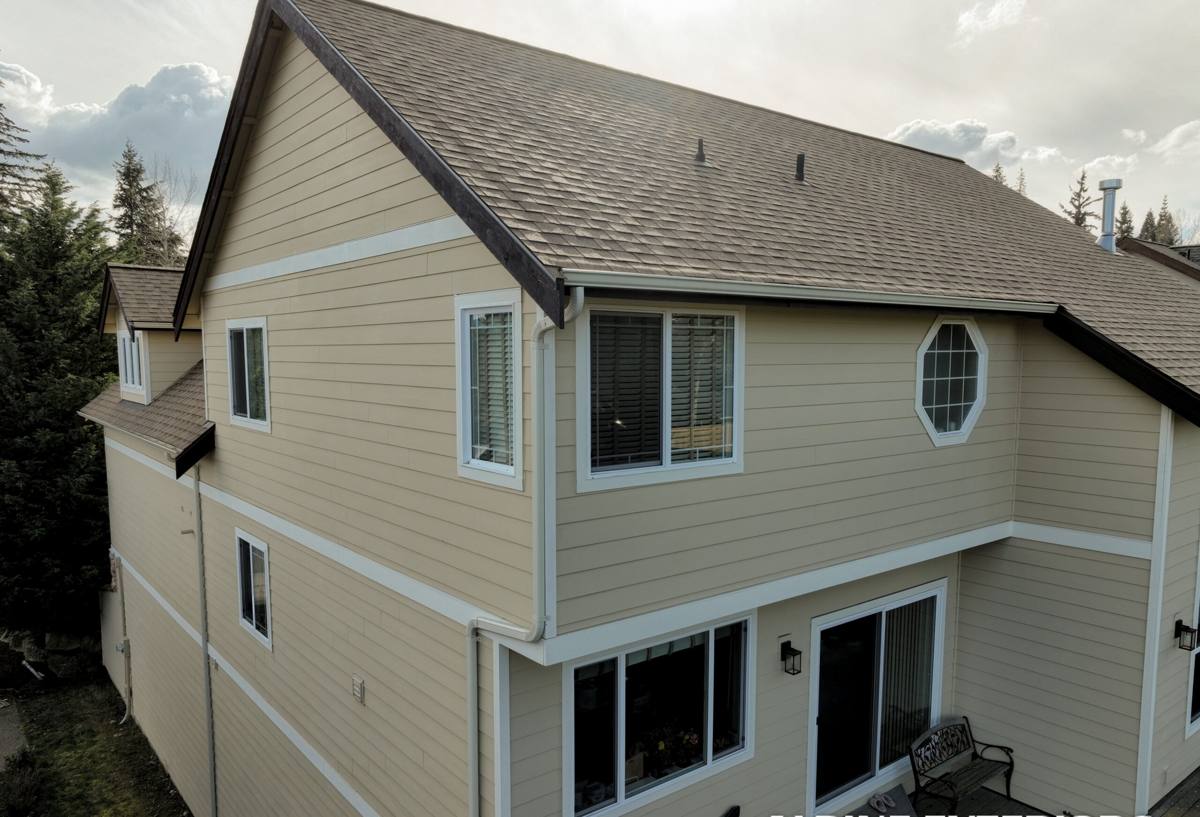
What Big Lake Homes Actually Need From a Siding Job
A siding installation that looks right the day it's finished but wasn't built for this environment will show problems within a few wet seasons — cupping panels, staining at the seams, moss creeping up from the bottom courses, and soft trim around windows and doors. Correct installation in a place like Big Lake comes down to a few non-negotiables:
- A drainage plane behind the siding so any water that gets past the surface has somewhere to go besides your sheathing
- Properly lapped and sealed flashing at every window, door, and roof-to-wall transition
- Correct fastener placement and clearance so panels can move slightly with moisture and temperature without splitting or working loose
- Bottom clearance off decks, patios, and grade so the lowest courses aren't sitting in standing moisture or snowmelt
- A siding material that doesn't absorb water into its core, because a material that swells and dries repeatedly will eventually fail at the seams no matter how well it's installed
That last point is why we only install James Hardie fiber cement siding on Big Lake homes. Wood-based and wood-fiber products can be installed correctly and still struggle here, because the material itself takes on moisture. Hardie's fiber cement doesn't have that vulnerability — it's engineered to hold paint, hold its shape, and resist moisture intrusion in exactly the conditions Skagit County produces every winter.
Why We Standardized on James Hardie
We used to install a broader range of siding products. We don't anymore, and the reason is simple: in a climate with this much sustained moisture and a moss season that runs long, the products that fail first are the ones with a wood or wood-composite core. LP SmartSide and cedar can both be installed well and still develop edge swelling, fastener staining, and moisture-related rot over time if water finds a way in — and in a lake environment with heavy shade and driving rain, water finds a way in more often than homeowners expect.
James Hardie fiber cement is made from cement, sand, and cellulose fiber. It doesn't have a wood core to absorb water, it won't support moss growth the way a porous wood surface will, and it carries a factory-applied ColorPlus finish that's baked on rather than field-painted — which matters in a climate where field-applied paint has fewer good drying days per year to cure properly. Hardie also builds specific product lines engineered for wetter climates (their HZ5 line is rated for exactly the freeze-thaw and moisture conditions the Pacific Northwest sees), so the product itself is matched to the region, not just installed by a crew that hopes for the best.
We're not going to tell you every other siding product is junk — that's not true, and it's not our call to make about your neighbor's house. What we will say is that after years of doing tear-offs and repairs on homes around this county, we stopped installing products we knew would need a homeowner's constant vigilance to survive here. Hardie is what we put on our own trucks' worth of work because it holds up without asking the homeowner to baby it.
What This Means for Your Project
If you're looking for vinyl, LP SmartSide, or unfinished cedar, we're not the right contractor for that job, and we'll tell you that upfront rather than take the work. If you want a fiber cement installation done correctly, with the flashing and drainage details that actually matter in a lake-adjacent, moss-prone climate, that's exactly what we do.
Our Installation Process for Big Lake Projects
Every home is different, but the sequence of a correct Hardie installation doesn't change:
- Inspection and tear-off. We remove the existing siding and inspect the sheathing underneath for rot, soft spots, or prior water damage — common on older Big Lake homes where moisture has been working behind the walls for years without anyone seeing it.
- Sheathing repair. Any damaged sheathing gets replaced before anything else happens. Installing new siding over compromised sheathing just hides a problem instead of fixing it.
- Weather-resistive barrier. We install a code-compliant water-resistive barrier across the entire wall, lapped correctly from bottom to top so water is always directed outward and down, never trapped behind the siding.
- Flashing at every penetration. Windows, doors, hose bibs, light fixtures, and roof intersections all get properly integrated flashing — this is where most siding failures actually start, not in the field of the wall.
- Furring or rainscreen detailing where appropriate. On shaded or heavily exposed walls, we build in an air gap behind the siding so moisture that does reach the wall can dry out instead of sitting against it.
- Hardie installation to manufacturer spec. Correct fastener type, spacing, and penetration depth; correct panel gaps and caulking at butt joints; correct clearance at the bottom edge and any grade or hardscape contact.
- Trim, caulk, and touch-up paint at cut edges. Any field-cut edges get sealed per Hardie's specifications so the exposed cut edge doesn't become the one weak point in an otherwise sealed system.
- Final walk-through. We go over the finished exterior with you before we consider the job done.
Hardie Product Lines That Work Well Around Big Lake
Most homes in this area do well with one of these approaches, and we'll walk you through which fits your home during the estimate:
| Product | Look | Best fit for Big Lake homes |
|---|---|---|
| HardiePlank lap siding | Traditional horizontal lap | Most common choice; wide color range, familiar look for the lake's mostly traditional and craftsman-style homes |
| HardieShingle | Staggered or straight-edge shingle | Good for cabin-style or lake-cottage homes wanting a more textured, rustic look without a wood core to maintain |
| HardiePanel | Vertical panel with battens | Works well on gables, accent walls, and more contemporary builds near the water |
| HardieTrim | Fascia, corner boards, window trim | Paired with any of the above to fully replace wood trim that's usually the first thing to rot in this climate |
What Drives the Cost of a Big Lake Siding Project
Every estimate is specific to the home, but the same factors move the number up or down on almost every project we quote in this area:
| Factor | Why it matters here |
|---|---|
| Extent of hidden moisture damage | Older homes near the lake often have sheathing or framing damage discovered only after tear-off, which affects repair scope |
| Home size and wall complexity | Dormers, gables, and multiple roof lines mean more flashing detail and labor, not just more square footage |
| Siding profile chosen | Lap, shingle, and panel styles have different material and labor costs; mixing profiles on one home adds detail work |
| Trim scope | Full trim replacement adds cost but removes the wood components most likely to fail next |
| Access and site conditions | Lakefront lots, slopes, and mature trees around Big Lake properties can affect staging and scaffolding needs |
Maintenance: What Ownership Looks Like After Installation
One of the real advantages of a correctly installed Hardie system in this climate is how little it asks of you afterward. That said, no siding is entirely maintenance-free, and being honest about that upfront is part of doing this right:
- Rinse the exterior once or twice a year, especially shaded walls, to keep moss and mildew from building a foothold on the surface
- Keep gutters clear so overflow doesn't run down the siding face or pool at the base of a wall
- Trim back vegetation that's holding moisture against the siding or blocking airflow and sun exposure
- Have caulking at trim and penetrations checked every few years — caulk is the one component in the system with a shorter service life than the siding itself
- Address any impact damage promptly rather than letting a cracked panel sit through a wet winter
None of this is unique to Hardie — every siding product needs some upkeep in a climate like Skagit County's. The difference is that Hardie's maintenance needs are cosmetic, not structural. You're cleaning a surface, not fighting to keep water out of a material that absorbs it.
Why Local Experience in Big Lake Matters
A crew that mostly works drier inland climates will make assumptions that don't hold up around a lake. They'll under-detail flashing because it's "usually fine" where they normally work, or skip a rainscreen gap on a shaded wall because it wasn't necessary on their last job somewhere else. Those shortcuts don't show up as a failure on day one — they show up two or three wet seasons later, as staining, soft trim, or moss working its way under a butt joint.
Working around Big Lake and the rest of Skagit County regularly means we already know which walls need extra flashing attention, which lots hold moisture longer into spring, and how the lake's humidity behaves differently than a similar home a few miles inland. That's not a marketing point — it's the difference between a siding job that looks good at handoff and one that's still performing correctly in ten years.
Questions Worth Asking Any Siding Contractor Before You Hire
- Do you install a water-resistive barrier and flashing to code, or just the siding itself?
- What's your fastening pattern and clearance spec, and does it match the manufacturer's requirements?
- Will you inspect and repair sheathing before installing new siding, or install over what's there?
- How do you handle bottom-of-wall clearance near decks, patios, and grade?
- What's the warranty, and is it backed by the manufacturer or just your own labor guarantee?
Ready to Talk About Your Home
If your Big Lake home's siding is showing moss, staining, soft spots, or you're just planning ahead before it becomes a bigger repair, we're glad to take a look. We'll walk the exterior with you, explain what we see, and give you a straight answer about what's needed — no pressure, no upsell to a product we don't stand behind. Reach out below for a free estimate.