 Skagit County
 Board & Batten in Burlington: A Style That Suits the Skagit Valley
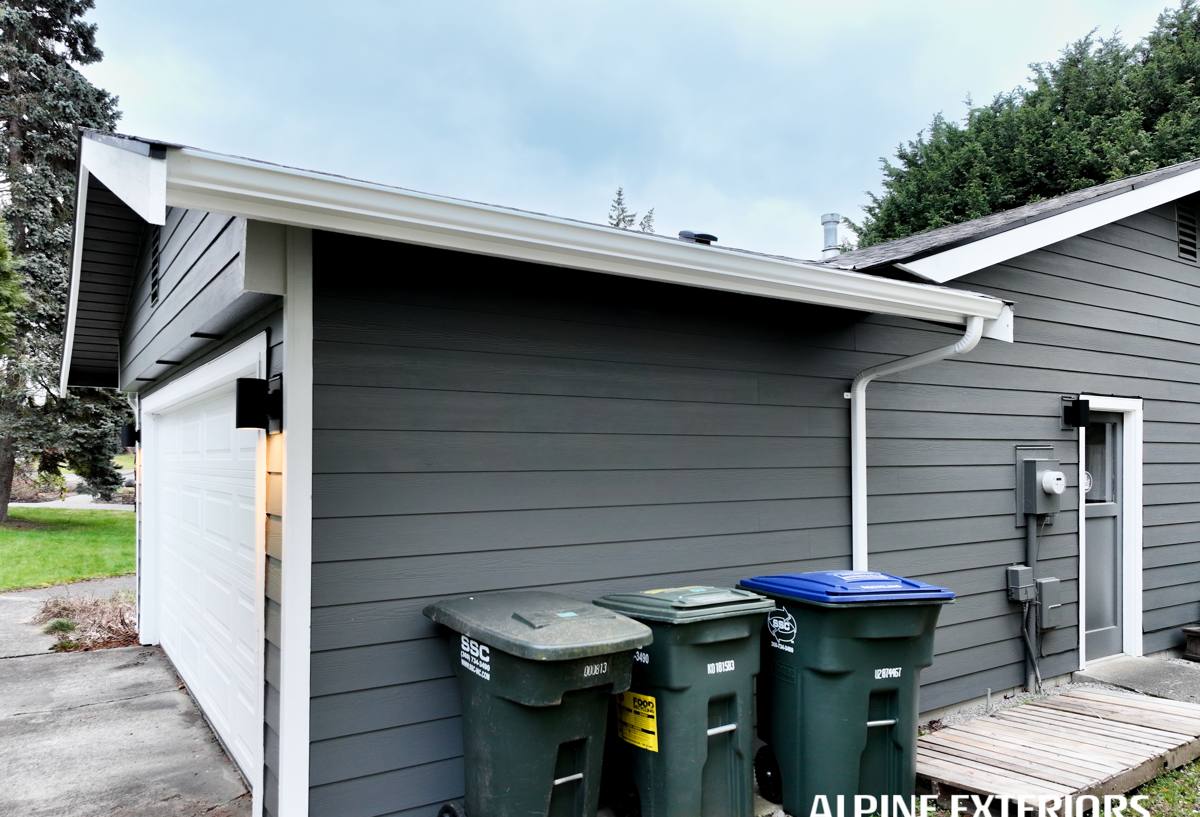
Board and batten has deep roots in this part of Washington. Walk or drive through Burlington and the surrounding Skagit Valley and you'll see the vertical-plank look on old farmhouses, barns, and packing sheds, and now on a growing number of new-construction and remodeled homes that want that same clean, linear character with a modern finish. The style reads as tall and simple — wide flat panels with narrow strips (battens) covering the seams — and it pairs well with the mix of farmhouse, craftsman, and contemporary homes going up around Burlington and greater Skagit County.
But board and batten isn't just an aesthetic choice here. The vertical orientation, when built correctly, sheds water differently than horizontal lap siding, and that matters in a county that sits between the Cascade foothills and Skagit Bay, where rain arrives sideways more often than most homeowners expect.
What Salt Air, Rain, and Moss Do to Vertical Siding Here
Skagit County's climate is hard on siding in three specific ways, and board and batten systems are not automatically immune to any of them:
- Salt air: Burlington's proximity to Skagit Bay and the greater Puget Sound means airborne salt reaches homes even a few miles inland. Over years, salt-laden moisture accelerates corrosion on fasteners, hardware, and any siding material that isn't engineered to resist it.
- Driving rain: Wind-driven rain off the Sound doesn't just fall on a wall — it pushes into every seam, joint, and batten gap. A board and batten system depends entirely on what's behind the boards (the water-resistive barrier, flashing, and drainage gaps) to manage that water once it gets past the surface, which it will.
- Long moss season: Skagit County's wet, mild fall-through-spring stretch is ideal moss and algae growth weather. Vertical siding traps less standing water on horizontal ledges than lap siding does, which helps, but any siding material that stays damp for long stretches — untreated wood, some composites — will feed moss growth at the base of walls, under eaves, and on the north-facing sides of a home that see the least sun.
None of this is unique to board and batten as a style. It's a function of what the boards are made of and how the system is built behind them — which is exactly where a lot of installations go wrong.
The James Hardie Board & Batten System We Install
We install James Hardie fiber cement exclusively, and for board and batten applications that typically means HardiePanel vertical siding paired with Hardie fiber cement battens, or Hardie's vertical panel and trim combinations depending on the look a homeowner wants. A few reasons this matters specifically for a Burlington home:
Built for This Climate Zone
James Hardie engineers its siding in climate-specific formulations, and homes in Skagit County fall under the HZ10 product line built for the Pacific Northwest's wet, moderate-temperature conditions. That's not marketing — it affects how the product handles moisture cycling over decades of Skagit County winters.
Non-Combustible, Dimensionally Stable
Fiber cement doesn't expand and contract with moisture the way wood does, which matters for board and batten specifically, because the batten strips are narrow and any material that swells or shrinks unevenly will telegraph gaps, cracking, or paint failure at every seam over time.
ColorPlus Factory Finish
Hardie's ColorPlus finish is baked on at the factory under controlled conditions, with better fade and moisture resistance than field-applied paint — which matters in a climate where a home's siding rarely gets more than a few dry weeks in a row to properly cure a job-site paint job.
Why We Don't Install Other Board & Batten Materials
Vinyl vertical panel systems are inexpensive and low-maintenance, but they flex and expand more in temperature swings, which shows at batten laps over time, and they don't offer the same fire performance. Cedar board and batten looks excellent when new, but it requires ongoing staining or sealing to hold up against Skagit County's rain and moss exposure — skip a maintenance cycle and a cedar wall can show rot at the base or around battens within a few seasons. Engineered wood products carry similar moisture-sensitivity trade-offs. We standardized on Hardie because it holds its finish, its shape, and its warranty coverage with the least ongoing maintenance burden for homeowners in this specific climate.
What Correct Installation Actually Involves
Board and batten is less forgiving of installation shortcuts than lap siding, because there are more vertical seams and more fastening points per square foot. A correct installation for a Burlington home includes:
- A continuous water-resistive barrier installed and lapped correctly behind the panels, not just a barrier that's present but improperly sequenced with flashing
- Proper flashing at every window, door, and roofline penetration — the single most common failure point on any vertical siding job
- A drainage gap or rainscreen approach so water that gets behind the panel has somewhere to go and dry out, rather than sitting against the sheathing
- Correct panel and batten fastening per Hardie's published installation specs — fastener type, spacing, and embedment all affect long-term performance and warranty validity
- Proper gaps at panel bottoms, corners, and trim to allow for drainage and prevent wicking
- Battens installed to cover panel seams fully with consistent reveal, both for appearance and to keep water from tracking sideways into a seam
Every one of these steps is inspectable, and every one of them is easy to skip on a rushed job. Skagit County's rain load doesn't give a poorly flashed wall much time before a problem shows up — sometimes inside the wall cavity long before it's visible on the surface.
Board & Batten Material Comparison
| Material | Moisture Behavior in This Climate | Maintenance | Typical Lifespan |
|---|---|---|---|
| James Hardie fiber cement | Dimensionally stable, resists moisture-driven warping and swelling | Occasional wash; factory finish holds color for years | Decades, with strong transferable warranty coverage |
| Cedar board and batten | Absorbs moisture; prone to cupping and checking without upkeep | Re-stain or reseal every few years, more often in wet exposure | Highly dependent on maintenance |
| Vinyl vertical panel | Expands/contracts with temperature; can show at seams over time | Low, but limited repair options if damaged | Variable; more UV and impact-sensitive |
| Engineered wood panel | Moisture-sensitive at cut edges and seams if not properly sealed | Ongoing sealing/inspection of edges recommended | Manufacturer-dependent |
Our Process, Start to Finish
For a Burlington board and batten project, our process starts with an on-site look at the home's exposure — which walls take the worst of the wind-driven rain off Skagit Bay, where moss is already established, and where existing trim or window flashing needs attention before new siding goes on. From there:
- We assess the existing wall assembly and remove old siding down to the sheathing so we can check for hidden moisture damage before it's covered up again
- We correct any sheathing or framing issues found during tear-off — this is common enough on older Skagit County homes that we build time for it into the plan
- We install the water-resistive barrier, flashing, and drainage components to spec
- We install HardiePanel and battens per James Hardie's fastening and spacing requirements, with attention to consistent reveal and clean corners
- We do a final walk-through so the homeowner sees the finished work and understands what maintenance, if any, is needed going forward
Living With Board & Batten in This Climate
One of the practical advantages of a correctly installed Hardie board and batten system in Skagit County is how little ongoing attention it needs compared to wood alternatives. Homeowners should still plan on an occasional gentle wash to knock back moss and algae on shaded or north-facing walls, and a periodic look at caulking around windows and trim, since caulk has a shorter service life than the siding itself. What they shouldn't need is repainting, re-staining, or chasing rot at the base of battens — the failure points that keep wood board and batten owners on a maintenance schedule year after year.
Cost Factors for a Burlington Board & Batten Project
| Factor | Why It Matters |
|---|---|
| Home size and wall complexity | More corners, gables, and dormers mean more cuts, seams, and flashing detail |
| Condition of existing sheathing | Older Skagit County homes sometimes need sheathing repair discovered at tear-off |
| Batten spacing and reveal chosen | Tighter batten spacing uses more material and labor time than wider spacing |
| Trim and window detail work | Board and batten's clean look depends on precise trim work around openings |
| Access and site conditions | Lot layout, height, and staging access affect labor time |
We walk every homeowner through these factors on-site rather than quoting a number sight unseen, since two homes of the same square footage can have very different scopes of work once we look at the actual walls.
Why a Local Skagit County Crew Matters
A board and batten installation is only as good as the details behind the boards, and those details are climate-specific. A crew that's used to building for the Skagit Valley's rain patterns and salt-air exposure flashes and drains a wall differently than a crew that mostly works drier inland climates. Before hiring anyone for a board and batten project in Burlington, it's worth asking:
- Do they install to James Hardie's published fastening and flashing specifications, and can they explain why?
- Have they worked on homes with similar exposure to wind-driven rain or coastal-adjacent salt air?
- Do they inspect and address sheathing condition during tear-off, or just cover over what's there?
- Can they explain how their drainage plane and flashing approach handles water that gets behind the panels?
- Do they offer manufacturer-backed warranty coverage tied to a certified installation?
If you're weighing board and batten for a home in Burlington or elsewhere in Skagit County, we're happy to take a look and talk through what your walls actually need — no pressure, no obligation. Reach out for a free estimate using the form below.