 Skagit County
 Bow sits close enough to Samish Bay that the water shapes almost everything about how a house here ages. Salt-laden air moves inland further than most homeowners expect, wind-driven rain hits walls at an angle instead of falling straight down, and a long, shaded moss season keeps north- and west-facing siding damp for months at a stretch. We install James Hardie fiber cement siding exclusively, and Bow is one of the areas in Skagit County where the gap between a correctly installed fiber cement wall and a rushed one shows up fastest.
What Bow's Climate Actually Does to Siding
The combination of open water to the west and low, flat farmland around Bow means there's little to slow weather down before it reaches a house. Salt air corrodes exposed fasteners and metal trim faster here than it would ten or twenty miles inland, and it does that work quietly — you usually don't notice until a fastener head is rusting through paint or a piece of trim is failing years before it should. Driving rain is the bigger issue for the siding itself: wind-pushed water finds horizontal laps, unsealed end joints, and any gap around a window or door that a calmer climate would never expose. And because so much of Skagit County's low ground and tree-shaded lots stay damp well into the dry months, moss and algae get a long runway to establish themselves on any surface that holds moisture, especially siding that isn't backed by a proper drainage gap.
None of this means a house in Bow is fighting a losing battle. It means the material and the installation details carry more weight here than they would in a milder, drier market, and that a generic approach to siding tends to fail sooner than it would somewhere less exposed.
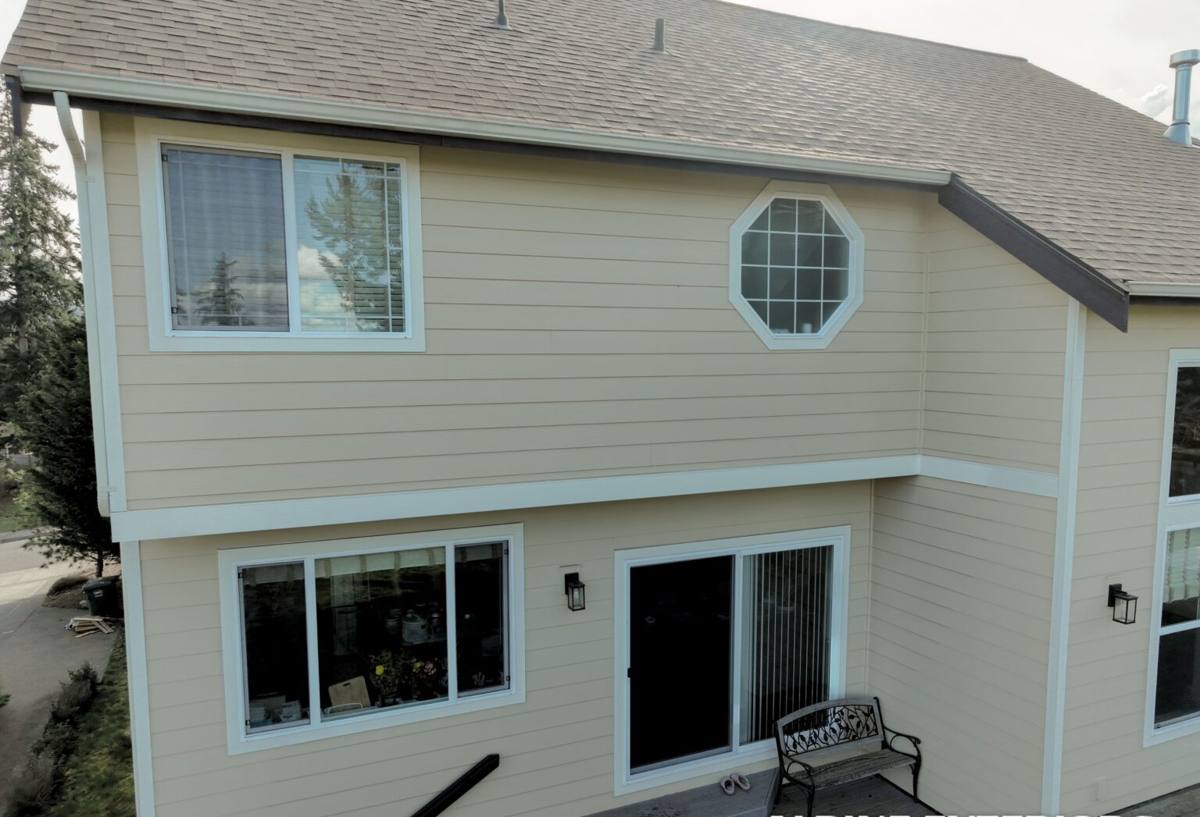
Why We Only Install James Hardie
Fiber cement is a cement, sand, and cellulose fiber composite — there's no organic wood core for moisture to work into over time, and it doesn't go brittle or chalky under years of UV and salt exposure the way some other materials can. That's the baseline reason it's a strong fit for Bow. We narrow it further to James Hardie specifically because their HZ5 product line is engineered for wet, moisture-heavy climates like the Pacific Northwest, and because their ColorPlus finish is baked on at the factory rather than brushed or sprayed on site — a real advantage in a spot that sees more wet-dry cycles per year than most inland markets.
What We Turn Down, and Why
Homeowners in Bow ask us about vinyl, LP SmartSide, primed wood, and cedar fairly often, usually because they're familiar or cost less up front. We don't install any of them. Vinyl depends on the barrier behind it staying intact for the long haul and can become brittle with age under coastal sun and salt exposure. Engineered wood siding uses a wood-strand core that's vulnerable if moisture reaches a cut edge, a fastener hole, or a poorly sealed joint — a real risk in a climate where wind-driven rain is routine rather than occasional. Primed wood and cedar both look good going up, but they need a genuine, ongoing maintenance schedule — recoating, caulk renewal, moss and mildew treatment — to keep performing, and that schedule only gets tighter in a place like Bow. None of these are bad products everywhere. We've just made a professional call that they're not the right standard for what this stretch of Skagit County does to a wall system, and we'd rather tell you that upfront than sell something we don't believe will hold up.
Matching the Product Line to This Specific Climate
James Hardie doesn't make one siding — they make several product lines engineered for different climate zones, and HZ5 is the version built for regions like ours: sustained rain, humidity, and freeze-thaw swings. That climate engineering shows up in how the board is formulated to resist moisture absorption and how it's tested to hold its ColorPlus finish under prolonged wet exposure rather than just intense sun. We spec HZ5 as the standard for Bow projects rather than treating fiber cement as one interchangeable product regardless of where the house sits.
ColorPlus Finish vs. Field-Applied Paint
A factory-applied finish cures under controlled conditions and bonds to the board in a way a job-site paint job can't fully replicate, especially when the weather during installation is exactly the kind Bow gets a lot of — damp, cool, and inconsistent. ColorPlus siding typically only needs field-applied paint at cut edges, which we seal with Hardie's touch-up products rather than whatever's left over from a previous job. That factory bond is also a big part of why the finish holds its color and resists the moss and algae growth that plague field-painted surfaces on shaded, damp lots throughout this part of the county.
What a Correct Installation Actually Involves
Fiber cement is a forgiving material in the sense that it doesn't rot or warp, but it's not forgiving of a rushed or careless installation. Most siding failures we get called out to inspect trace back to installation shortcuts, not the material itself.
The Details That Matter Most Here
- A drainage plane and rain screen gap behind the siding, so any moisture that does get past the surface has somewhere to go instead of sitting against the wall sheathing
- Fastener spacing and placement per Hardie's published specs — over-driven or under-driven nails are one of the most common causes of premature failure at the panel face
- Butt joints properly gapped, backed with flashing, and never simply caulked shut as the sole line of defense against water intrusion
- Corrosion-resistant fasteners and trim hardware, given how much faster standard fasteners corrode this close to open water
- Correct clearance between the bottom of the siding and grade, decks, or roof lines, so water doesn't wick up into the board over time
- Careful flashing and integration at every window, door, and penetration — the points where most water actually gets in
Every one of these is easy to skip and hard to notice from the ground once the wall is painted. They're also exactly the details that decide whether a fiber cement wall performs for its full service life or starts showing problems within a handful of wet seasons.
Cost Factors for Fiber Cement Siding in Bow
| Factor | Why It Matters |
|---|---|
| Wall condition underneath | Rot or moisture damage found during tear-off has to be repaired before new siding goes up, and it's common on older homes in a wet climate |
| Home size and wall complexity | More corners, dormers, and roof transitions mean more cuts, more flashing details, and more labor |
| Siding profile | Lap siding, board and batten, and panel systems differ in material use and installation time |
| Trim and window count | Every opening needs individual flashing and finish work, so more windows and doors add labor |
| Site access | Rural lots, long driveways, or limited staging space in and around Bow can add setup and material-handling time |
| Existing siding removal | Tear-off and disposal of the old material is a separate cost from the new installation itself |
We'll walk your specific house and give you real numbers based on what we find, not a rough per-square-foot guess. Two homes of similar size in Bow can land in very different places depending on wall condition, access, and how much of the original trim and flashing needs to be replaced along with the siding.
How the Job Actually Runs
- Walkthrough and assessment — we look at the existing siding, wall condition, and any moisture or rot issues before we quote anything
- Written estimate — a clear scope covering material, tear-off, prep, and installation, with the cost factors specific to your home spelled out
- Prep and repair — any damaged sheathing or framing found once the old siding comes off gets addressed before new material goes up, not papered over
- Drainage plane and installation — house wrap or building paper, rain screen where called for, and Hardie boards installed to manufacturer spec
- Trim, flashing, and detail work — the window, door, and penetration details that determine long-term performance
- Final walkthrough — we go over the finished work with you before calling the job done
Signs Your Siding in Bow Needs a Look
- Soft, spongy, or visibly warped panels, especially on north- or west-facing walls that stay shaded and damp longest
- Persistent moss or algae growth that returns quickly after cleaning, suggesting moisture is trapped behind the surface
- Rust streaking below fasteners or trim hardware, a common early sign of corrosion in salt-exposed areas
- Peeling or bubbling paint on wood-based siding, which often points to moisture working its way out from inside the wall
- Gaps opening up at butt joints or around window and door trim, which give wind-driven rain a direct path inward
- Visible daylight or drafts at interior wall penetrations, a sign that exterior water management has already failed
Why Hiring a Crew That Already Works Bow Matters
Manufacturer installation guides are written for average conditions, and Bow's conditions aren't average — the salt exposure, the volume of wind-driven rain, and the length of the moss season all push harder on a wall system than they would in a drier or more sheltered part of Skagit County. A crew that has actually installed fiber cement siding on homes in this specific area knows where to add rain screen even when it's not strictly required, which fastener spacing to hold to without cutting corners, and which trim and flashing details are worth the extra time here even though they'd be optional somewhere calmer. That local pattern recognition doesn't show up in a sales pitch, but it shows up in how the siding performs ten and twenty years out.
It also matters for the practical side of the job — knowing realistic timelines around Bow's weather windows, understanding rural lot access and material staging, and being familiar with how Skagit County permitting and inspection typically runs for exterior work. None of that replaces a correct installation, but it's part of what keeps a project moving without surprises.
If you're weighing fiber cement siding for a home in Bow, we're glad to walk the property, talk through what your specific walls are dealing with, and give you a straightforward, no-pressure estimate. There's a form below — reach out and we'll get a time on the schedule.