 Skagit County
 Cedardale's Climate Is Harder on Siding Than It Looks
Cedardale sits in that stretch of Skagit County where the marine air off Puget Sound and the surrounding sloughs mixes with heavy seasonal rainfall and long stretches of overcast, damp weather. It doesn't look extreme on paper, but it's a slow, steady kind of punishment: salt-laden air that accelerates corrosion on fasteners and trim, driving rain that finds every gap in a wall system, and a moss season that can run from fall through spring on north- and west-facing walls. None of these are dramatic events. They're just constant, and constant is what wears siding out early.
Homes in Cedardale that were sided with materials not suited to this pattern — or sided correctly with the wrong assumptions about maintenance — tend to show it in predictable places: near grade, at butt joints, around window trim, and on the shaded sides of the house where moss and mildew get a foothold and stay there. Fiber cement siding, installed correctly, is one of the few claddings that holds up to this combination without constant upkeep. That's why it's the only siding material we install, in Cedardale and everywhere else we work in Skagit County.
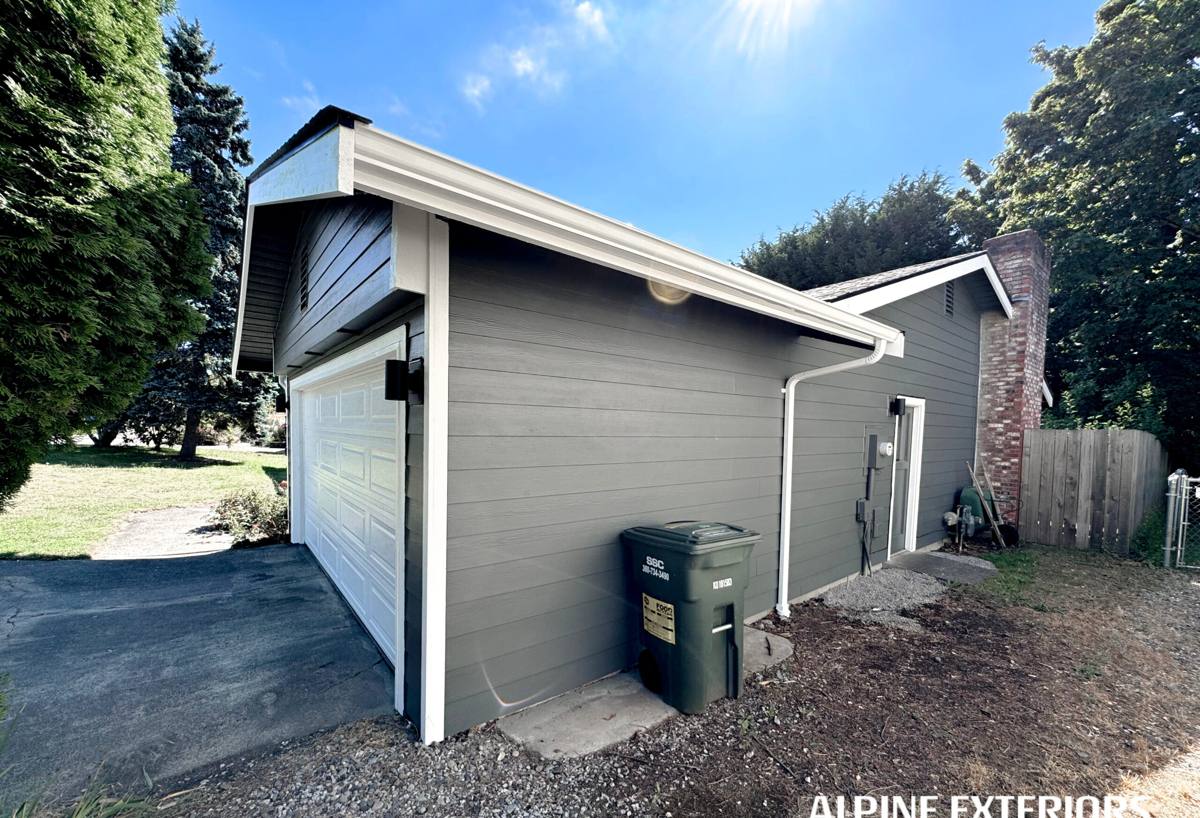
Why We Only Install James Hardie Fiber Cement
There are other fiber cement and engineered wood products on the market, and some of them are reasonable products in the right application. We made a decision, as a company, to standardize on James Hardie for every siding job we take on — including here in Cedardale — for a few concrete reasons:
- Non-combustible core. Fiber cement doesn't provide fuel the way wood-based products can, which matters in a region that sees wildfire smoke and dry-season risk even west of the Cascades.
- Factory-cured ColorPlus finish. A baked-on finish resists the fading and peeling that field-applied paint eventually suffers under constant UV and moisture cycling.
- Climate-engineered product lines. Hardie builds regional formulations (HZ5, HZ10) specifically for moisture and freeze/thaw exposure, rather than one generic board for the whole country.
- Warranty structure. A transferable, manufacturer-backed warranty that survives a home sale — something that matters if a Cedardale homeowner sells within the warranty window.
We're not going to tell you every other product is junk — some have real strengths. But we won't put our name on an install using a product we don't trust to perform through fifteen or twenty Skagit County winters without babysitting. That's the whole reason we standardized.
What a Correct Fiber Cement Install Actually Involves
Fiber cement siding fails early almost exclusively because of installation mistakes, not because the material itself gave out. In a climate like Cedardale's, the details that get skipped on a rushed job are exactly the details that cause problems two or three winters later. A correct install includes:
Moisture Management Behind the Siding
A properly lapped weather-resistive barrier, correctly integrated flashing at every window, door, and penetration, and a rainscreen gap where the wall assembly calls for one. This is what actually keeps driving rain from reaching the sheathing — the siding itself is the second line of defense, not the first.
Clearances and Fastening
Hardie specifies minimum clearances from grade, roof lines, and decks — typically 6 inches from grade and 1-2 inches from roofing and horizontal surfaces, depending on the detail. Fasteners need to be corrosion-resistant and driven correctly, not overdriven, which is a common shortcut on production-speed crews.
Joint Treatment and Caulking
Butt joints either need to be flashed with H-channel or properly caulked with a high-quality, paintable sealant rated for the exposure. Skipped or undersized caulk joints are one of the most common failure points we find on homes in this area that were sided by out-of-town or one-time crews.
Finish and Touch-Up
ColorPlus finished boards need factory-matched touch-up product at cut edges and any field damage — not a generic exterior paint that will weather differently than the rest of the board within a couple of years.
Our Process on a Cedardale Job
| Step | What Happens |
|---|---|
| Assessment | We walk the exterior, check for moisture intrusion, moss buildup, trim rot, and existing flashing condition before quoting anything. |
| Product selection | We match the Hardie plank, panel, or shingle profile and HZ formulation to the wall's actual sun/shade and rain exposure. |
| Tear-off and inspection | Existing cladding comes off so we can inspect sheathing and framing for hidden damage before it gets covered up again. |
| Weather barrier and flashing | Housewrap or building paper installed correctly-lapped, with flashing integrated at every opening. |
| Installation | Siding installed to Hardie's fastening, clearance, and joint specifications — not shortcuts to save labor hours. |
| Trim, caulk, and touch-up | Final detailing at corners, joints, and cut edges using matched finish product. |
| Walkthrough | We review the finished job with the homeowner and explain what maintenance, if any, to expect going forward. |
Fiber Cement vs. Other Claddings in This Climate
We get asked why we won't install vinyl, LP SmartSide, cedar, or primed spruce on Cedardale homes. It's not that these products can't be installed — it's that none of them hold up to salt air, driving rain, and moss exposure the way properly installed fiber cement does, without a maintenance burden most homeowners don't want to sign up for.
| Factor | Fiber Cement (Hardie) | Vinyl | Wood / Engineered Wood |
|---|---|---|---|
| Moisture absorption | Very low, non-organic core | Doesn't absorb, but seams/gaps let water behind it | Absorbs moisture, prone to swelling and rot over time |
| Moss and mildew resistance | Resists growth on the surface with normal cleaning | Moss can grip textured surfaces | Organic surface actively feeds moss and mildew |
| Salt air / corrosion exposure | Non-corrosive material, corrosion-resistant fasteners specified | Doesn't corrode but embrittles with UV/salt over decades | Fasteners and surface both vulnerable over time |
| Finish longevity | Factory-baked ColorPlus, resists fade and peel | Color molded in, but can chalk and fade | Field paint/stain needs reapplication every few years |
| Fire performance | Non-combustible | Combustible, can deform in heat | Combustible |
Signs a Cedardale Home's Siding Is Already in Trouble
Because the damage from this climate is gradual, most homeowners don't notice until it's well underway. Walk your exterior and look for:
- Persistent moss or black-green staining on north- or west-facing walls that comes back within weeks of cleaning
- Soft or spongy trim boards, especially around window sills and near ground contact
- Visible gaps opening up at butt joints or corner boards
- Paint that's peeling or bubbling rather than just fading evenly
- Bulging, wavy, or separated panels, particularly on the weather side of the house
- Rust streaking from fasteners bleeding through the finish
- Musty smell or visible staining on interior walls that share an exterior wall with heavy moss growth
Any one of these on its own isn't necessarily an emergency. Several together, especially combined with a siding material that's already past its expected service life, usually means it's time for a real assessment rather than another round of patching.
Why a Crew That Already Works Cedardale Matters
Cedardale is a small enough community that it doesn't always get the same attention from larger regional contractors headquartered in Seattle or south of Skagit County. A crew that already works this specific area understands the local permitting process through Skagit County, knows which wall orientations in the neighborhood tend to take the worst of the weather, and has already seen how different Hardie profiles perform on homes with similar exposure. That local pattern recognition is worth more than it sounds — it means fewer surprises mid-job and a finished install that's actually matched to how this specific piece of Skagit County weathers a house.
Maintenance After Installation
Correctly installed Hardie siding in Cedardale's climate is low-maintenance, not no-maintenance. Plan on:
- An annual rinse-down, focused on shaded sides where moss and mildew build up
- A visual check of caulked joints every year or two, resealing anything that's cracked or pulled away
- Prompt touch-up of any chips or gouges using matched ColorPlus touch-up product, before moisture gets behind the finish
- Keeping gutters clear and grading/vegetation pulled back from clearance zones at the base of the walls
That's a fraction of the upkeep wood siding demands, and it's the difference between a 30-plus year install and one that needs attention again in a decade.
If you're in Cedardale and dealing with aging, moss-covered, or failing siding — or planning ahead before it gets there — we're happy to take a look and give you a straight, no-pressure estimate. There's a form right below to get that started.