 Skagit County
 Why Decks in Mount Vernon Take More Abuse Than People Expect
Mount Vernon sits low in the Skagit Valley, surrounded by farmland, river bottom, and enough tree cover that a lot of backyards stay shaded and damp well into the afternoon. Add in the marine air that moves up through Skagit County off the Sound, and you get a climate that's rarely dry for long. Rain here isn't just frequent, it's the slow, soaking kind that sits on horizontal surfaces for hours. A deck is one of the most exposed structures on a house because it takes that moisture from above, below, and the sides all at once.
That combination of moisture and shade is exactly what moss, algae, and mildew need to take hold. In a lot of Mount Vernon yards, especially ones backed up to trees or facing north, the moss season isn't really a season anymore, it's most of the year. On a wood deck, that means a surface that's slick when wet, and boards that hold water against the grain longer than they should. On any decking material, it means the finish and the fasteners need to be chosen with that reality in mind, not the drier climate that a lot of decking products are actually engineered and marketed for.
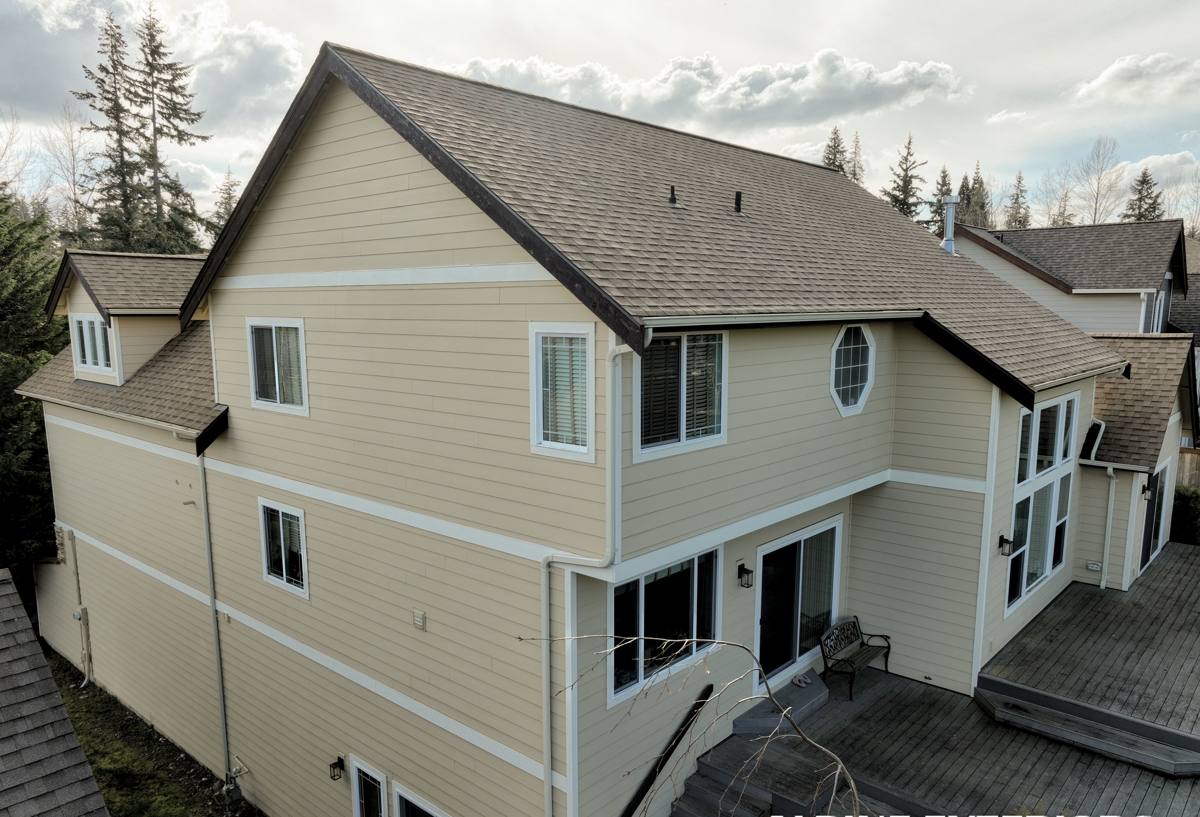
What Composite Decking Solves in This Climate
Composite decking exists specifically to deal with the failure modes that wood struggles with here: rot, splintering, warping, and the constant maintenance cycle of stripping and re-sealing. That doesn't mean every composite board or every installation handles Skagit County conditions equally well, but the material category itself is a legitimate answer to a real local problem.
Where Wood Struggles Locally
Pressure-treated and cedar decking both need a sealant or stain reapplied on a schedule to stay water-resistant, and in a climate that gives you fewer good drying days per year, that schedule gets harder to keep up with. Skip a season and the boards start absorbing water at the end grain, which is where checking, cupping, and eventually rot start. Add moss growth on top of that and you've got a surface that's both losing structural integrity and becoming a slip hazard at the same time.
Where Composite Holds Up
A quality composite board doesn't absorb water the way solid wood does, so it isn't feeding the same rot cycle. It doesn't need staining or sealing, which removes the maintenance task that most homeowners here fall behind on. It also won't splinter, which matters on a deck that's wet and used barefoot for a good chunk of the year. That said, composite isn't maintenance-free, and we tell people that up front instead of overselling it. Moss and algae will still grow on the surface of any decking material if it's shaded and damp long enough. The difference is that on composite, cleaning it off doesn't damage the material the way pressure washing can chew up soft wood fibers.
What a Correct Composite Deck Installation Actually Involves
Composite decking has a reputation for being simple to install, and the boards themselves are more forgiving than wood in some ways. But most of the composite deck problems we get called out to inspect in Skagit County trace back to shortcuts in the structure underneath, not the boards on top.
Substructure and Framing
Composite is heavier than wood decking and behaves differently under load and temperature swings. Joist spacing needs to match the manufacturer's specification for the specific board profile, and in a wet climate we typically tighten that spacing rather than relying on the minimum, especially on stair treads and cantilevered sections. Any wood framing underneath still needs to be treated lumber and still needs to be protected from standing water, because composite boards don't rot but the frame holding them up still can.
Ventilation and Drainage Underneath
This is the piece that gets skipped most often, and it's the one that matters most in a climate like ours. A deck built low to the ground, or over a patio, or against a house wall without a gap, traps moist air underneath the boards. That trapped moisture doesn't hurt the composite decking directly, but it accelerates rot in the joists, corrosion in fasteners, and it's a major contributor to mold and mildew smell coming up through the boards. Correct grading below the deck, gaps at the perimeter, and keeping the structure off grade all matter more here than they would in a drier region.
Fastening and Hidden Clip Systems
Most composite lines are designed for hidden fastener systems rather than face-screwing, both for appearance and because it reduces the number of penetration points where water can work its way into the board core. We use stainless or coated fasteners rated for ground contact and coastal-adjacent moisture exposure, because a cheap fastener corroding under a board is a slow, hidden failure that shows up as a squeak or a loose board a couple years down the road.
Board Selection and Manufacturer Specifications
Not all composite is built the same. Capped composite boards have a plastic shell around a wood-plastic composite core, which handles our rain and humidity noticeably better than older, uncapped composite formulations that can still absorb moisture at cut ends and swell over time. We follow the manufacturer's expansion gap, fastener, and ventilation requirements exactly, because those specs are usually written with a climate like this one in mind, and ignoring them is how warranties get voided.
Comparing Decking Materials for a Mount Vernon Backyard
| Material | Moisture Behavior Here | Maintenance | Typical Lifespan |
|---|---|---|---|
| Pressure-treated wood | Absorbs water; prone to cupping and checking in shaded, damp yards | Annual cleaning, periodic staining/sealing | 10-15 years with upkeep |
| Cedar | Naturally rot-resistant but still needs sealing to shed our rain long-term | Regular sealing, more frequent in shaded areas | 15-20 years with upkeep |
| Uncapped composite | Can absorb moisture at cut edges; older formulations prone to mold in shade | Periodic cleaning; no staining | 15-20 years |
| Capped composite | Best moisture resistance of the group; shell resists staining and swelling | Occasional washing | 25-30 years |
We're honest that capped composite costs more up front than wood or uncapped composite. In a climate that doesn't give you many dry weeks to do maintenance in, that upfront cost is what buys back the time and labor you'd otherwise spend fighting moisture every year.
How We Approach a Composite Deck Project
We start with a site walk, not a sales pitch. That means looking at drainage on the lot, how much sun or shade the deck area actually gets through the seasons, what the existing structure looks like if we're resurfacing versus building new, and how the deck will be used. A deck tucked under mature trees on a shaded lot gets a different ventilation and cleaning conversation than one out in the open.
From there we put together a plan that covers the substructure work, drainage or grading corrections if needed, board and color selection, and fastening system, so there are no surprises once the crew is on site. During installation we check expansion gaps, ventilation clearances, and fastener spacing as we go rather than at the end, because those are the details that are hard to fix after the fact. We finish with a walk-through so you know exactly what maintenance, if any, the specific board line we installed actually needs.
Maintaining a Composite Deck Through Skagit County's Moss Season
Composite decking cuts down maintenance significantly, but "low maintenance" isn't "no maintenance," especially with the amount of moss pressure a lot of Mount Vernon properties deal with. A basic seasonal routine keeps a composite deck looking and performing the way it should:
- Sweep debris, leaves, and needles off regularly, especially in fall, so organic matter isn't sitting wet against the boards
- Rinse the surface periodically through the wet months to keep algae and moss spores from getting a foothold
- Clean with a soft-bristle brush and a manufacturer-approved deck cleaner if moss does appear, rather than a wire brush or high-pressure setting that can damage the cap
- Keep gutters and downspouts near the deck clear so runoff isn't draining directly onto the decking or the structure below
- Check that furniture and planters aren't sitting in the same spot long enough to trap moisture underneath
- Confirm the gap between boards and against the house or fascia hasn't been blocked by mulch, plantings, or debris buildup
Common Mistakes We See on Existing Decks in the Area
A lot of the composite decks we get called to inspect or repair in Mount Vernon weren't installed badly because of the boards, they were installed without accounting for local conditions. The most common issues are decks built too low to the ground without adequate ventilation underneath, fastener spacing stretched to the maximum allowed instead of tightened up for our wetter climate, and boards installed without the manufacturer's specified expansion gap, which leads to buckling once the material moves seasonally. We also see a fair number of decks where the framing underneath was never upgraded to match the heavier composite load, which shows up as bounce or sag well before the decking itself shows any wear.
Why It Matters to Hire a Crew That Already Works in Mount Vernon
A composite deck built to a generic national spec sheet can still fail here if the crew installing it hasn't accounted for how wet this valley stays and how long the shade lingers on a typical lot. Local experience means knowing which yards need extra ventilation clearance, which slopes need regrading before a deck goes in, and which board lines actually hold up to a Skagit County winter versus ones that look fine on a showroom sample. It also means we're not disappearing after the install. If a manufacturer defect or a drainage issue shows up two winters from now, we're still a local call away, not a name on a warranty card for a company that only worked in the area for one season.
Get a Straight Answer on Your Deck Project
If you're planning a new composite deck or replacing an aging wood one, we'll walk the site, look at drainage and sun exposure, and give you a straightforward estimate with no pressure to decide on the spot. Use the form below to request a free estimate for your Mount Vernon property.