 Skagit County
 Building Decks on the March Point Peninsula
March Point sits out on its own finger of land between Fidalgo Bay and Padilla Bay, which means almost every home here deals with water on more than one side. That's a great location for a deck — you get views and breeze that inland Skagit County homes don't — but it's also a tougher environment to build in. Salt-laden air moves across the peninsula more or less constantly, wind-driven rain comes in sideways more often than it falls straight down, and the wet months bring a moss season that can turn bare wood green in a single winter. A deck built to a generic spec sheet doesn't hold up well out here. A deck built for March Point's actual conditions does.
This page is about custom deck construction and replacement specifically for March Point properties — what the local climate demands, what a correctly built deck looks like underneath the surface, and how we approach the job from first walk-through to final inspection.
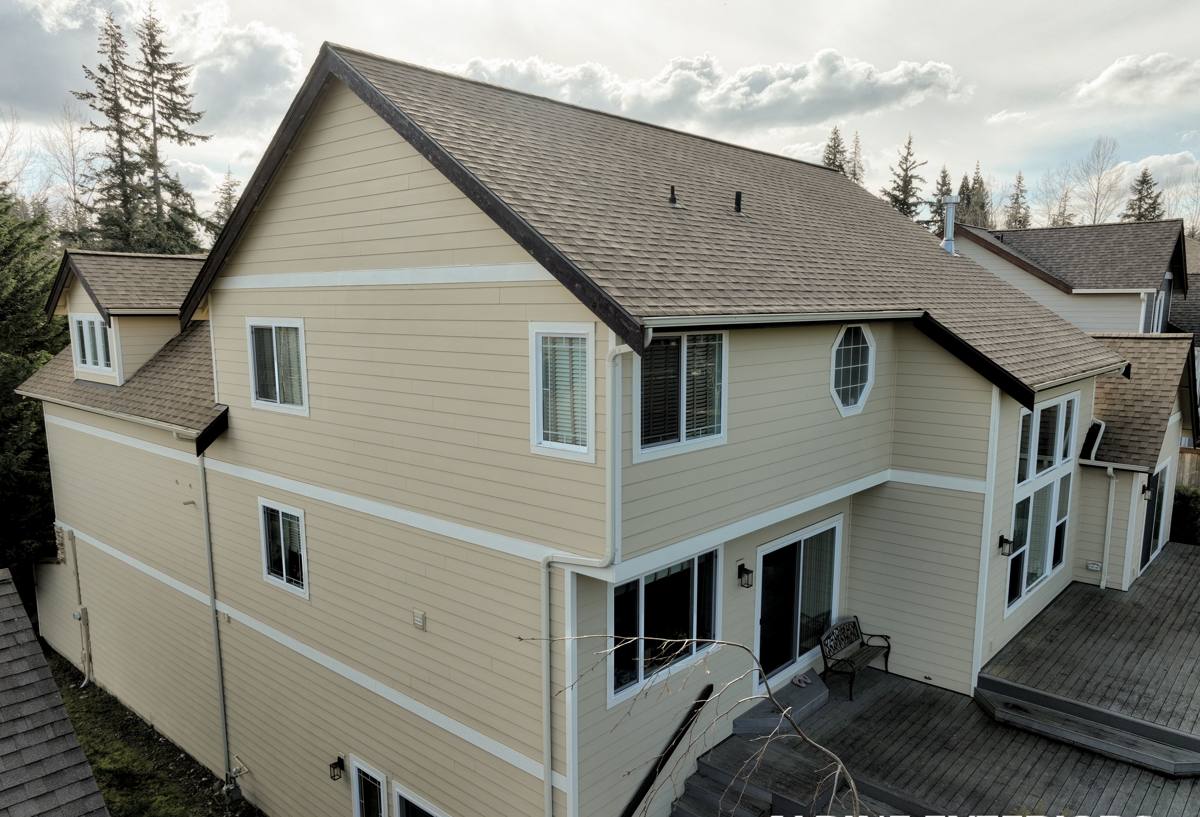
What Salt Air and Driving Rain Actually Do to a Deck
It's worth understanding the failure modes before talking about how we prevent them, because they explain every decision that follows.
Salt Air and Metal Fasteners
Airborne salt is corrosive to standard fasteners. Nails, screws, and structural hardware that would last decades in a dry inland yard can start rusting within a few years on a peninsula lot. Once a fastener corrodes, it loses holding strength — and on a deck, that's not cosmetic, it's structural. Rust stains bleeding out around screw heads or joist hangers are a visible sign that the wrong hardware went in.
Driving Rain and Water Intrusion
Wind off the bay pushes rain at an angle, which means water gets forced into places a straight-down rain never would: up under ledger board flashing, behind rim joists, into end-grain cuts on decking boards. Standing or trapped moisture is what rots framing and delaminates lower-grade composite decking from the inside out, long before the surface looks bad.
Moss and Algae Growth
Skagit County's wet season gives moss and algae months to establish themselves on any surface that stays damp and shaded — under railings, in board gaps, on the north side of a deck that doesn't get much sun. Beyond looking bad, a mossy deck surface is a slip hazard, especially on stairs.
Designing for the Site, Not Just the Structure
A deck on a peninsula lot needs a few things worked out before a single post goes in the ground.
Orientation and Exposure
Where the deck faces relative to prevailing wind and rain direction changes how much weather it actually takes. A deck oriented to catch the view often also catches the worst of the driving rain — that's not a reason to avoid the good view, it's a reason to detail the flashing and fastener choices more carefully on that side.
Ground Conditions Near the Bay
Soil closer to Fidalgo Bay and Padilla Bay can run wetter and less consistent than soil further inland, which affects footing depth and how we size and place posts. We check ground conditions on-site rather than assuming a standard footing spec will work everywhere on the peninsula.
Drainage Under and Around the Deck
Water needs somewhere to go — off the deck surface, and away from the framing underneath. Grading, gaps between boards, and how the substructure sheds water all matter more here than on a dry inland lot, because there's simply more water to move.
Material Choices for a Salt-Air Climate
There's no single "best" decking material for every home — it depends on budget, maintenance appetite, and how close the deck sits to open water. Here's how the common options actually perform in this specific environment.
| Material | Salt Air Performance | Maintenance | Notes |
|---|---|---|---|
| Cedar | Naturally rot- and insect-resistant; needs sealing to handle salt exposure long-term | Annual cleaning, periodic re-staining or sealing | Classic look; requires more upkeep near the water than inland |
| Pressure-Treated Fir/Pine | Decent if properly sealed; end cuts and fastener points are weak spots | Regular sealing, watch for checking and splitting | Budget-friendly; best for framing, less ideal as a finish surface this close to the bay |
| Composite Decking | Good — doesn't rot, but quality varies a lot by product | Occasional washing; no staining or sealing | Higher upfront cost, lower long-term maintenance; we're selective about which composite lines we install here |
| PVC/Capped Decking | Very good — fully sealed surface resists moisture and salt | Low; occasional cleaning | Highest upfront cost; best long-term option for exposed, water-facing decks |
We don't push one material on every job. A protected deck on the inland side of a March Point property has different needs than an open, water-facing deck catching full wind and spray — we talk through the trade-offs for your specific site rather than defaulting to whatever's easiest to install.
What Goes Into a Deck That Actually Lasts Out Here
Fastener and Hardware Selection
This is the detail that separates a deck that holds up from one that starts showing rust streaks in year three. In a salt-air environment, we use stainless steel or marine-grade coated fasteners and structural hardware — joist hangers, post bases, ledger bolts — rather than standard galvanized components that are fine inland but undersized for this exposure.
Ledger Attachment and Flashing
The ledger board — where the deck attaches to the house — is the single most common source of hidden rot on any deck, and driving rain makes it worse. Proper flashing that directs water out and away from the house wall, rather than letting it wick behind the ledger, is non-negotiable on a March Point build.
Board Spacing and Airflow
Correct gapping between deck boards lets water drain through instead of pooling, and lets air move underneath to keep framing dry between storms. Too tight, and you're building a moss farm; too wide, and you're compromising the walking surface for no benefit.
Railings and Guard Framing
Railings take direct wind load in a way other parts of the deck don't, especially on an elevated deck facing open water. We size and fasten railing posts to hold up under sustained wind, not just to pass a quick visual check.
Stairs
Stair treads are where moss and slip risk matter most. Tread spacing, surface texture, and drainage all get extra attention on stair sections specifically.
Our Process, Start to Finish
- On-site walk-through: we look at exposure, existing structure (for replacements), grading, and ground conditions before recommending anything.
- Design and material conversation: we go over the trade-offs in the table above against your budget and how much maintenance you actually want to do.
- Permitting: deck projects in Skagit County typically require a permit depending on size and height — we handle that process as part of the job.
- Demolition and disposal (replacement projects): removing the old deck and hauling away debris.
- Framing and footings: built to the ground conditions and structural loads for your specific lot, with corrosion-resistant hardware throughout.
- Decking, railing, and stair installation: using the material and detailing decided on up front.
- Final walkthrough: checking the deck with you before we consider the job done.
Maintenance That Actually Matters Near the Water
Even a well-built deck needs some upkeep in this climate — but the right maintenance is targeted, not a full annual overhaul.
- Rinse off salt residue and debris a few times a year, more often on decks facing open water
- Check board gaps and drains for buildup that traps moisture
- Look at fastener heads and hardware once a year for early rust — catching it early is cheap, ignoring it isn't
- Clean moss and algae off the surface and stairs before it builds up into a slip hazard, especially heading into fall and winter
- Re-seal or re-stain wood decking on the schedule appropriate to that product — don't wait until it's visibly gray and dry
- Have the substructure looked at periodically, especially around the ledger connection, since that's the area most prone to hidden problems
Repair, Not Always Replacement
Not every deck problem on the peninsula means starting over. Rotted ledger connections, failing railings, or a handful of damaged boards can often be repaired without rebuilding the whole structure — as long as the underlying framing is still sound. Part of our job on any repair call is telling you honestly whether a repair will actually hold up given the exposure, or whether the smarter long-term move is a partial or full rebuild. We'd rather give you that answer straight than sell a patch job that fails again in two years.
Why a Local Skagit County Crew Matters for This Job
Deck construction that works fine in a dry inland climate can fail early on a water-facing March Point lot if it's built to a generic spec. Working regularly in Skagit County means we've seen how salt exposure, driving rain, and the local moss season actually play out on decks over years, not just at the point of installation — which shapes the fastener, flashing, and material calls we make before problems show up. We're also familiar with the county's permitting process, so that part of the job doesn't stall your timeline.
If you're planning a new deck or need to deal with one that's showing its age, we're glad to come take a look and talk through what your specific site actually needs. Reach out for a free, no-pressure estimate using the form below.