 Skagit County
 Anacortes' Marine Climate and What It Does to a Roof
Anacortes sits right where the Salish Sea meets Skagit County, and that location shapes everything about how a roof ages here. Salt-laden air off the water accelerates corrosion on exposed metal fasteners, flashing, and vents. Driving rain off Rosario Strait and Guemes Channel doesn't fall straight down the way it does further inland — wind-driven rain gets pushed sideways and upward under shingle edges, valleys, and eaves if the underlayment and flashing details aren't built for it. Add in the shade from mature fir and cedar trees common on Anacortes lots, and you get a roof surface that stays damp longer after every storm, which is exactly what moss and algae need to take hold.
None of this means a roof in Anacortes needs to be exotic or overbuilt. It means the installation details that get skipped on an easier job — proper underlayment coverage, correctly lapped flashing, fastener choice, and real ventilation — matter more here than they do on a roof twenty miles inland. A new roof installed for this climate should be judged on those details, not just on the shingle brand.
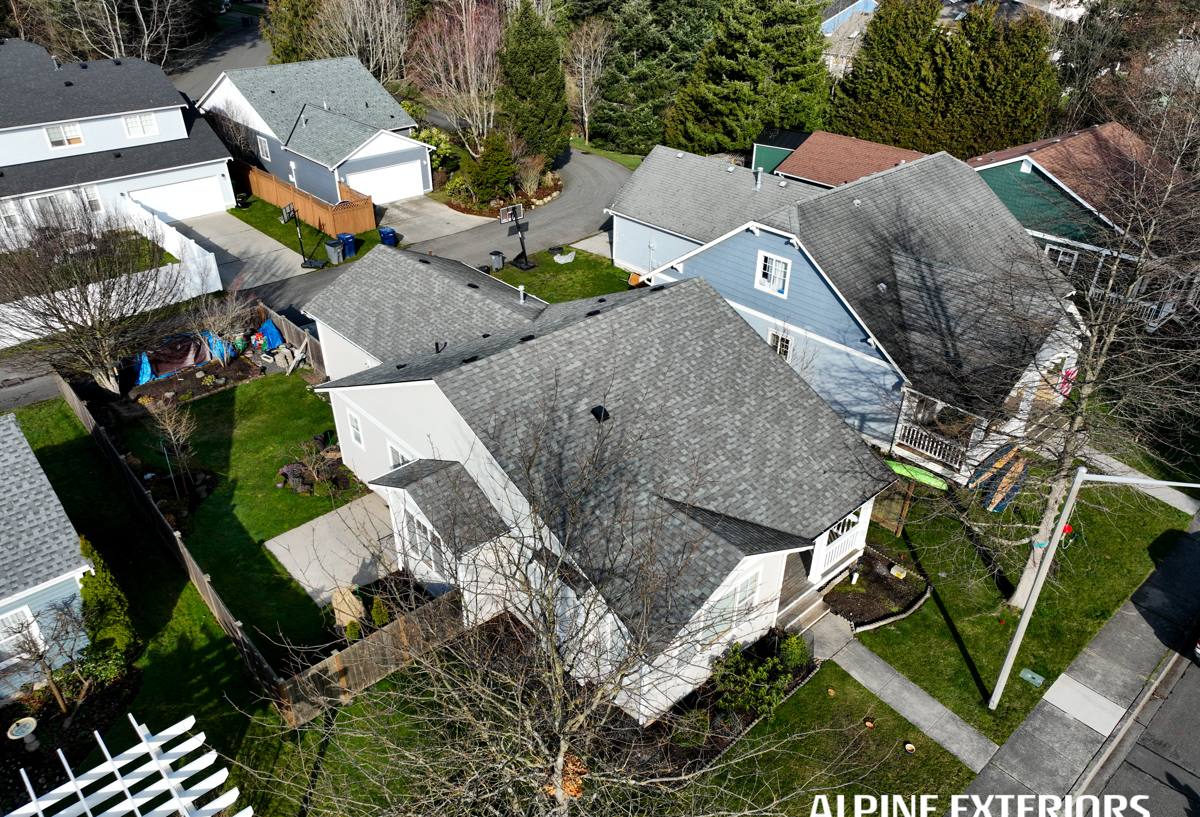
What "Correct" Roof Installation Means Here
A new roof is a system, not a single product. The shingles or panels are the most visible layer, but they're the last line of defense, not the only one. A correct installation for a Skagit County coastal property includes:
- A full tear-off to bare decking so the sheathing can actually be inspected, not roofed over
- Repair or replacement of any water-damaged or rotted decking before anything else goes down
- A synthetic or felt underlayment rated for the exposure, with extra coverage at eaves and valleys
- Ice-and-water shield membrane at vulnerable points, even though Anacortes rarely sees hard freeze conditions, because that membrane also does the job of stopping wind-driven rain intrusion
- Corrosion-resistant fasteners and flashing appropriate for a marine-influenced environment
- Balanced intake and exhaust ventilation sized to the attic, not just a couple of vents added for looks
Skip any one of these and the roof will still look finished on installation day. The problems show up eighteen months to five years later, usually as a soft spot in the decking, a leak at a valley, or premature granule loss where wind-driven rain has been finding a way in that a straight-down rain never would.
Choosing a Roofing Material for Salt Air and Driving Rain
There's no single "best" roofing material for Anacortes — the right choice depends on the home's exposure, the roof's pitch, budget, and how much long-term maintenance the homeowner wants to take on. What matters is understanding the real trade-offs for a coastal Skagit County climate rather than picking based on price alone.
| Material | Moisture & Moss Behavior | Salt Air Considerations | Typical Maintenance |
|---|---|---|---|
| Architectural asphalt shingle | Algae-resistant (AR) versions resist staining better than standard shingles | Performs well; fasteners and flashing metal matter more than the shingle itself | Periodic moss removal and gutter clearing |
| Standing seam metal | Sheds water and moss very effectively due to steep, smooth profile | Needs a coastal-grade coating or finish to resist salt corrosion over decades | Low; occasional fastener and sealant check |
| Synthetic/composite shake or slate | Good moisture resistance, doesn't absorb water like real wood | Generally stable in salt air; check manufacturer coastal warranty terms | Low to moderate |
| Cedar shake | Attractive but holds moisture and is the most moss-prone option in a shaded, damp climate | Salt air plus repeated wet-dry cycles shortens service life without diligent upkeep | High — regular treatment and moss control required |
We don't refuse to install any of these materials, but we're honest about which ones fit a given roof. On a heavily shaded, north-facing slope near the water, we'll tell a homeowner up front that cedar shake means a real ongoing maintenance commitment, and we'll walk through algae-resistant asphalt or a composite alternative as options that get a similar look with less upkeep.
Shingle Rating Matters More on Exposed Lots
Anacortes has plenty of lots with open water exposure or elevated positions with no windbreak. For those roofs, we pay attention to the wind and impact rating of the shingle line, not just its algae resistance, and we make sure the fastening pattern matches what the manufacturer specifies for high-exposure installs — that's a warranty condition on most product lines, not an optional upgrade.
Ventilation, Flashing, and Underlayment: The Parts You Don't See
Most of what determines whether a new roof lasts its full expected lifespan in this climate is invisible once the job is done. Three systems do the real work:
Ventilation
A damp climate means attic moisture has fewer chances to dry out between storms. Without balanced intake (soffit) and exhaust (ridge or box vents) ventilation, moisture gets trapped, which can rot decking from underneath and encourage mold regardless of how good the shingles are. We calculate ventilation based on attic square footage, not a flat "add a couple of vents" approach.
Flashing
Anywhere two roof planes meet, or the roof meets a wall, chimney, or skylight, is where wind-driven rain finds its way in. Flashing has to be layered correctly with the underlayment — installed in the right order, not just caulked over gaps — so water is directed out and down rather than sealed in.
Underlayment Coverage
Standard underlayment is fine on straightforward roof fields, but valleys, eaves, and low-slope sections benefit from self-adhering membrane that seals around fastener penetrations. On a roof exposed to sideways rain off the water, that extra membrane at the vulnerable spots is often the difference between a dry attic and a slow leak that isn't found for a year.
Moss, Algae, and the Long Wet Season
Skagit County's moss season runs long, and Anacortes' mix of marine humidity and tree cover makes it worse than many neighboring areas. Moss isn't just cosmetic — its root structure lifts shingle edges and holds water against the roof deck, which shortens the life of even a well-installed roof if it's left unmanaged.
A new installation can be set up to fight this from day one:
- Algae-resistant (AR) shingles with copper or zinc granules built in, where the product line offers them
- Zinc or copper strips installed near the ridge on moss-prone slopes, letting rainwater carry trace metal down the roof to inhibit regrowth
- Correct shingle overlap and nailing so moss and debris can't work into lifted edges
- A gutter and downspout layout that actually clears water instead of letting it back up under the eaves
None of this eliminates the need for periodic moss removal on a shaded roof — no roofing product does that — but it significantly reduces how often it's needed and how much damage moss can do before it's caught.
Our New Roof Installation Process
The steps don't change much from job to job, but the amount of attention paid at each one is what separates a roof that holds up on the water side of Skagit County from one that doesn't.
- Inspection and estimate. We look at the existing roof, the attic, and the home's specific exposure to wind and rain before recommending a material or scope.
- Tear-off. Old roofing comes off down to the deck so nothing is hidden under a new layer.
- Deck evaluation and repair. Any soft, rotted, or delaminated sheathing is replaced before installation continues.
- Underlayment and membrane. Full underlayment coverage, with self-adhering membrane at eaves, valleys, and other vulnerable areas.
- Flashing. New flashing at all penetrations, walls, chimneys, and valleys, layered correctly with the underlayment.
- Roofing material installation. Installed to manufacturer specifications for the exposure level of the specific roof.
- Ventilation. Intake and exhaust vents installed or upgraded to match the attic's actual needs.
- Final inspection and cleanup. A walk-through of the finished roof and a thorough site cleanup, including magnetic sweep for stray fasteners.
What Affects the Cost of a New Roof in Anacortes
We don't publish fixed prices because every roof is different, but the main cost drivers are consistent from job to job. A straightforward, single-layer tear-off on a simple gable roof will always cost less than a steep, cut-up roof with multiple valleys and existing layers to remove.
| Factor | Why It Matters |
|---|---|
| Roof size and pitch | More square footage and steeper pitches mean more material, more labor time, and added safety measures |
| Number of layers to remove | Tearing off two or three old layers takes longer and generates more disposal cost than one |
| Decking condition | Rotted or delaminated sheathing found during tear-off has to be replaced before roofing continues |
| Material choice | Standard architectural shingle, metal, and composite products carry different material and install costs |
| Roof complexity | Valleys, dormers, skylights, and chimneys each add flashing detail and labor time |
| Accessibility | Tight lots, steep driveways, or limited staging area near the water can affect equipment and disposal logistics |
The only way to get an accurate number is a site visit — anyone quoting a firm price over the phone without seeing the roof and attic is guessing.
Why a Crew That Already Works Anacortes Matters
Roofing crews that mostly work inland don't always account for wind exposure, salt air corrosion, or the sheer length of the wet season the way a crew that works this specific stretch of Skagit County does. That shows up in small decisions: which fastener grade gets used, whether ridge vents are sized for actual attic volume, and how much underlayment goes down in valleys versus the minimum the code allows.
It also shows up in scheduling. Anacortes weather windows for tear-off and dry-in can be tighter than they are further inland, and a crew that works the area regularly knows how to plan around that instead of leaving a roof exposed and hoping the forecast holds.
Maintenance Checklist After Installation
A new roof still needs basic upkeep to reach its full expected lifespan in this climate. After installation, we recommend:
- Clearing gutters and downspouts at least twice a year, more often under heavy tree cover
- Removing moss buildup before it spreads, rather than waiting for a visible problem
- Trimming back overhanging branches to reduce shade and debris on the roof surface
- Walking the attic once a year to check for any signs of moisture or staining
- Having flashing and sealant checked periodically, especially around chimneys and skylights
A roof that's installed correctly and maintained lightly will consistently outlast one that's installed cheaply and maintained heavily.
If you're planning a new roof in Anacortes or elsewhere in Skagit County, we're happy to take a look and walk you through what your specific roof needs — no pressure, no obligation. Use the form below to request a free estimate.