 Skagit County
 Why Cedardale Roofs Age Differently Than Roofs Inland
Cedardale sits close enough to Skagit Bay and the Puget Sound lowlands that homes here deal with a specific combination of punishment: salt-tinged marine air, wind-driven rain that comes in sideways more often than straight down, and long stretches of shade and dampness that keep roof surfaces wet for days at a time. None of these on their own is unusual for Western Washington. Together, on the same roof, year after year, they shorten the life of a roofing system that wasn't built or installed with them in mind.
Salt air accelerates corrosion on exposed metal fasteners, flashing, and vent components. Driving rain finds every weak lap, nail pattern, and flashing gap that a calmer climate would forgive. And the moss season here isn't a few weeks — on shaded, north-facing slopes in Skagit County it can be most of the year, feeding on the moisture that never fully leaves the roof deck. A new roof installation in Cedardale has to answer all three of these at once, not just look good going on.
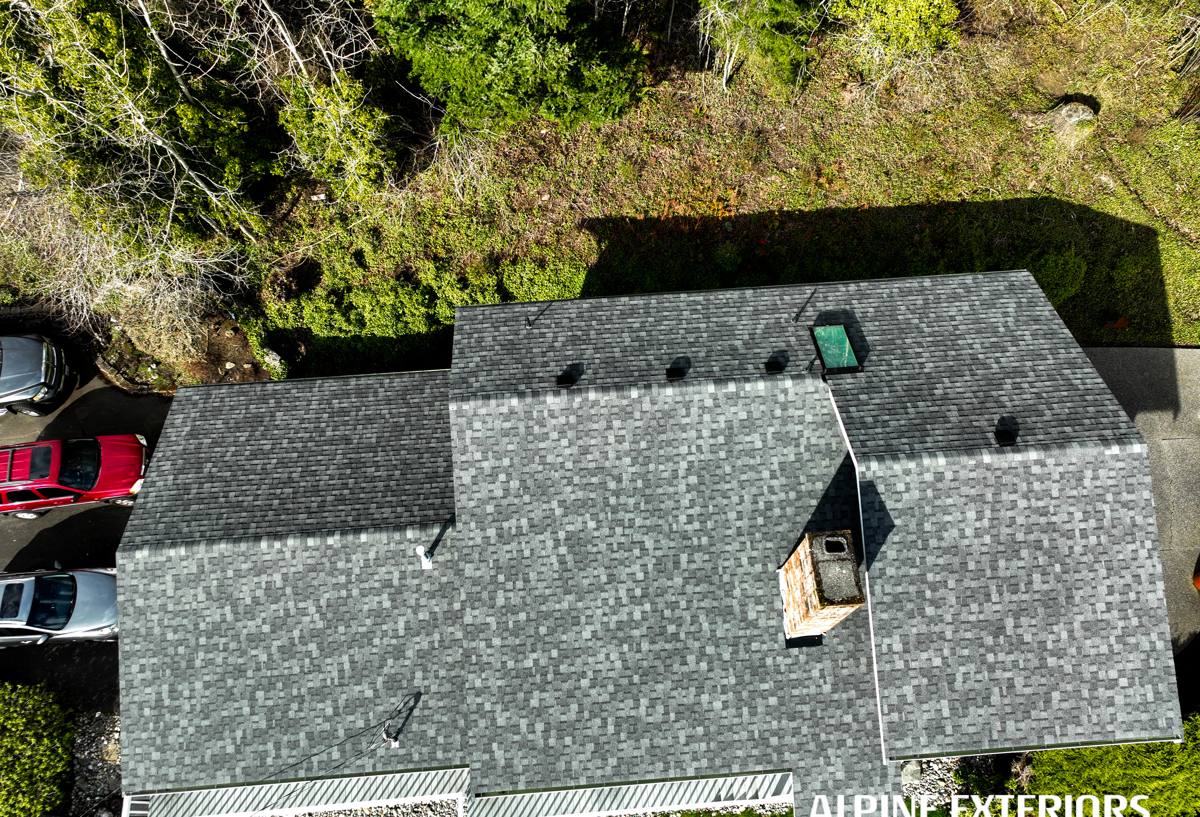
Signs a Cedardale Home Needs Replacement, Not Another Repair
Not every roof problem calls for a full tear-off. But there's a point where patching stops being the honest answer. Some signals we look for during an inspection:
- Granule loss heavy enough that you can see bare asphalt mat on multiple slopes, not just one worn spot
- Moss that has worked its way under shingle tabs and is lifting them, rather than just sitting on the surface
- Soft or spongy decking felt underfoot, especially near valleys, eaves, or old skylight cuts
- Daylight visible through the attic at the ridge, hips, or nail penetrations
- Repeated leaks in the same area after prior repairs — a sign the underlying flashing or decking is compromised, not just the surface layer
- A roof original to the home and past 20-25 years old, particularly on shaded slopes that stay damp longer
If a roof is showing two or more of these, repair costs start adding up without solving the underlying moisture problem, and replacement becomes the more honest long-term answer.
Choosing Materials for This Climate
There's no single "best" roofing material for every Cedardale home — it depends on the roof's slope, shading, exposure to wind, and the homeowner's budget and maintenance appetite. Here's how the common options compare against this specific climate:
| Material | Moss & Moisture Behavior | Salt Air / Wind Exposure | Typical Lifespan Here |
|---|---|---|---|
| Standard architectural asphalt shingle | Prone to moss on shaded slopes without algae-resistant granules | Good with proper nailing and sealed fasteners | 18-25 years |
| Algae-resistant (copper-granule) asphalt shingle | Significantly slows moss and algae growth | Good; standard flashing details still required | 22-28 years |
| Standing seam metal | Sheds moisture fast, very moss-resistant on adequate pitch | Excellent with proper coatings and stainless fasteners | 40-50+ years |
| Wood shake | High maintenance burden in this climate; retains moisture in shaded areas | Requires diligent upkeep near salt air | Highly variable, maintenance-dependent |
We're upfront that wood shake, while attractive, asks a lot of a homeowner in a climate like Skagit County's — it needs consistent maintenance to manage moisture retention on shaded slopes, and we'll say so plainly rather than sell against our own advice. Algae-resistant asphalt and standing seam metal are what we install most often in Cedardale because they hold up to the actual conditions without demanding constant attention.
Cost Factors Worth Understanding Upfront
| Factor | Why It Moves the Price |
|---|---|
| Roof pitch and access | Steeper slopes and limited access add labor and safety-equipment time |
| Deck condition | Rot or soft sheathing found during tear-off requires replacement before new material goes down |
| Layers to remove | Multiple existing layers add disposal and labor time |
| Material choice | Metal and premium shingle lines cost more upfront but shift the maintenance and lifespan math |
| Ventilation and flashing scope | Correcting inadequate attic ventilation or old flashing adds real value but adds line items |
What a Correct Installation Actually Involves
A new roof is only as good as what's underneath the visible surface. In a climate that throws salt air, driving rain, and constant dampness at a roof, the details most homeowners never see are what determine whether it performs for the next few decades.
Underlayment and Water Barriers
We use synthetic underlayment across the full deck, with self-adhered ice-and-water barrier membrane at the eaves, valleys, and any roof-to-wall transitions — the spots where wind-driven rain is most likely to get pushed backward under the shingle line. This is standard practice for us on every Cedardale roof, not an upsell.
Flashing
Step flashing at walls, proper kick-out flashing where a roof edge meets a wall (a detail that's frequently missed or done wrong, and a common source of hidden wall rot), and new flashing at every penetration — vents, chimneys, skylights. Old, reused flashing is one of the most common causes of "mystery" leaks after a re-roof done by a crew in a hurry.
Ventilation
Balanced intake and exhaust ventilation keeps the attic from becoming a warm, moist environment that feeds moss growth from underneath and shortens the life of the decking itself. On many older Cedardale homes, ventilation was undersized or blocked by insulation over the years, and we address that as part of the install rather than leaving it as an existing problem.
Moss-Resistance Details
Where a roof has shaded slopes prone to moss, we can install zinc or copper strips near the ridge — rain washing over these releases trace metal ions that inhibit moss regrowth on the slopes below. It's not a substitute for algae-resistant shingle granules, but the two together give a shaded roof real staying power.
Our Installation Process
- Inspection and estimate — we walk the roof and attic, document conditions, and give a written estimate with material options explained plainly
- Permit and scheduling — we pull the required permit and schedule around a realistic weather window
- Tear-off — full removal of old roofing down to the deck, with the deck inspected board by board
- Deck repair — any soft, rotted, or delaminated sheathing is replaced before anything new goes down
- Underlayment and water barriers — synthetic underlayment plus ice-and-water membrane at vulnerable areas
- Flashing — new flashing at all walls, valleys, and penetrations
- Roofing material installation — installed to manufacturer specification, including nailing pattern and exposure
- Ventilation check and correction — intake and exhaust balanced for the attic's actual size and insulation
- Cleanup and magnetic sweep — full site cleanup, including a magnetic sweep for stray fasteners
- Final walkthrough — we go over the finished roof with the homeowner before calling the job done
Living With Moss and Salt Air After the Install
A correctly installed roof in Skagit County still needs a small amount of homeowner attention. Keeping gutters clear so water doesn't back up under the eave line, trimming back overhanging branches that keep a slope shaded and damp, and having the roof looked at every few years rather than ignored until a leak shows up inside — these habits do more for a roof's lifespan here than almost any single material upgrade. We're glad to walk any homeowner through what to watch for on their specific roof after the work is done.
Why Hiring a Crew That Already Works in Cedardale Matters
Roofing crews that mostly work drier, inland climates sometimes treat ventilation, moss-resistance details, and wind-driven-rain flashing as optional extras. In Cedardale and the rest of Skagit County, they're not optional — they're the difference between a roof that looks fine for five years and one that actually performs for its full rated lifespan. A crew that installs roofs in this specific area regularly knows which slopes on which orientations tend to hold moss, how much wind exposure a given site actually sees off the bay, and how to schedule tear-offs around a realistic rain window instead of hoping the weather cooperates.
Local presence also matters after the job is done. If a question comes up two years in — a shingle lifted in a windstorm, a gutter question, a ventilation concern — a crew still working in the area is easy to reach and has a record of exactly what was installed and how.
Get a Straight Answer on Your Roof
If your Cedardale roof is showing its age, or you just want an honest read on how many years it has left, we're happy to take a look. We'll give you a clear inspection, explain what we find in plain terms, and put together a free, no-pressure estimate — no scare tactics, just what your roof actually needs. The form below gets that conversation started.