 Skagit County
 Why Anacortes Siding Wears Differently Than Inland Homes
Anacortes sits right on the water, and that location shapes everything about how siding ages here. Homes on Fidalgo Island and along the Skagit County shoreline take on a steady diet of salt-laden air, wind-driven rain that hits siding at an angle instead of falling straight down, and long stretches of shade and dampness that keep moss and algae growing for most of the year. None of that damage happens overnight. It shows up as small, specific failures — a soft spot near a window trim, a streak of green climbing up a north-facing wall, a fastener head bleeding rust through the paint — and each of those small failures is trying to tell you something about what's happening underneath.
Siding repair in a climate like this isn't just "find the bad piece and swap it." It's diagnosing why that piece failed in the first place, because if the cause is still there — a flashing detail that's letting water behind the wall, a fastener that shouldn't have been used this close to salt water, a shaded corner that never dries out — a patch job will fail again in a year or two. A repair done right in Anacortes accounts for the site conditions, not just the visible damage.
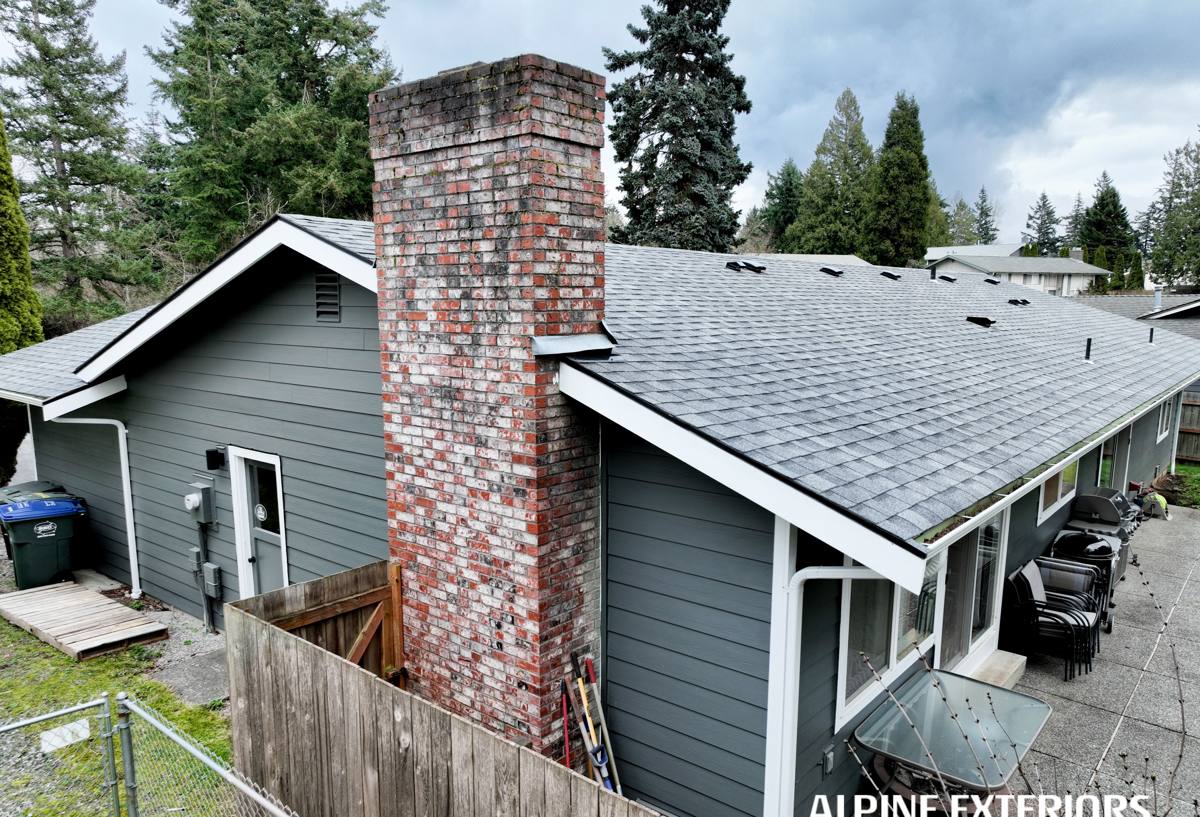
Signs Your Siding Needs Repair, Not a New Full Install
Most homes don't need to be resided just because a section of siding is failing. Repair makes sense when the damage is localized and the rest of the siding is sound. Here's what we look for during an inspection:
- Soft, spongy, or crumbling siding near window and door trim, roof-to-wall intersections, or deck ledger boards
- Visible gaps, cracks, or separated caulk joints where water can track behind the siding
- Panels or boards that have buckled, bowed, or pulled away from the wall
- Persistent moss or black algae streaking on shaded or north-facing walls that keeps coming back after cleaning
- Rust staining bleeding out from fastener heads, especially on walls that face the water or prevailing wind
- Paint or factory finish that's peeling, chalking, or blistering in isolated spots rather than across the whole house
- Soft trim boards or corner boards even where the siding field itself still looks fine
If what you're seeing matches a handful of items on that list but the rest of the exterior is holding up, repair is almost always the right call — and the more affordable one.
When Repair Isn't Enough
Sometimes what looks like a repair opens up into something bigger. If we pull damaged siding and find rot has spread into the sheathing, if multiple walls show the same failure pattern, or if the siding is an older product nearing the end of its service life across the whole house, we'll tell you honestly. There's no benefit to either of us in patching a wall that's going to need full replacement in three years.
What a Correct Siding Repair Actually Involves
A repair that holds up in Anacortes' conditions is more than cutting out a bad board and nailing in a new one. Done right, it includes:
- Diagnosing the water path. Before anything gets replaced, we trace where moisture is actually getting in — flashing, caulk, a penetration, or a grade issue — not just where the damage shows.
- Removing damaged material back to sound substrate. Rot spreads further than it looks from the outside; cutting back to solid wood or sheathing matters more than the patch itself.
- Checking and correcting flashing and house wrap at the repair area, since a new piece of siding over bad flashing just fails again.
- Using corrosion-appropriate fasteners. Salt air corrodes standard fasteners faster than people expect; the right fastener spec matters more here than it would twenty miles inland.
- Matching the replacement material so the repair blends in rather than becoming a visible patch — both in profile and in factory finish color.
- Re-sealing and re-painting or finishing to spec so the repaired section performs and looks the same as the surrounding wall.
Common Siding Problems We See Around Anacortes
The specific failures we get called for here follow a pattern shaped by the local environment. The table below breaks down what we typically find, why it happens, and what an honest fix looks like.
| Problem | Why It Happens Here | What a Proper Fix Looks Like |
|---|---|---|
| Rust streaking from fastener heads | Salt air accelerates corrosion on fasteners not rated for coastal exposure | Remove and replace with corrosion-resistant fasteners, not just spot-painting over the stain |
| Recurring moss and algae on shaded walls | Damp, shaded exposures common on tree-lined and water-adjacent lots rarely dry out fully | Clean, treat, and address the underlying moisture and airflow issue, not just a one-time power wash |
| Soft or delaminating trim near windows | Driving rain forces water past worn caulk joints and undersized flashing | Replace trim, correct flashing detail, re-caulk with a proper sealant joint |
| Buckled or bowed panels | Improper original fastening or moisture cycling behind the siding | Remove, inspect sheathing and house wrap, refasten to manufacturer spec |
| Faded or blistered finish in patches | Sun and salt exposure vary by wall orientation, aging finishes unevenly | Match factory finish where possible rather than field-painting a visible patch |
Repair vs. Replacement: How We Make the Call Honestly
Cost is only part of the decision. The bigger question is whether repair actually solves the problem or just delays a bigger one. We walk through this with every homeowner before recommending either path.
| Factor | Favors Repair | Favors Replacement |
|---|---|---|
| Extent of damage | Isolated to one or two wall sections | Recurring across multiple walls or the whole house |
| Age of existing siding | Mid-life, otherwise sound | At or near end of expected service life |
| Cause of failure | A fixable, contained issue (flashing, caulk, one bad fastener run) | Systemic issue — original product choice, wall-wide moisture intrusion |
| Match feasibility | Replacement material and finish can be matched closely | Discontinued product or finish makes matching impractical |
| Underlying sheathing condition | Sound where exposed during repair | Rot or damage found spreading into structural sheathing |
Our Repair Process
We keep the process straightforward and don't upsell repairs into replacements they don't need to be:
- On-site inspection of the damaged area and a check of the rest of the exterior for related issues
- Straight answer on whether it's a repair or something bigger, in writing
- A clear estimate before any work starts — no surprise change orders for anything we could have caught during inspection
- Removal of damaged material back to sound substrate, with flashing and moisture barrier corrected as needed
- Replacement with matched material and fasteners suited to a marine environment
- Final finish work so the repair reads as part of the wall, not a patch
Why It Matters That We Already Work in Anacortes
A crew that only occasionally works this far west on the Skagit County coastline can miss things a local crew catches automatically — which walls in this area take the worst of the wind-driven rain, how much moss pressure a shaded lot near the water actually generates, or which fastener specs hold up and which corrode out early. That's not a knock on any contractor's skill; it's just familiarity that comes from repeat work in this specific environment. We've done enough repair work on Fidalgo Island and the surrounding area to know what fails here first, and we build that knowledge into every estimate and repair plan instead of treating this as a generic siding job.
What We Use for Repairs
We install and repair with James Hardie fiber cement exclusively. For repair work specifically, that matters for a practical reason: Hardie's ColorPlus factory finish and consistent product lines make it realistic to match an existing repair area closely, rather than field-painting a patch that ages differently than the rest of the wall. Fiber cement also doesn't share the moisture-related failure patterns we see in some other siding materials in this climate, which means a proper repair is more likely to actually hold rather than needing revisiting in a couple of years. If a home we're called to already has a different siding product installed, we'll still give an honest assessment of the repair — but our own installs and full replacements are Hardie, for the same reasons.
Keeping Repaired Siding From Failing Again
Once a repair is done correctly, a little maintenance goes a long way in this climate:
- Rinse moss and algae growth off shaded walls before it establishes, rather than after it's visibly thick
- Check caulk joints around windows, doors, and trim every year or two, since this is where driving rain finds its way in first
- Keep gutters and downspouts clear so wall-adjacent runoff doesn't concentrate water at grade
- Trim back vegetation that's keeping a wall shaded and damp longer than it needs to be
- Have any new soft spots or rust staining looked at early — it's a far smaller repair caught in year one than year four
If you're seeing damage on your siding anywhere in Anacortes or elsewhere in Skagit County, we're happy to take a look and give you a straight answer on what it actually needs. The estimate is free, there's no pressure to sign up for more than the job calls for, and you'll know before we start whether you're looking at a repair or something bigger.