 Skagit County
 Siding Built for Skyline's Specific Climate
Skyline sits close enough to the water that salt-laden air is a daily fact of life, not an occasional weather event. Add in the driving, wind-pushed rain that comes through Skagit County in the fall and winter, plus a moss season that can stretch for months on shaded north- and west-facing walls, and you end up with a climate that is genuinely hard on exterior materials. Siding here doesn't just need to look good on installation day — it needs to hold its finish, resist moisture intrusion, and shrug off organic growth year after year without constant homeowner intervention.
This is the environment fiber cement was engineered for. It doesn't absorb moisture the way wood does, it won't warp or buckle in freeze-thaw swings, and a factory-cured finish stands up to salt exposure far better than field-applied paint. But "fiber cement" isn't one product — the brand, the product line, and the installation details matter enormously in a climate this demanding, which is why we're specific about what we put on Skyline homes and how.
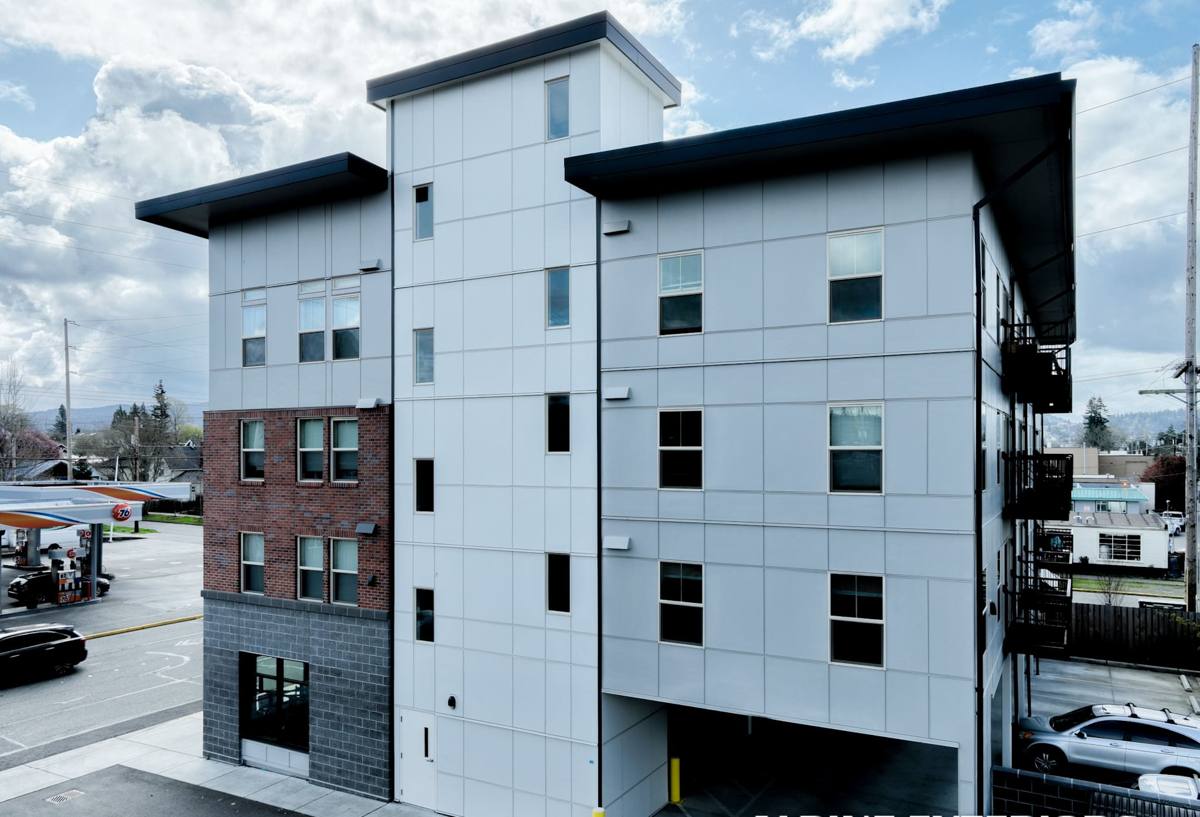
Why We Only Install James Hardie in This Area
We install James Hardie fiber cement exclusively — not LP SmartSide, not vinyl, not Cemplank or Allura, not primed wood. That's not a marketing position, it's a standard we've held ourselves to because of what we've seen play out on homes in coastal and high-moisture parts of Skagit County over time.
What matters most for a Skyline home
- Non-combustible core: Hardie's cement-based composition doesn't feed a fire the way wood-based siding products can.
- Factory-cured ColorPlus finish: baked on and cured before the siding ever reaches the jobsite, giving it better adhesion and UV/salt resistance than a coat of paint applied on-site after installation.
- Climate-engineered HZ5 formulation: Hardie's HZ product line is engineered specifically for the moisture and freeze-thaw conditions of the Pacific Northwest, rather than a one-size-fits-all national formulation.
- Dimensional stability: fiber cement doesn't swell, split, or cup the way wood-based composite products can when they take on repeated moisture.
- Transferable warranty: a written product warranty that can move with the home, which matters for resale in a market where buyers are increasingly asking about siding age and condition.
We're not going to tell you every other siding product is unusable — plenty of them have a place. But when a home is going to sit through decades of Skagit County salt air and rain, we'd rather stand behind one system we trust completely than offer a menu of options with very different long-term track records.
What a Correct Fiber Cement Job Actually Involves
Fiber cement is only as good as its installation. It's a heavier, less forgiving material than vinyl, and the details that get skipped on a rushed job are exactly the ones that cause problems five or ten years down the road — especially in a wet climate.
The details we don't skip
- Proper weather-resistive barrier and flashing at every window, door, and penetration — the single biggest factor in whether moisture stays out of the wall assembly.
- A drainage plane (rainscreen or furring strip approach where the wall assembly calls for it) so any incidental moisture behind the siding has somewhere to go instead of sitting against the sheathing.
- Correct fastener type, spacing, and depth — Hardie specifies this closely, and getting it wrong is one of the most common causes of premature failure.
- Manufacturer-specified caulking and sealant only at the joints designed to be sealed — not at every seam, which traps moisture instead of letting it shed.
- Proper clearance from grade, decks, and roof lines so the bottom edge of the siding isn't sitting in standing water or snow.
- Field-cut edges primed or sealed per spec so the cut ends of ColorPlus boards don't become the weak point in an otherwise protected system.
None of this is exotic — it's just disciplined, unglamorous work that has to happen in the right order. Skipping any one of these steps doesn't usually show up as a problem on day one. It shows up two or three winters later, after the driving rain and moss season has had a chance to find the gap.
Local Trouble Spots Worth Knowing About
Homes in Skyline tend to show wear in fairly predictable places, and it's worth knowing what to watch for whether your siding is fiber cement, wood, or something else.
Signs worth a closer look
| What you're seeing | What it often means |
|---|---|
| Green or black growth on north/shaded walls | Normal moss/algae exposure for this climate — a cleaning and maintenance issue, not necessarily a siding failure, unless it's tracking with soft spots |
| Peeling or chalking paint on wood or older composite siding | Field-applied finishes breaking down under UV and salt exposure faster than a factory-cured finish would |
| Soft or swollen boards near the bottom courses | Moisture wicking up from grade contact or splashback — often a clearance or flashing issue |
| Cracked or missing caulk at trim and window joints | Sealant reaching end of life, allowing wind-driven rain a path behind the siding |
| Rust streaking at fastener heads | Wrong fastener material or coating used for a coastal-air environment |
If any of these sound familiar, it's worth having someone take a real look rather than just patching the cosmetic symptom.
Our Process for Skyline Projects
1. Site and wall assessment
Before we talk product or price, we look at what's actually happening on your walls — existing siding condition, moisture history, sun and wind exposure on each elevation, and anything unusual about the wall assembly. Skyline homes on more exposed elevations often need a different approach on the water-facing side than on a sheltered wall.
2. Scope and product selection
We walk through which Hardie plank, panel, or shingle profile fits the home, which ColorPlus color performs well against salt exposure, and what trim and accessory details make sense. This is also where we flag anything underneath the existing siding — sheathing damage or old flashing issues — that needs to be addressed before new siding goes on, not after.
3. Removal and prep
Old siding comes off, the wall is inspected and repaired as needed, and the weather-resistive barrier and flashing system goes in correctly the first time. This step gets rushed on lower-quality jobs; it's the step that determines how the house performs in ten years.
4. Installation to manufacturer spec
Fastening, clearances, caulking, and finish work all follow Hardie's published installation requirements — not a generic "good enough" standard. This is also what keeps the manufacturer's warranty intact, which only applies when the product is installed to spec.
5. Final walkthrough
We go over the finished work with you, including basic care guidance for this climate, before calling the job done.
What Fiber Cement Siding Typically Costs
Every home is different, but the factors that move the price on a Skyline project are fairly consistent:
| Factor | Why it matters |
|---|---|
| Home size and wall complexity | More corners, gables, and dormers mean more cutting, flashing, and labor time |
| Condition of the existing wall assembly | Hidden moisture or sheathing damage found during tear-off adds repair scope |
| Siding profile and trim package | Lap siding, panel systems, and shingle-style accents carry different material and labor costs |
| Access and site conditions | Multi-story elevations, tight lot lines, or limited equipment access affect labor time |
| Color and finish selection | Standard ColorPlus colors versus premium or custom finish options |
We'll never quote a number without seeing the home, and we won't pad an estimate with padding for problems that might not exist — but we will flag likely cost drivers upfront so there aren't surprises mid-project.
Maintenance in a Salt-Air, High-Moss Environment
One of the real advantages of properly installed Hardie siding is how little it asks of you compared to wood or field-painted alternatives — but "low maintenance" isn't "no maintenance," especially here.
- Rinse siding annually (a garden hose is usually enough) to clear salt residue and organic buildup before it sets in, particularly on shaded elevations prone to moss.
- Keep gutters and downspouts clear so overflow doesn't run down the siding face repeatedly.
- Keep vegetation and mulch beds pulled back from direct contact with the bottom courses.
- Inspect caulking at trim and penetrations every couple of years and have it renewed before it fails, not after.
- Address any impact damage or exposed fastener heads promptly rather than letting them sit through a wet winter.
Why a Crew That Already Works in Skyline Matters
Fiber cement installation isn't regionally exotic — but the judgment calls around it are. Knowing which elevations in this part of Skagit County take the worst of the driving rain, how aggressively moss establishes itself on shaded walls near the water, and what clearance and flashing details actually hold up here versus in a drier inland climate comes from having done the work locally, not from a manufacturer's install manual alone. A crew that's worked Skyline before also knows the practical realities of the area — typical lot layouts, access considerations, and the kind of exposure a given elevation is actually going to see.
That local pattern-recognition is what keeps a job from becoming a callback. It's the difference between a siding system that's technically installed correctly and one that's installed correctly for this specific place.
Ready to Talk About Your Home
If your Skyline home's siding is showing its age, or you're planning ahead of a needed replacement, we're happy to take a look and give you an honest read on condition, scope, and options — no pressure, no obligation. Use the form below to request a free estimate.