 Skagit County
 Skyline Roofs Face a Different Kind of Wear
If you own a home in Skyline, you already know the roof over your head works harder than roofs in drier parts of the state. Skagit County sits close enough to the water that salt-laden air moves through on a regular basis, and the storms that roll in off the Sound don't just drop rain straight down — they drive it sideways, forcing water up under shingles, flashing, and roof vents that were never designed to handle wind-driven moisture from that angle. Add in a moss season that can stretch for the better part of the year in shaded, tree-covered lots, and you've got a roof that's under near-constant low-grade stress even when there isn't a single named storm in the forecast.
Storm damage repair here isn't just about patching a hole after a dramatic windstorm. It's about recognizing the slower damage that driving rain, salt exposure, and moss growth cause in between storms, and fixing both the visible problem and the conditions that caused it. A repair that only addresses the surface symptom tends to fail again within a season or two — which is the single most common complaint we hear from homeowners who've had storm damage "fixed" before and are calling us because it's leaking again.
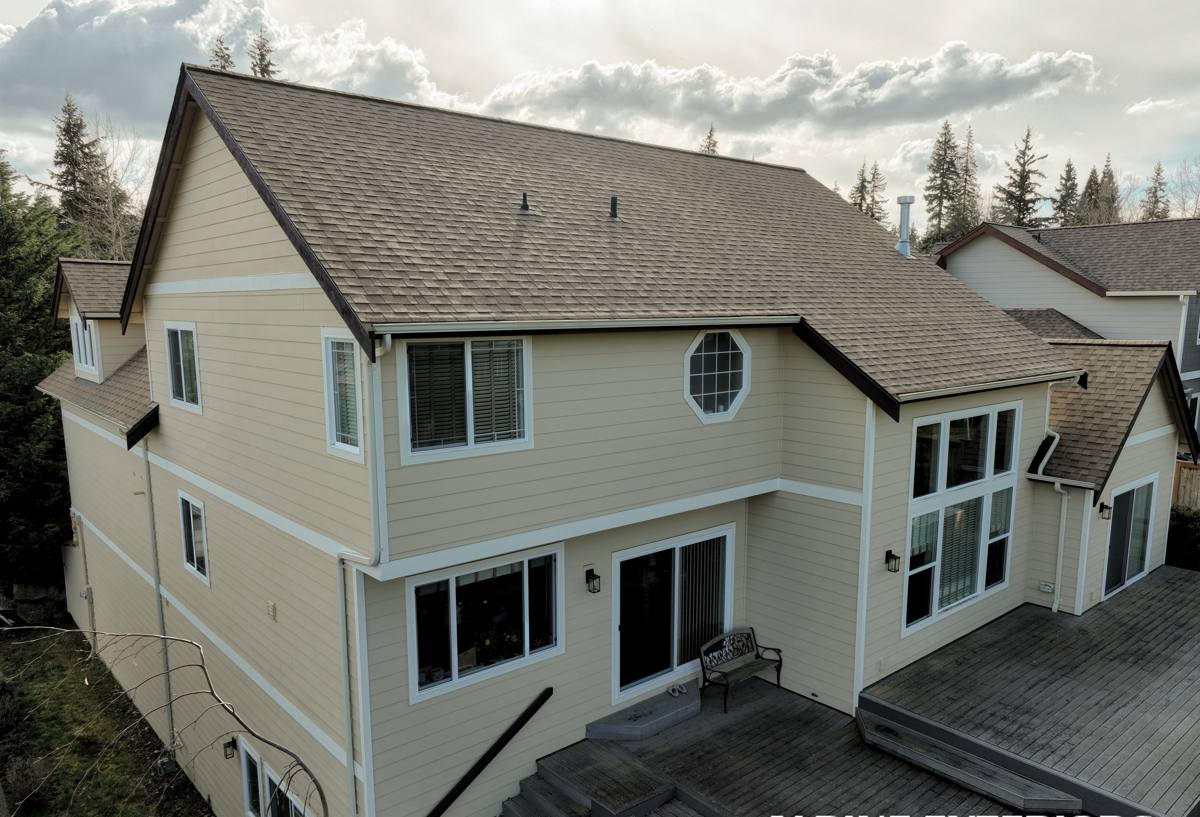
What Actually Counts as Storm Damage
Not every roof problem in Skyline traces back to a specific storm event, and it matters which one you're dealing with because it changes both the repair approach and, often, whether an insurance claim applies.
Wind Damage
Gusts strong enough to lift shingle edges, crease ridge caps, or tear off a section outright are the most obvious form of storm damage. Wind doesn't have to be catastrophic to do this — a roof with shingles that were already loosening from age or improper nailing can lose material in a fairly ordinary wind event.
Driving Rain Intrusion
This is the damage type most specific to our climate. When rain comes in nearly horizontal, it can work its way under shingle tabs, around chimney flashing, and through vent boots that would be perfectly adequate in a straight-down rain. You often won't see a torn shingle at all — just a growing stain on a ceiling or a musty smell in an attic.
Moss and Algae Damage
Moss isn't cosmetic. Its root structure lifts shingle granules and holds moisture against the roof deck, and during a storm that saturated, moss-covered section is exactly where water finds a way in. A storm can expose damage that moss has been quietly causing for a year or more.
Salt Air Corrosion
Metal flashing, fasteners, and vent components corrode faster this close to the water. A storm can be the event that finally pushes an already-corroded flashing seam or fastener past the point of holding water back.
What a Correct Repair Actually Involves
A storm damage repair done right is more than swapping out the shingles you can see from the driveway. Here's what we check and address on every Skyline storm repair call:
Decking Assessment
Before any new material goes down, we check whether the roof deck underneath has taken on moisture. Wet or soft decking has to be replaced — covering it with new shingles just traps the problem under a fresh layer.
Underlayment and Flashing
Given how much of our storm damage here comes from driven rain rather than straight impact, the underlayment and flashing details matter as much as the shingles themselves. Flashing around chimneys, skylights, and roof-to-wall transitions gets inspected and resealed or replaced as needed, not just caulked over.
Material Matching
We match shingle color, profile, and where possible manufacturer to what's already on your roof, so a repaired section doesn't stand out. When an exact match isn't available — which happens with older roofs — we'll talk through the closest options honestly rather than surprise you after the fact.
Moss and Debris Treatment
If moss contributed to the damage, we clear it from the repair area and surrounding roof, and talk through options for keeping it from coming back, since re-repairing the same spot in two years because moss regrew isn't a good use of your money.
Our Process, Start to Finish
- Inspection. We walk the roof (weather permitting) and check the attic from inside where accessible, looking for both the obvious damage and the secondary issues — soft decking, compromised flashing, moss undermining nearby sections.
- Temporary weatherproofing. If there's active exposure, we get a tarp or emergency seal on it the same visit so you're not taking on more water while repairs are scheduled.
- Written scope and estimate. You get a clear explanation of what's damaged, what needs to be done, and why — no vague line items.
- Repair. We do the work to match existing materials and correct the underlying cause, not just the visible symptom.
- Cleanup and walkthrough. We clear debris and walk the repair with you before we consider the job done.
Matching the Repair to the Damage
Not every storm-damaged roof needs the same scope of work. Part of an honest assessment is telling you when a small repair is genuinely enough, and when patching a bigger problem would just be delaying a larger cost.
| Repair Scope | When It Fits | What to Watch For |
|---|---|---|
| Spot repair (single area) | Localized damage — one lifted section, a torn ridge cap, a compromised flashing seam | Rest of the roof is sound and reasonably close in age to the repaired section |
| Section replacement | Damage spread across a slope, or decking beneath a section is wet or soft | Worth checking whether the section's underlayment is original — reusing old underlayment under new shingles shortens the fix's life |
| Full reroof evaluation | Storm damage on a roof that's already near the end of its expected service life, or damage recurring in multiple areas | Repeated storm repairs on an aging roof often cost more over time than one properly planned reroof |
Working With Your Insurance
Many storm repairs in Skyline are at least partially insurance claims, and the paperwork matters as much as the physical repair. We document the damage with dated photos and a written scope before work begins, which gives you something concrete to bring to your adjuster. We're not a public adjuster and we won't tell you what your policy covers — that's between you and your insurer — but we'll give you an honest, unembellished description of the damage so your claim is based on what's actually there.
After a Storm: What to Check
You don't need to get on the roof yourself — and in wet, mossy conditions especially, you shouldn't. But there's a lot you can check safely from the ground or from inside the house that helps us diagnose faster when we arrive.
- Check the attic (if accessible) for new staining, damp insulation, or a musty smell after a storm
- Look at gutters and downspouts for shingle granules, which can indicate accelerated wear or damage
- Note any interior ceiling stains, even faint ones, and roughly where they sit relative to the roof above
- Look from the ground for visibly lifted, missing, or curled shingles, or debris caught on the roof
- Check that gutters aren't overflowing or backing up, which points to a blockage that can worsen storm damage
- Take photos of any visible damage as soon as it's safe to do so, before cleanup or repair begins
Why Local Experience in Skyline Matters
A crew that already works in and around Skyline knows what to expect before they climb the ladder. They know which roof orientations tend to take the worst of the driving rain, how fast moss reestablishes itself in shaded, tree-heavy yards typical of this area, and how salt air accelerates wear on metal components compared to roofs further inland. That familiarity means a faster, more accurate diagnosis and fewer surprises mid-repair. It also means faster response — when a storm damages roofs across the neighborhood at once, a crew that's already working locally in Skagit County can typically get to you sooner than one dispatching from farther away, and getting a tarp on an exposed roof quickly is often what separates a manageable repair from a much bigger one.
Ready for a Straight Answer on Your Roof?
If a recent storm has left you with a leak, missing shingles, or just a nagging feeling that something's not right up there, we're happy to take a look and tell you plainly what we find — no pressure, no upsell. Reach out for a free estimate using the form below.