 Skagit County
 Building New in Lyman: Why Window Timing Matters
If you're building new in Lyman, windows are one of the few components on the job site where a mistake made in week two doesn't show up until year two. A crooked reveal or a missed nailing fin gets covered by siding and trim long before anyone notices the water stain forming behind the wall. New-construction window work isn't just "install the window" — it's a coordination job between the framer, the weather-resistive barrier, the flashing sequence, and the window itself, all happening in the right order before the building gets closed in.
Skagit County sees a long, wet stretch of the year, and Lyman's setting along the Skagit River valley means homes here deal with sustained moisture exposure, not just the occasional storm. Windows installed correctly at the framing stage are what keep that moisture out of the wall assembly for the life of the house. Windows installed sloppily give water a path in that no amount of caulking will fix later.
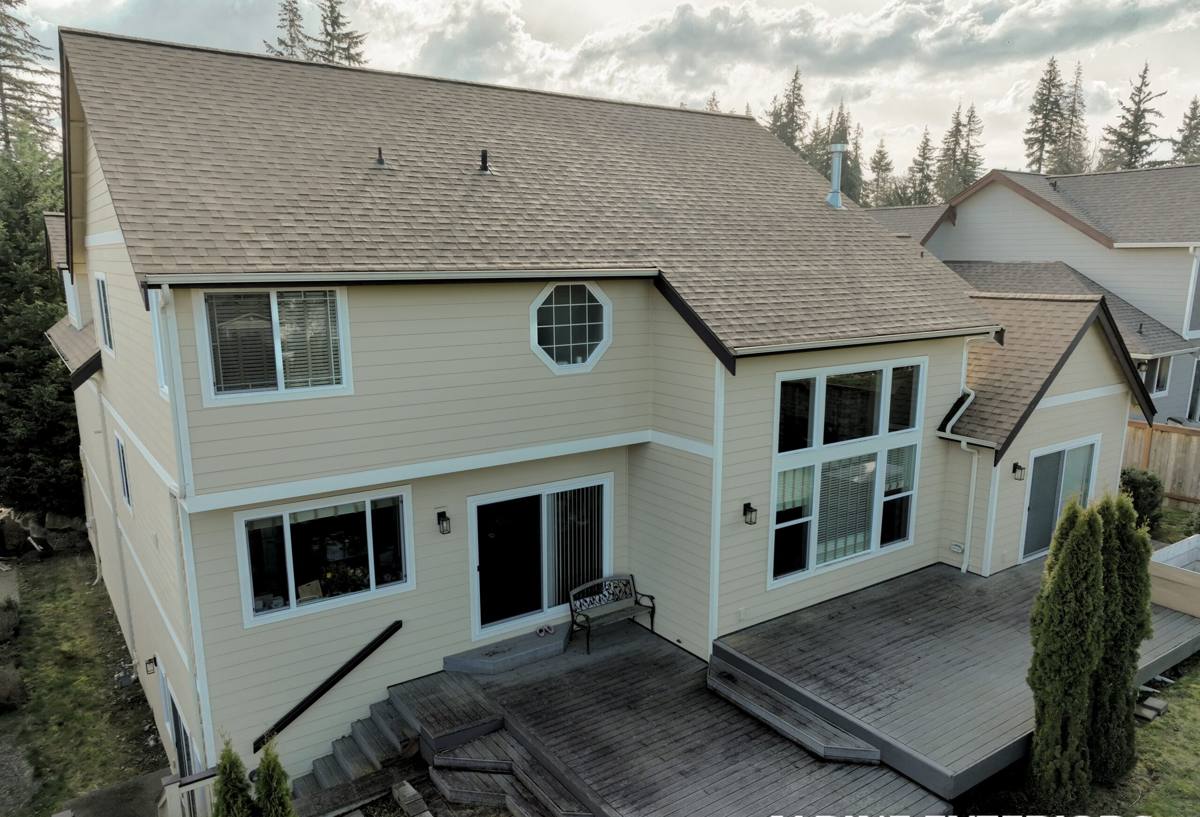
What Skagit County's Climate Demands From New-Construction Windows
Western Washington's marine climate is a mixed blessing for builders. Temperatures stay mild, which is easy on window seals and frame materials, but the tradeoff is months of driving rain, high ambient humidity, and a moss season that coats anything horizontal or shaded. Salt-tinged air moving inland off Puget Sound adds another layer of corrosion pressure on hardware and fasteners over the years. None of this is dramatic on any single day — it's the cumulative effect that separates a window installed to hold up for decades from one that starts failing at the sill in five years.
For a new build, that means three things matter more here than in a drier climate:
- Sill pan flashing that actually drains, rather than trapping the water it's supposed to redirect.
- Corrosion-resistant fasteners and hardware rated for prolonged moisture and marine-influenced air.
- Frame materials and finishes that don't rely on constant homeowner maintenance to resist mildew and moss staining.
These aren't upgrades — in Skagit County's climate, they're the baseline for a window installation that's going to be right the first time.
New-Construction vs. Replacement Windows: What's Actually Different
Homeowners planning a new build in Lyman sometimes assume window installation is window installation. It isn't. New-construction windows have a nailing fin around the perimeter of the frame, designed to be fastened directly to the sheathing before siding goes on, with flashing tape and the weather-resistive barrier layered over the fin in a specific shingle-style sequence. Replacement windows (often called "pocket" or "insert" windows) are built without that fin, sized to slide into an existing frame after the old sash is removed — a very different product for a very different situation.
Using the wrong approach in either direction causes problems. Installing a new-construction window as if it were a pocket unit skips the flashing integration that protects the rough opening. Trying to retrofit a replacement window into new framing wastes the advantage a clean, unfinished wall gives you — the chance to get the flashing and drainage plane right from scratch, which is far harder to correct once siding is on.
For a new build in Lyman, we always work with true new-construction units and the full flashing sequence, because that's the only approach that lets us build a wall assembly designed to shed water from the start.
Choosing Window Materials for a Skagit County New Build
Frame material affects how a window performs against moisture, how much upkeep it needs, and how it holds up cosmetically in a climate where moss and mildew are a fact of life. There's no single "best" choice — it depends on budget, style, and how much maintenance you want to take on.
| Frame Material | Moisture Resistance | Maintenance | Typical Cost Range | Best For |
|---|---|---|---|---|
| Vinyl | Excellent — won't rot or corrode | Low — occasional cleaning | Lower | Budget-conscious builds, rental properties, straightforward openings |
| Fiberglass | Excellent — very stable in wet/dry cycling | Low | Mid to upper | Larger openings, homes wanting a paintable, wood-like look without wood's upkeep |
| Wood-clad | Good on the exterior clad face, but interior wood needs protection from condensation | Higher — clad exterior is low-maintenance, interior wood needs periodic attention | Higher | Homeowners prioritizing interior wood aesthetics who accept the added care |
Whatever material you land on, we steer every new build toward corrosion-resistant hardware and factory finishes rated for coastal and marine-influenced climates — that detail matters more in Skagit County than the base frame material choice itself.
The Flashing and Moisture-Management Details That Make or Break a New Build
Most window failures we get called out to fix, on any house, trace back to flashing done out of sequence or skipped altogether — not to the window unit itself. On a new build, this is the one chance to do it right before it's buried behind siding.
The sequence we follow
- Sill pan flashing installed first, sloped and lapped so any water that reaches the rough opening drains back outward, not into the wall cavity.
- Window set into the opening, checked for level, plumb, and square before a single fastener goes in.
- Nailing fin fastened per the manufacturer's schedule — spacing and fastener type matter for both structural performance and warranty validity.
- Flashing tape applied over the side and head fins in proper shingle-lap order, integrated with the weather-resistive barrier so water is always directed down and out.
- Head flashing or a drip cap where called for, especially on south- and west-facing walls that take the brunt of driving rain.
Skip step one, or lap step four backward, and the window can look perfect from the outside while quietly feeding water into the framing every time it rains — which in this part of Skagit County is often.
Our New-Construction Window Installation Process
For builders and homeowners working on a new home in Lyman, we plug into the framing schedule directly rather than treating windows as a standalone trade show up at random.
- Plan review: we confirm window sizes, egress requirements, and rough opening dimensions against the actual framing plans before anything is ordered.
- Product selection walkthrough: we go over frame material, glass package, and hardware finish options based on your budget and how the elevation faces the weather.
- Coordination with the general contractor: we schedule around the sheathing and weather-resistive barrier install so flashing happens in the correct order, not as an afterthought.
- Installation: sill pan, window set, fastening, and flashing integration performed to manufacturer specification.
- Final check: every unit is checked for operation, seal, and square before we sign off, so nothing gets covered by trim or siding with an unresolved issue underneath.
Energy Code and Egress Requirements in Skagit County
Washington's energy code sets minimum performance requirements for new-construction windows, including U-factor limits that affect how much heat a window lets escape. New builds in Skagit County need to meet these standards as part of permitting, and window selection is one of the more straightforward ways to hit the target without over-engineering other parts of the building envelope. We help you pick products that meet code comfortably rather than just barely scraping by.
Bedrooms also have egress requirements — minimum opening size and sill height for emergency escape — that have to be accounted for at the window selection stage, not discovered during inspection. Getting this wrong on a new build means a return trip, a schedule delay, and in some cases swapping out a unit that's already installed. We check egress sizing against the room's use before windows are ordered, so it's settled before installation day, not after.
Choosing a Window Installer Who Already Works in Lyman
New-construction window work depends on coordinating with a framing crew and a build schedule that doesn't wait around. A crew that already knows how builds in Skagit County typically run — the inspection timing, the weather windows for exterior work, the way local GCs sequence sheathing and wrap — moves through that coordination without the guesswork a crew from outside the area brings in.
It also matters after the build is done. A contractor familiar with Lyman's climate has seen firsthand how flashing shortcuts show up years later — moss buildup at the sill, staining below the frame, soft trim — and installs accordingly the first time, rather than learning that lesson on your house.
What to confirm before your windows go in
- Rough opening sizes and egress requirements are confirmed against the actual framing plans, not just the architectural drawings.
- Frame material and glass package are chosen with Skagit County's moisture and marine air exposure in mind, not just price.
- Sill pan flashing is part of the written installation plan, not left to on-site improvisation.
- Fasteners and hardware are corrosion-resistant, appropriate for a marine-influenced climate.
- Installation is scheduled to align with the weather-resistive barrier sequence, not squeezed in before or after it out of convenience.
- The installer will walk the openings with you or your GC before ordering, to catch sizing issues before they become change orders.
If you're planning a new build in Lyman and want the window installation handled by a crew that already understands what Skagit County's climate asks of a new home, we're happy to walk your plans and give you a straightforward, no-pressure estimate — just fill out the form below.