 Skagit County
 Deck Replacement Built for Sedro-Woolley's Weather
Sedro-Woolley sits in the Skagit River valley, tucked between farmland and the foothills of the Cascades. That location means a lot of rain moving through the valley, heavy tree cover on many lots, and the kind of persistent damp that comes with living this close to Puget Sound's marine air. Decks here don't fail because homeowners neglect them. They fail because the climate is relentless, and most decks simply weren't built or maintained with that in mind.
If you're looking at a deck that's soft underfoot, coated in green moss by March, or showing rot around the ledger board and post bases, you're not dealing with a one-off problem. You're dealing with what happens to any deck in Skagit County that wasn't detailed for driving rain, standing moisture, and a moss season that can run half the year. Deck replacement isn't just about swapping old boards for new ones. It's about correcting the parts of the original build that let water win in the first place.
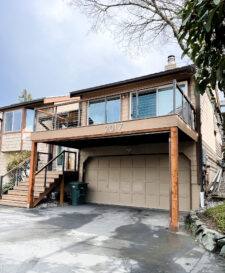
Why Skagit County Decks Wear Out Faster Than the National Average
Deck lumber and fasteners are rated for general use, not for the specific combination of conditions we get in the Skagit Valley. A few things stack up against decks here:
- Driving rain — wind-driven rain off the valley pushes moisture sideways into ledger connections, stair stringers, and any gap where flashing was skipped or installed poorly.
- Long moss and algae season — shaded, tree-covered lots common around Sedro-Woolley stay damp for months, which means moss and algae get a head start on wood fibers and turn boards slick and spongy.
- Marine humidity — even away from the water, the moisture that comes off Puget Sound and moves up the valley keeps ambient humidity high, so wood never fully dries out between storms.
- Freeze-thaw cycling — Skagit County gets enough cold snaps each winter that water trapped in wood grain or under fasteners can freeze, expand, and split fibers that were already weakened by rot.
None of these factors are dramatic on their own. Together, over ten or fifteen years, they're why so many decks in this area need full replacement well before a homeowner expects it.
The Parts of a Deck That Fail First
When we tear into an old deck in this area, the failure points are consistent:
- The ledger board connection to the house, where flashing was missing, undersized, or installed without a proper drainage gap.
- Post bases sitting in or near standing water, especially on decks built low to grade.
- Joist hangers rusted from moisture trapped between the hanger and the wood.
- Decking boards installed tight together with no drainage gap, so water and debris sit between boards and never dry.
- Stair stringers, which take more direct rain exposure than almost any other part of the structure.
What a Correct Deck Replacement Involves
A deck replacement isn't just new boards on the old frame. Done right, it's a chance to fix the structural and moisture problems that shortened the life of the last one. Our process on a full replacement includes:
1. Full Structural Assessment
Before we quote anything, we check the ledger connection, framing, post bases, and footings. Some decks only need the surface and framing rebuilt; others have footing or grading issues that need to be corrected first, or the new deck will fail the same way the old one did.
2. Ledger Flashing Done Properly
The connection between the deck and the house is the single most common source of hidden rot, both in the deck framing and in the wall behind it. We install proper flashing with a drainage gap so water sheds away from the house instead of tracking behind the ledger board.
3. Framing Rated for Wet Climates
We use pressure-treated framing lumber and corrosion-resistant fasteners and hardware rated for ground contact and coastal-adjacent moisture exposure. Cutting corners on fasteners is one of the fastest ways to get a deck that looks fine but is rusting from the inside within a few years.
4. Drainage-Conscious Layout
Decking boards get proper spacing for drainage and airflow underneath. Where a deck sits low or over a patio or walkway, we talk with homeowners about drainage systems that route water off the deck surface rather than letting it pool underneath and feed mold and rot in the framing above.
5. Grading and Post Base Correction
If old post bases were sitting in poor drainage or low spots that collect water, we correct the grading or post base height as part of the rebuild. Reusing a wet footprint just resets the clock on the same failure.
Decking Material Options for Sedro-Woolley Homes
There's no single right answer for every home — it depends on budget, how much shade the deck sits in, and how much upkeep a homeowner actually wants to do. Here's how the common options compare for this climate specifically:
| Material | How It Handles Rain & Moss | Maintenance | Typical Lifespan Here |
|---|---|---|---|
| Pressure-treated wood | Sheds water fine if sealed regularly; moss and algae take hold quickly in shade without upkeep | Annual cleaning and re-sealing recommended | 10–15 years |
| Cedar | Naturally rot-resistant but still needs sealing; can gray and get slick in shaded, damp spots | Sealing every 1–2 years | 15–20 years |
| Composite decking | Handles standing moisture well; textured surfaces resist slickness better than smooth boards | Occasional wash-down, no sealing or staining | 25–30+ years |
| PVC decking | Fully moisture-resistant, best option for heavily shaded or low-clearance decks | Low — wash-down only | 25–30+ years |
For lots around Sedro-Woolley with heavy tree cover, we often steer homeowners toward composite or PVC decking specifically because of the moss and algae issue — a textured, moisture-resistant surface simply doesn't give organic growth the foothold that a smooth, sealed wood surface does. That said, plenty of homeowners prefer the look and cost of wood and are happy to keep up with sealing. Both are legitimate choices; the right one depends on how much maintenance you actually want to commit to.
Railings, Stairs, and Structural Hardware
Railings and stairs take more weather exposure than the deck surface itself, since they're vertical and catch driving rain directly. We match railing material to the decking choice — wood railings on wood decks, composite or metal railings where low maintenance matters more. Stair stringers get the same treated-lumber and hardware standards as the rest of the frame, since a rotted stringer is a safety issue, not just a cosmetic one. All structural hardware — joist hangers, post bases, ledger bolts — gets specified for exterior, corrosion-resistant use. This is a small line item in the overall cost of a deck, and it's not one worth cutting.
Signs It's Time to Replace, Not Repair
Not every deck needs full replacement. Some just need boards swapped, hardware refreshed, or a proper cleaning and re-sealing. Replacement is the right call when:
- The frame flexes or feels spongy when you walk across it, not just the surface boards.
- You can push a screwdriver into the ledger board, joists, or post bases with little resistance — a sign of rot, not just surface wear.
- Moss and algae keep coming back within weeks of cleaning, meaning the wood is staying damp under the surface.
- The deck was built without proper ledger flashing, which means the moisture problem is at the connection to your house, not just the deck itself.
- Multiple structural elements — framing, posts, stairs — are all reaching the end of their life around the same time.
If it's just a handful of boards or a railing section, we'll tell you that instead of selling a full rebuild. A deck replacement is a bigger investment, and it should only happen when the structure actually needs it.
Why a Crew That Already Works Sedro-Woolley Matters
Building or replacing a deck to handle Skagit County's climate isn't guesswork if you've done it repeatedly in this specific area. We know which details actually matter here — proper ledger flashing for driving rain, fastener and hardware ratings suited to marine-influenced humidity, and material choices that hold up against a moss season that can run from fall through spring on shaded lots. A crew unfamiliar with this valley might build a deck that would be perfectly fine somewhere drier, and then watch it fail here in a fraction of the expected lifespan.
We also know the practical side of working in and around Sedro-Woolley — permitting expectations, typical lot layouts, and how local grading and drainage tend to run on the properties we see most often. That local familiarity shows up in fewer surprises during the project and a deck that's actually built for where it sits, not a generic spec.
What to Expect From the Process
Every replacement starts with an on-site look at the existing deck and the ground conditions underneath it — not a phone estimate. We'll walk you through what we find, what's driving the failure, and what your material and layout options actually cost against each other. From there:
- We confirm the scope — full tear-out and rebuild, or a partial structural repair paired with new decking.
- We handle permitting where required, since deck rebuilds in this area often need a permit depending on size, height, and attachment to the home.
- We remove the old deck, inspect and correct framing, footings, and ledger flashing before a single new board goes down.
- We install the new deck to the material and layout you've chosen, with drainage and moisture details built in from the start, not added as an afterthought.
- We walk the finished deck with you before we call the job done.
Cost Factors Worth Understanding Up Front
Deck replacement costs vary a lot based on size, material, and how much structural correction is needed. Rather than quote a number that won't mean much without seeing your specific deck, here's what actually moves the price:
| Factor | Why It Matters |
|---|---|
| Deck size and footprint | More square footage means more framing, more decking, and more hardware |
| Decking material | Composite and PVC cost more upfront than wood but need far less long-term maintenance |
| Height and stairs | Elevated decks and multi-level stairs add framing complexity and railing code requirements |
| Footing and post condition | If footings need to be replaced or moved, that's additional excavation and concrete work |
| Ledger and wall condition | Rot found behind the ledger board during tear-out can mean repair to the house siding or framing, not just the deck |
| Railing style | Cable, glass, or custom railing systems cost more than standard baluster railings |
If your deck in Sedro-Woolley is showing its age — soft spots, chronic moss, rusted hardware, or a ledger connection you're not confident in — we're happy to come take a look and give you an honest, no-pressure estimate on what it would take to replace it right. Use the form below to get started.